Review
. 2018 May 15:2018:2481076.
doi: 10.1155/2018/2481076. eCollection 2018.

Ayurvedic Medicine for the Treatment of Dementia: Mechanistic Aspects

Affiliations
Review

Ayurvedic Medicine for the Treatment of Dementia: Mechanistic Aspects

Akhlaq A Farooqui et al. Evid Based Complement Alternat Med. .

Abstract

Ayurvedic medicine is a personalized system of traditional medicine native to India and the Indian subcontinent. It is based on a holistic view of treatment which promotes and supports equilibrium in different aspects of human life: the body, mind, and soul. Popular Ayurvedic medicinal plants and formulations that are used to slow down brain aging and enhance memory include Ashwagandha (Withania somnifera), Turmeric (Curcuma longa), Brahmi (Bacopa monnieri), Shankhpushpi (Convolvulus pluricaulis, Evolvulus alsinoides, and other species), gotu kola (Centella asiatica), and guggulu (Commiphora mukul and related species) and a formulation known as Brāhmī Ghita, containing Brahmi, Vacā (Acorus calamus), Kuṣṭha (Saussurea lappa), Shankhpushpi, and Purāṇa Ghita (old clarified butter/old ghee). The rationale for the utilization of Ayurvedic medicinal plants has depended mostly on traditional usage, with little scientific data on signal transduction processes, efficacy, and safety. However, in recent years, pharmacological and toxicological studies have begun to be published and receive attention from scientists for verification of their claimed pharmacological and therapeutic effects. The purpose of this review is to outline the molecular mechanisms, signal transduction processes, and sites of action of some Ayurvedic medicinal plants. It is hoped that this description can be further explored with modern scientific methods, to reveal new therapeutic leads and jump-start more studies on the use of Ayurvedic medicine for prevention and treatment of dementia.


Figures
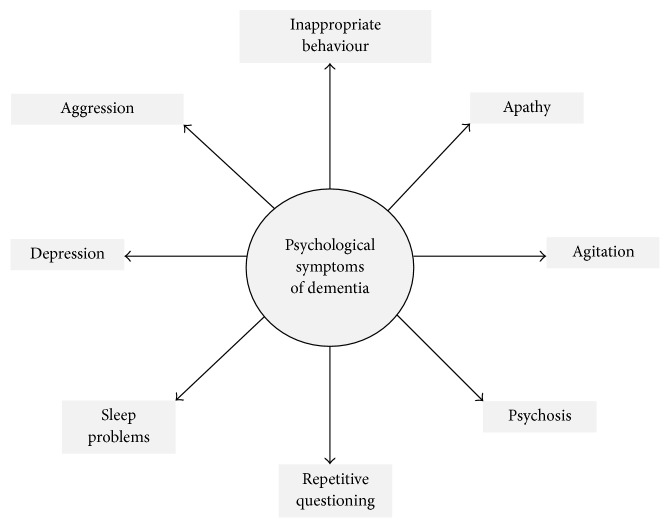
Figure 1
Figure 1
Symptoms of dementia.
Figure 2
Figure 2
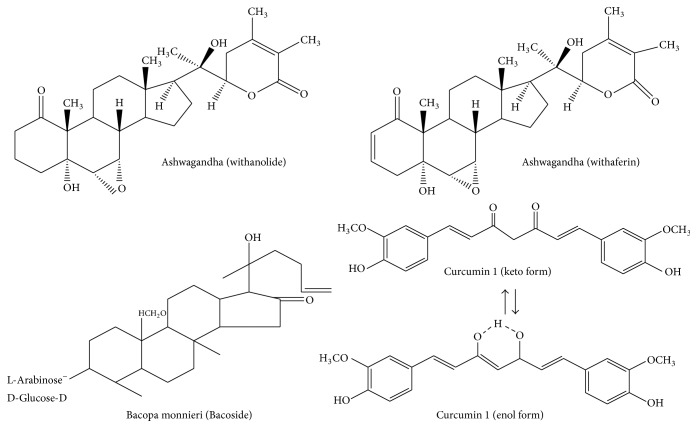
Chemical structures of withanolide, withaferin, bacoside, and curcumin.
Figure 3
Figure 3
Hypothetical diagram showing target sites for the action of Ashwagandha (Withania somnifera). Glutamate (Glu); NMDA receptor (NMDA-R); phosphatidylcholine (PtdCho); cytosolic phospholipase A2 (cPLA2); cyclooxygenase-2 (COX-2); 5-lipoxygenase (5-LOX); arachidonic acid (ARA); reactive oxygen species (ROS); nuclear factor-κB (NF-κB); nuclear factor-κB-response element (NF-κB-RE); inhibitory subunit of NF-κB (I-κB); tumor necrosis factor-α (TNF-α); interleukin-1β (IL-1β); interleukin-6 (IL-6); monocyte chemoattractant protein-1 (MCP-1); nuclear factor E2-related factor 2 (Nrf2); kelch-like ECH-associated protein 1 (Keap1); antioxidant response element (ARE); small leucine zipper proteins (Maf); heme oxygenase (HO-1); NADPH quinine oxidoreductase (NQO-1); γ-glutamate cystein ligase (γ-GCL); B-cell lymphoma 2 (Bcl-2); cytochrome (cyto-c); amyloid precursor protein (APP); β-amyloid (Aβ); Aβ-derived diffusible ligand (ADDL); and Alzheimer disease (AD).
Figure 4
Figure 4
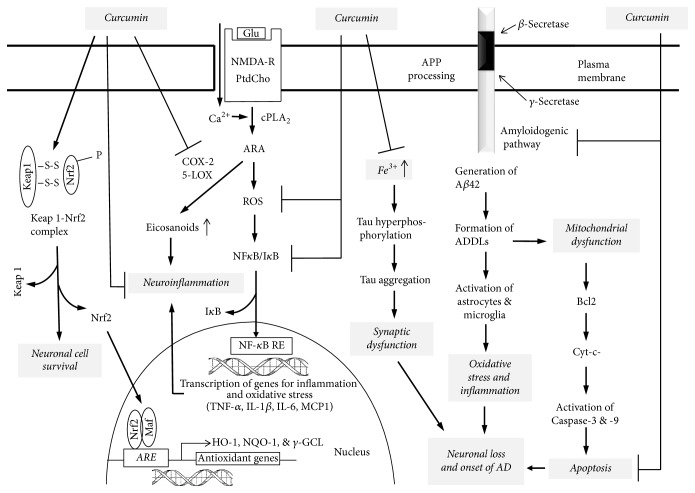
Hypothetical diagram showing target sites for the action of curcumin (diferuloylmethane) in signal transduction pathway. Glutamate (Glu); NMDA receptor (NMDA-R); phosphatidylcholine (PtdCho); cytosolic phospholipase A2 (cPLA2); cyclooxygenase-2 (COX-2); 5-lipoxygenase (5-LOX); arachidonic acid (ARA); reactive oxygen species (ROS); nuclear factor-κB (NF-κB); nuclear factor-κB-response element (NF-κB-RE); inhibitory subunit of NF-κB (I-κB); tumor necrosis factor-α (TNF-α); interleukin-1β (IL-1β); interleukin-6 (IL-6); monocyte chemoattractant protein-1 (MCP-1); nuclear factor E2-related factor 2 (Nrf2); kelch-like ECH-associated protein 1 (Keap1); antioxidant response element (ARE); small leucine zipper proteins (Maf); heme oxygenase (HO-1); NADPH quinine oxidoreductase (NQO-1); γ-glutamate cystein ligase (γ-GCL); B-cell lymphoma 2 (Bcl-2); cytochrome (cyto-c); amyloid precursor protein (APP); β-amyloid (Aβ); Aβ-derived diffusible ligand (ADDL); and Alzheimer disease (AD).
Figure 5
Figure 5
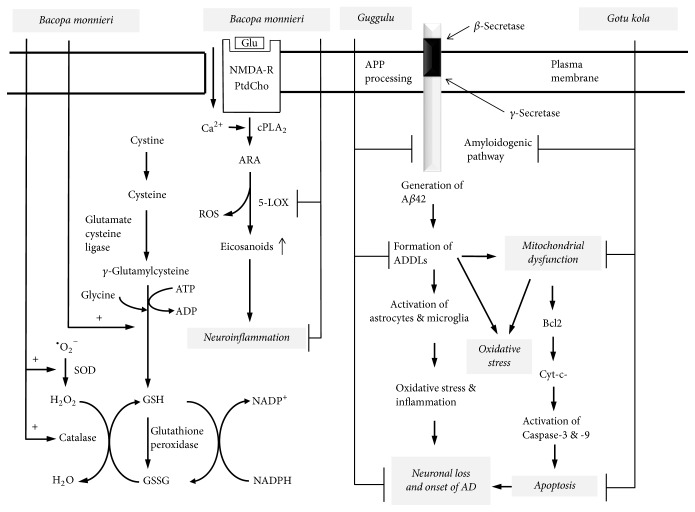
Hypothetical diagram showing target sites for the action of Bacopa monnieri, guggulu, and gotu kola. Plasma membrane (PM); β-amyloid (Aβ); Aβ-derived diffusible ligand (ADDL); B-cell lymphoma 2 (Bcl-2); cytochrome (cyto-c); amyloid precursor protein (APP); Alzheimer disease (AD); reduced glutathione (GSH); oxidized glutathione (GSSG).

References

    1. United Nations Department of Economic and Social Affairs - Population Division. New York, NY, USA: United Nations; 2015.
    1. WHO. Dementia. http://www.who.int/mediacentre/factsheets/fs362/en/
    1. Sosa-Ortiz A. L., Acosta-Castillo I., Prince M. J. Epidemiology of Dementias and Alzheimer's Disease. 2012;43(8):600–608. doi: 10.1016/j.arcmed.2012.11.003. - DOI - PubMed
    1. Ritchie K., Lovestone S. The dementias. 2002;360(9347):1759–1766. doi: 10.1016/S0140-6736(02)11667-9. - DOI - PubMed
    1. Román G. C. Vascular dementia: distinguishing characteristics, treatment, and prevention. 2003;51(5, supplement 2):S296–S304. doi: 10.1046/j.1532-5415.5155.x. - DOI - PubMed

LinkOut - more resources