. 2016 Jan 1;7(1):436-445.
doi: 10.1039/c5sc02124c. Epub 2015 Oct 8.

Photocatalytic proton reduction with ruthenium and cobalt complexes immobilized on fumed reversed-phase silica

Affiliations

Photocatalytic proton reduction with ruthenium and cobalt complexes immobilized on fumed reversed-phase silica

C Bachmann et al. Chem Sci. .

Abstract

Heterogeneous photocatalytic hydrogen production with a non-covalently immobilized molecular ruthenium based photosensitizer (PS) and a cobalt polypyridyl based water reducing catalyst (WRC) is reported. PS and WRC were derivatized with C18-alkyl chains and immobilized by adsorption on hydrophobic fumed silica. The resulting loaded support was suspended in water with anionic or cationic surfactants and subjected to heterogeneous photocatalytic H2 production with ascorbate as sacrificial electron donor (SED). No leaching was observed under catalytic conditions, thus catalysis was truly heterogeneous. The catalytic performance of immobilized PS and WRC clearly exceeded that of homogeneous catalysis at low concentrations. At high concentration, diffusion and light limitation lead to lower reaction rates, but the same stability as for homogeneous reactions was still achieved. WRC concentration variations indicated a relatively high stability (up to 1300 H2/Co) and mobility of amphiphilic catalysts on the hydrophobic silica surface. Comparison of fumed silica with porous and non-porous silica showed, that a high BET surface area along with a good accessibility from the reaction media are crucial for catalytic performance. Mechanistic investigations by transient absorption spectroscopy displayed reductive quenching of excited PS by ascorbate followed by on particle electron transfer to WRC as reaction pathway. Particles with additional cationic surfactants exhibited a significantly higher catalytic performance as compared to anionic surfactants. Non-covalent anchoring of correspondingly derivatized WRCs or PSs to reversed-phase silica offers a rapid and versatile transition from homogeneous to heterogeneous molecular proton reduction.


Figures
Scheme 1
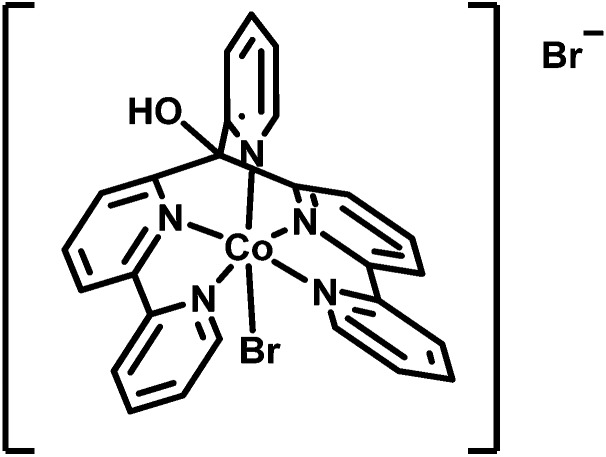
Scheme 1. Structure of water reducing catalyst [CoIIBr(appy)]Br 1.,
Scheme 2
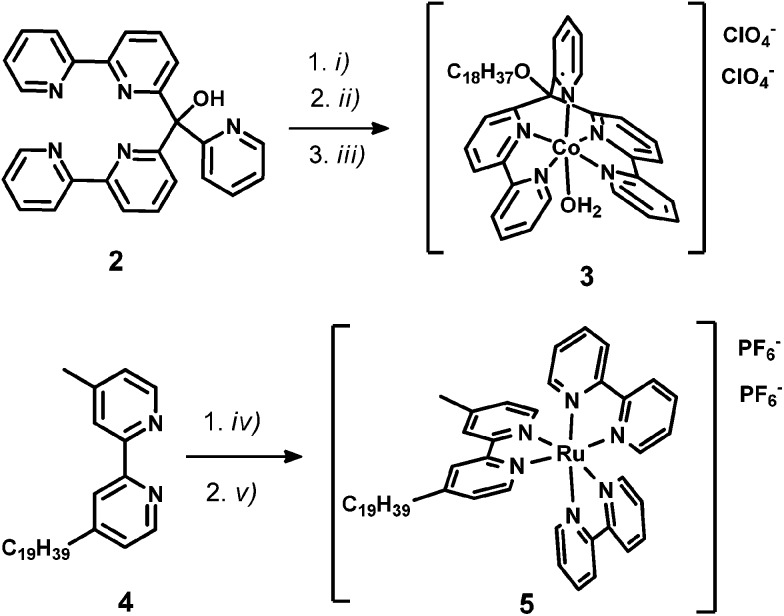
Scheme 2. Schematic representations of syntheses towards C18/C19-derivatized WRC and PS: (i) NaH, DMF, rt, 45 min; (ii) C18H37-I, rt, 15 h; (iii) Co(ClO4)2, MeOH, rt, 3 h; (iv) Ru(bpy)2Cl2, EtOH/H2O, 100 °C, 24 h; (v) NH4PF6, H2O. Detailed synthetic procedures are given in the experimental part.
Scheme 3
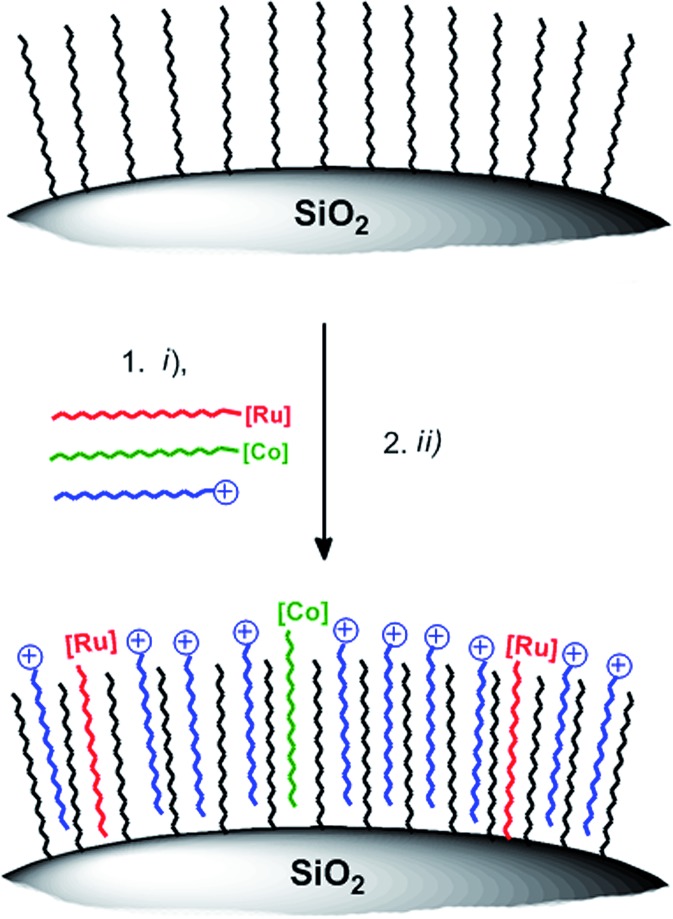
Scheme 3. Schematic illustration of WRC and PS adsorption on hydrophobic silica. (i) 3, 5, 7 (or 6), MeOH, rt, 30 min (ii) 0.1 M NaOTf electrolyte, MeOH evaporation. Detailed synthetic procedures are given in the experimental part.
Fig. 1
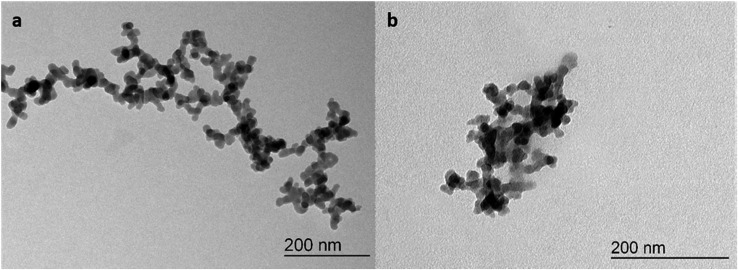
Fig. 1. Representative TEM micrograph of hydrophilic fumed silica without (a) and hydrophobic fumed silica with adsorbed PS 5 from a diluted aqueous suspension with 7 as surfactant (b).
Fig. 2
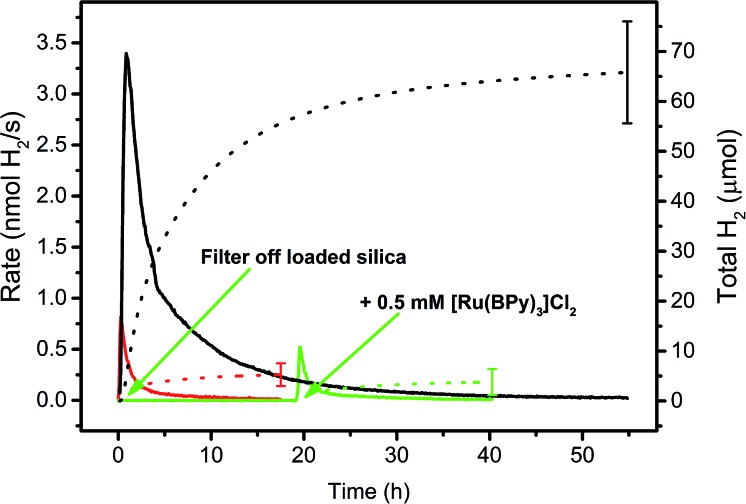
Fig. 2. Hydrogen evolution rate courses (solid lines) and total amounts of H2 (dotted lines) in 1 M ascorbate buffer (pH 4) with 0.1 M NaOTf. Black: 20 μM 3 and 200 μM 5 adsorbed on hydrophobic fumed silica with 300 μM [C16-NMe3][OAc] (7) as surfactant. Green: same as black, but loaded silica was filtered off and the residual solution irradiated, then 0.5 mM [Ru(bpy)3]Cl2 was added and irradiation continued (green arrows). Red: 0.5 mM [Ru(bpy)3]Cl2, no WRC. See Table SI3.
Fig. 3
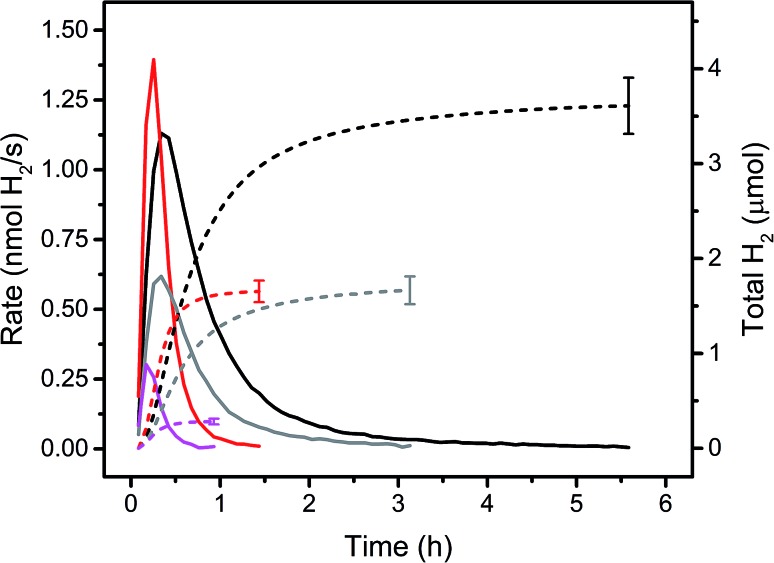
Fig. 3. Rates (solid lines) and amounts of H2 (dashed lines) for homo- and heterogeneous photocatalytic reactions in 1 M ascorbate buffer (pH 4) with 0.1 M NaOTf. Black: 20 μM PS 5 and 1 μM WRC 3 immobilized on f-SiO2-C18 with 300 μM 7. Red: 20 μM [Ru(bpy)3]Cl2 and 1 μM 1. Grey: 10 μM PS 5 and 0.5 μM WRC 3 immobilized on f-SiO2-C18 with 150 μM 7. Magenta: 10 μM [Ru(bpy)3]Cl2 and 0.5 μM 1. Detailed values are shown in Table 1.
Fig. 4
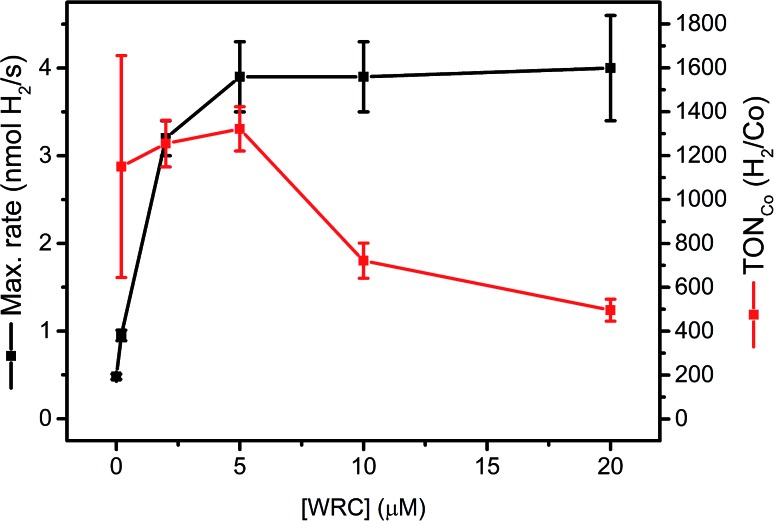
Fig. 4. [WRC] dependency study with 200 μM PS 5 and varying amounts of WRC 3 (0, 0.2, 2, 5, 10 and 20 μM) adsorbed on f-SiO2-C18 in 1 M ascorbate buffer, 0.1 M NaOTf and 300 μM [C16-NMe3][OAc] (7) as surfactant. The amount of H2 from the blank experiment (no WRC) was subtracted at each concentration and the corresponding TONs in Co (H2/Co) calculated (Table SI6†).
Fig. 5
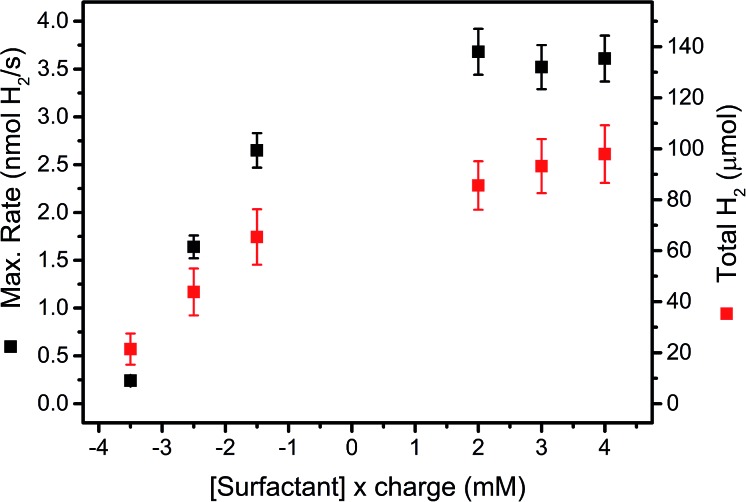
Fig. 5. Maximal H2 evolution rates (black squares, left scale) and total amounts of evolved H2 (red squares, right scale) in 1 M ascorbate buffer (pH 4) with 0.1 M NaOTf and 200 μM PS 5 and 20 μM WRC 3 immobilized on f-SiO2-C18 at different surfactant concentrations (mM) multiplied by their charge (negative: Na[C12-PhSO3], 6; positive: [C16-NMe3][OAc], 7). Results are summarized in Table SI5 and the structures of 6 and 7 depicted in Scheme SI1.
Fig. 6
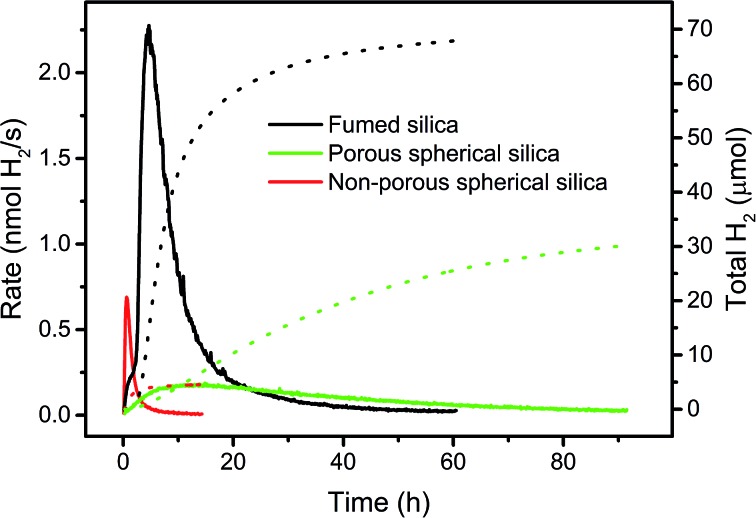
Fig. 6. Comparison of rates (solid lines, left scale) and H2 amounts (dotted lines, right scale) with WRC 3 and PS 5 immobilized on different types of hydrophobic silica in 1 M ascorbate buffer (pH = 4, 0.1 M NaOTf). Black: 200 μM PS 5 and 40 μM WRC 3 on f-SiO2-C18 with 2.5 mM 6. Red: 4.8 μM 5 and 1 μM 3 on non-porous spherical silica with 100 μM 6. Green: 200 μM 5 and 40 μM 3 on porous silica with 2.5 mM 6.
Scheme 4
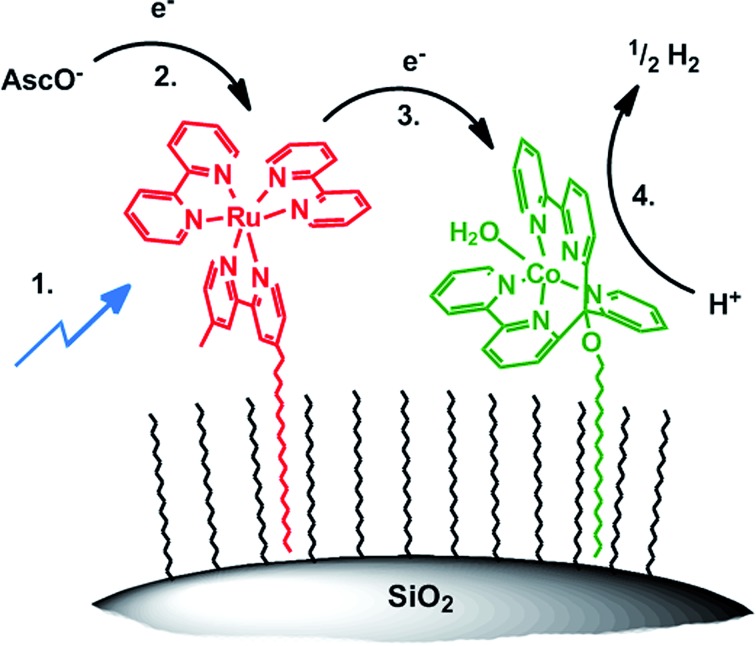
Scheme 4. Proposed reaction mechanism of photocatalytic H2 production on hydrophobic silica: (1) photoexcitation of 55*; (2) reductive quenching of 5*5; (3) electron transfer 53; (4) H+ reduction by 3.

References

    1. Styring S. Faraday Discuss. 2012;155:357–376. - PubMed
    1. Tachibana Y., Vayssieres L., Durrant J. R. Nat. Photonics. 2012;6:511–518.
    1. Dasgupta S., Brunschwig B. S., Winkler J. R., Gray H. B. Chem. Soc. Rev. 2013;42:2213–2214. - PubMed
    1. Cowan A. J., Durrant J. R. Chem. Soc. Rev. 2013;42:2281–2293. - PubMed
    1. Luo J., Im J. H., Mayer M. T., Schreier M., Khaja Nazeeruddin M., Park N.-G., Tilley S. D., Jin Fan H., Grätzel M. Science. 2014;345:1593–1596. - PubMed

LinkOut - more resources