. 2018 May 1;7(1):81-89.
doi: 10.1089/biores.2018.0006. eCollection 2018.

LUBAC and ABIN-1 Modulate TRAIL-Based NF-κB Induction in Human Embryonic Kidney 293 Cells

Affiliations

LUBAC and ABIN-1 Modulate TRAIL-Based NF-κB Induction in Human Embryonic Kidney 293 Cells

Sebastian Dorn et al. Biores Open Access. .

Abstract

Tumor necrosis factor (TNF)-related apoptosis-inducing ligand (TRAIL) is known to activate the canonical NF-κB pathway similar to TNF. The exact mechanism of the entire signaling cascade is still under investigation. The involvement of linear ubiquitylation as upregulating component has already been shown recently in some cell lines, but not in human embryonic kidney 293 (HEK293) cells. The downregulating function of the ABIN-1 (A20 binding and inhibitor of NF-κB) as linear ubiquitylation antagonist has been shown in combination with some NF-κB-inducing pathways, but not with TRAIL. We performed luciferase and western blot assays using HEK293 cells stimulated with either TRAIL (or TNF as a control) to analyze the involvement of linear ubiquitin chain assembly complex (LUBAC) components and the impact of ABIN-1 and ABIN-1-MAD (truncated form without A20 binding site) on NF-κB signaling. For overexpression experiments, we added plasmids of ABIN-1 and ABIN-1-MAD or LUBAC components HOIP, HOIL-1, or SHARPIN (single and combinations). For downregulation experiments five pairs of either SHARPIN, HOIL-1, or HOIP targeting miRNAs or one miRNA for ABIN-1 were designed and added. ABIN-1 and its truncated form ABIN-1-MAD reduced the NF-κB induction significantly indicating its involvement as antagonist (independent of deubiquitinase A20) of linear ubiquitylation in TRAIL-induced NF-κB signaling. In opposition, knockdown of ABIN-1 using a specific ABIN-1 miRNA led a clear increase of NF-κB signaling. Addition of single LUBAC components or combinations (except for SHARPIN with HOIL-1) resulted in clearly stronger NF-κB inductions. MiRNAs targeting LUBAC components significantly reduced NF-κB activation. Thus, in HEK293 cells linear ubiquitylation by LUBAC critically upregulates and ABIN-1 downregulates TRAIL-induced NF-κB signaling and may be interesting targets for future pathological therapies.

Keywords: ABIN-1; HEK 293 cells; LUBAC; NF-κB regulation; TRAIL.


Conflict of interest statement

The authors declare that they have no competing interest.

Figures
<b>FIG. 1.</b>
FIG. 1.
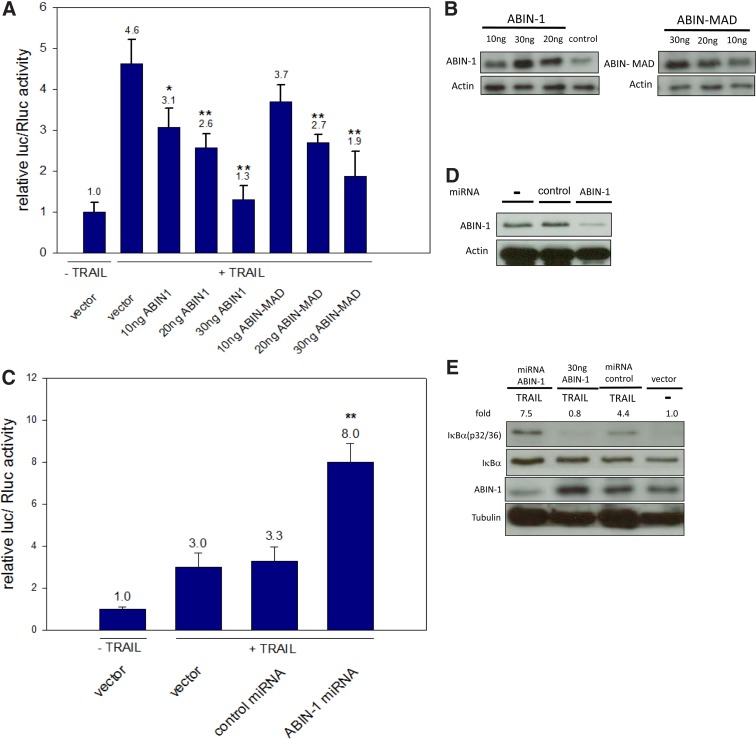
ABIN-1 and ABIN-MAD inhibit NF-κB signaling upon TRAIL treatment. ABIN-1, ABIN-MAD plasmids (A), ABIN-1-targeting miRNA (C), or Bluescript vector as control (A, C) in combination with a firefly luciferase expressing NF-κB responsive reporter, and a Renilla luciferase expressing vector were cotransfected in HEK293 cells. After 48 h, 1000 ng/mL TRAIL was added, and the cells were lysed 24 h later to measure the relative luciferase levels. All values from relative firefly/Renilla luciferase assay represent three independent experiments with four (A) or three (C) replicants (per each construct and the bars indicate standard deviations. The statistical calculations comparing the transcriptional NF-κB inductions of Bluescript vector with different plasmid amounts of ABIN-1, ABIN-MAD, or ABIN-1 miRNA were done by Student's t-test (one asterisk indicates p ≤ 0.05, two asterisks p ≤ 0.01). HEK293 cells were transfected with Bluescript vector (B, D, E), ABIN-1 (B, E), ABIN-MAD (B), ABIN miRNA (D, E), or control miRNA (D, E) and treated with TRAIL (1000 ng/mL for 50 min) or left untreated. The expression levels of ABIN-1 (B, D, E), ABIN-MAD (B), phosphorylated IκBα (32/36), unphosphorylated IκBα (E) β-Actin (B, D), and α-Tubulin proteins (E) were evaluated by western blotting. The expression level of α-Tubulin (E) was evaluated after membrane stripping. Numbers indicate ratios of signal intensities of phosphorylated IκBα (32/36) to unphosphorylated IκBα, normalized to the ratio of untreated cells (arbitrarily set to 1.0). For determination of intensities, the software Image Studio Lite was used. ABIN-1, A20 binding and inhibitor of NF-kappaB; ABIN-MAD, minimal active domain of ABIN; TRAIL, TNF-related apoptosis-inducing ligand.
<b>FIG. 2.</b>
FIG. 2.
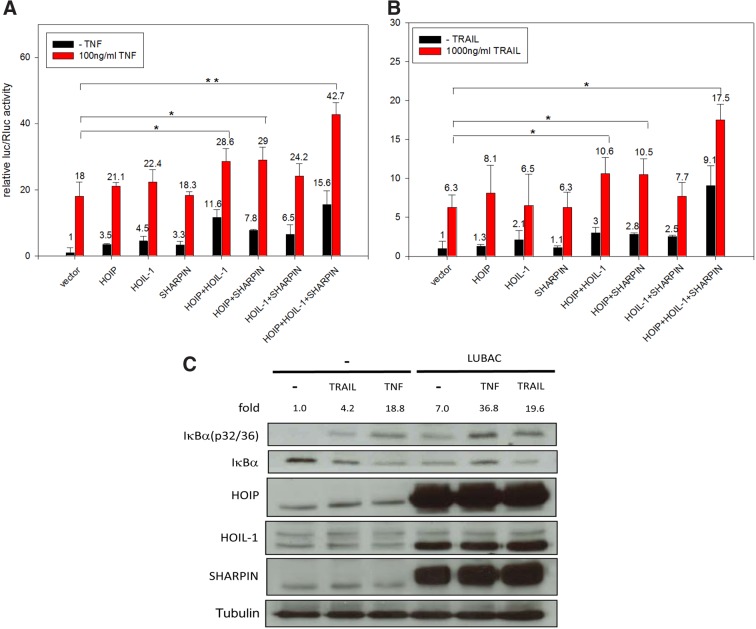
LUBAC further increases NF-κB signaling upon TRAIL treatment. HEK293 cells were cotransfected with Bluescript vector or different combinations of HOIP-Myc, HA-HOIL-1, or SHARPIN expressing plasmids in combination with firefly luciferase expressing NF-κB responsive reporter and Renilla luciferase expressing construct and treated after 48 h with (A) TNF (100 ng/mL) or (B) TRAIL (1000 ng/mL) for further 24 h or left untreated to analyze the resulting relative luciferase activity. (C) HEK293 cells were transfected with Bluescript vector as a control or with LUBAC (HOIP-Myc, HA-HOIL-1, and FLAG-SHARPIN-containing plasmids) and treated with TNF (100 ng/mL, 30 min) or TRAIL (1000 ng/mL, 50 min) or left untreated. The results of the relative firefly/Renilla luciferase assay are derived from three independent experiments with three replicants per each construct and the bars characterize standard deviations. One asterisk represents a significance level of p ≤ 0.05 and two asterisks of p ≤ 0.01 (The differences in NF-κB inductions between vector and LUBAC components with TNF or TRAIL were determined by Student's t-test). The expression levels of LUBAC components and phosphorylated IκBα (32/36) and unphosphorylated IκBα proteins were evaluated by western blotting. The expression levels of α-Tubulin and SHARPIN were analyzed after membrane stripping. Numbers indicate ratios of signal intensities of phosphorylated IκBα (32/36) to unphosphorylated IκBα, normalized to the ratio of untreated cells without overexpressed LUBAC components (arbitrarily set to 1.0). The determination of intensities was done by using the software Image Studio Lite. LUBAC, linear ubiquitin chain assembly complex.
<b>FIG. 3.</b>
FIG. 3.
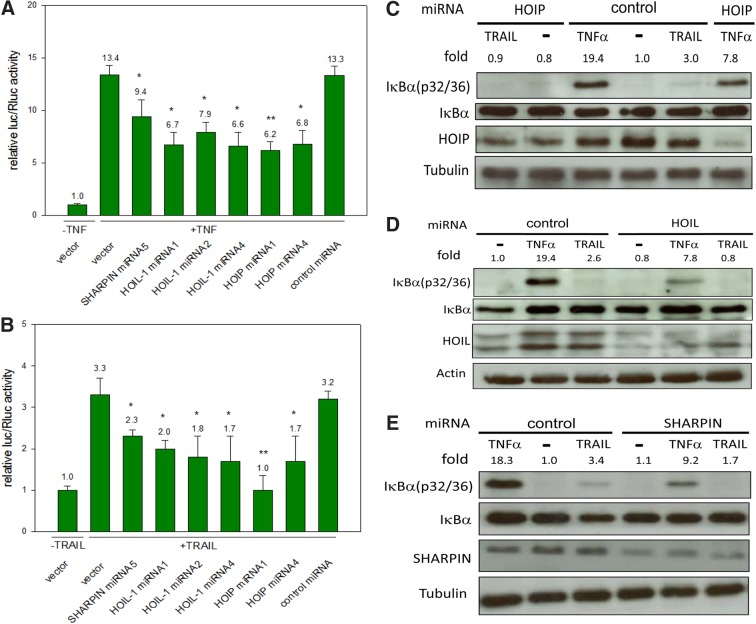
Downregulations of HOIP, HOIL-1, or SHARPIN decrease TRAIL-based NF-κB signaling. Various HOIP, HOIL-1, or SHARPIN-targeting miRNAs, a control miRNA, or Bluescript vector were cotransfected with the firefly luciferase expressing NF-κB responsive reporter and the Renilla luciferase expressing vector to evaluate the resulting relative luciferase expressing levels after 24 h in untreated or (A) TNF- (100 ng/mL, 48 h after transfection) or (B) TRAIL (1000 ng/mL, 48 h after transfection)-treated HEK293 cells. The results of the relative firefly/Renilla luciferase assay are derived from three independent experiments with three replicants per each construct and the bars characterize standard deviations. One asterisk represents a significant level of p ≤ 0.05 and two asterisks of p ≤ 0.01 (The differences in NF-κB inductions between vector and LUBAC components with TNF or TRAIL were determined by Student's t-test). HEK293 cells were transfected with Bluescript vector, (C) HOIP miRNA1, (D) HOIL-1 miRNA1, or (E) SHARPIN miRNA and treated with TNF (100 ng/mL for 30 min) or TRAIL (1000 ng/mL for 50 min) or left untreated. The expression levels of HOIP, HOIL-1, SHARPIN, phosphorylated IκBα (32/36), unphosphorylated IκBα, and α-Tubulin were analyzed by western blotting. The expression levels of β-Actin (D) and SHARPIN (E) were evaluated after membrane stripping. Numbers indicate ratios of signal intensities of phosphorylated IκBα (32/36) to unphosphorylated IκBα, normalized to the ratio of untreated cells with control miRNA (arbitrarily set to 1.0). For determination of intensities, the software Image Studio Lite was used.

References

    1. Varfolomeev E, Goncharov T, Fedorova AV, et al. . c-IAP1 and c-IAP2 are critical mediators of tumor necrosis factor alpha (TNFalpha)-induced NF-kappaB activation. J Biol Chem. 2008;283:24295–24299 - PMC - PubMed
    1. Vucic D, Dixit VM, Wertz IE. Ubiquitylation in apoptosis: a post-translational modification at the edge of life and death. Nat Rev Mol Cell Biol. 2011;12:439–452 - PubMed
    1. Kim KW, Kim BJ, Chung CW, et al. . Caspase cleavage product lacking amino-terminus of IkappaBalpha sensitizes resistant cells to TNF-alpha and TRAIL-induced apoptosis. J Cell Biochem. 2002;85:334–345 - PubMed
    1. Rothe M, Sarma V, Dixit VM, et al. . TRAF2-mediated activation of NF-kappa B by TNF receptor 2 and CD40. Science. 1995;269:1424–1427 - PubMed
    1. Micheau O, Tschopp J. Induction of TNF receptor I-mediated apoptosis via two sequential signaling complexes. Cell. 2003;114:181–190 - PubMed

LinkOut - more resources