. 2016 Oct;121(10):1865-1884.
doi: 10.1002/2016JE005128. Epub 2016 Sep 9.

Space Weathering on Airless Bodies

Affiliations

Space Weathering on Airless Bodies

Carle M Pieters et al. J Geophys Res Planets. 2016 Oct.

Abstract

Space weathering refers to alteration that occurs in the space environment with time. Lunar samples, and to some extent meteorites, have provided a benchmark for understanding the processes and products of space weathering. Lunar soils are derived principally from local materials but have accumulated a range of optically active opaque particles (OAOpq) that include nanophase metallic iron on/in rims formed on individual grains (imparting a red slope to visible and near-infrared reflectance) and larger iron particles (which darken across all wavelengths) such as are often found within the interior of recycled grains. Space weathering of other anhydrous silicate bodies, such as Mercury and some asteroids, produce different forms and relative abundance of OAOpq particles depending on the particular environment. If the development of OAOpq particles is minimized (such as at Vesta), contamination by exogenic material and regolith mixing become the dominant space weathering processes. Volatile-rich bodies and those composed of abundant hydrous minerals (dwarf planet Ceres, many dark asteroids, outer solar system satellites) are affected by space weathering processes differently than the silicate bodies of the inner solar system. However, the space weathering products of these bodies are currently poorly understood and the physics and chemistry of space weathering processes in different environments are areas of active research.


Figures
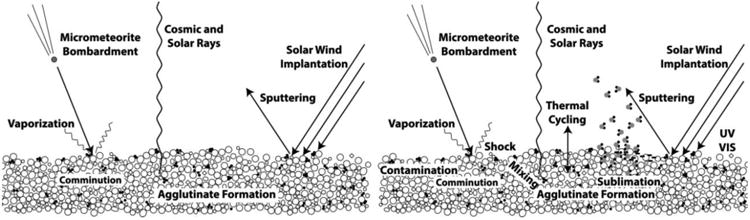
Figure 1
Figure 1
The complex array of processes involved in space weathering of airless bodies. Typical soils are particulate but heterogeneous in composition. (Left) Dominant processes affecting the surface of the Moon at 1 AU [after Noble 2004]. (Right) The broad range of surfaces processes now believed to be active across the solar system, but with different degrees of prominence for specific environments.
Figure 2
Figure 2
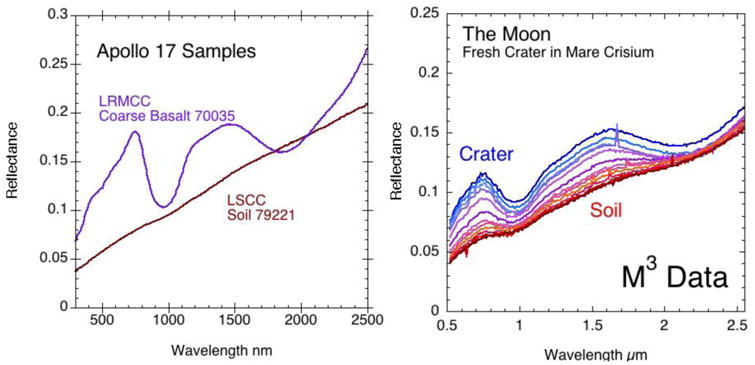
Spectra of lunar materials illustrating the optical differences between fresh rocks and well developed lunar soils. Left) Laboratory spectra of basaltic lunar rock and soil samples from Apollo 17 (RELAB data: LR-CMP-158 and LR-CMP-039). Right) Remote lunar spectra acquired from orbit with Moon Mineralogy Mapper (M3) as a traverse from a mare basalt small fresh crater into surrounding well-developed soil (M3 file M3T20090701T094734). For these basalt examples, diagnostic absorption bands are stronger for fresh materials, but note the prominent differences in brightness at visible wavelengths (500-700nm), but little if any brightness difference near 2 μm.
Figure 3
Figure 3
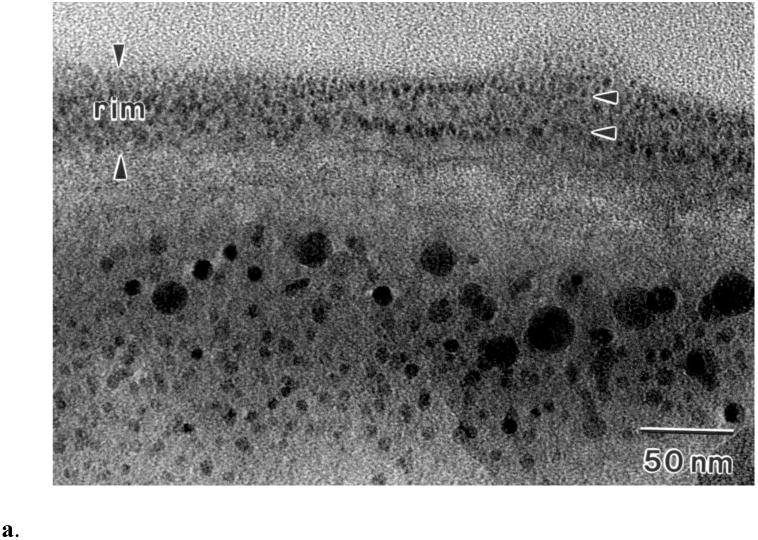
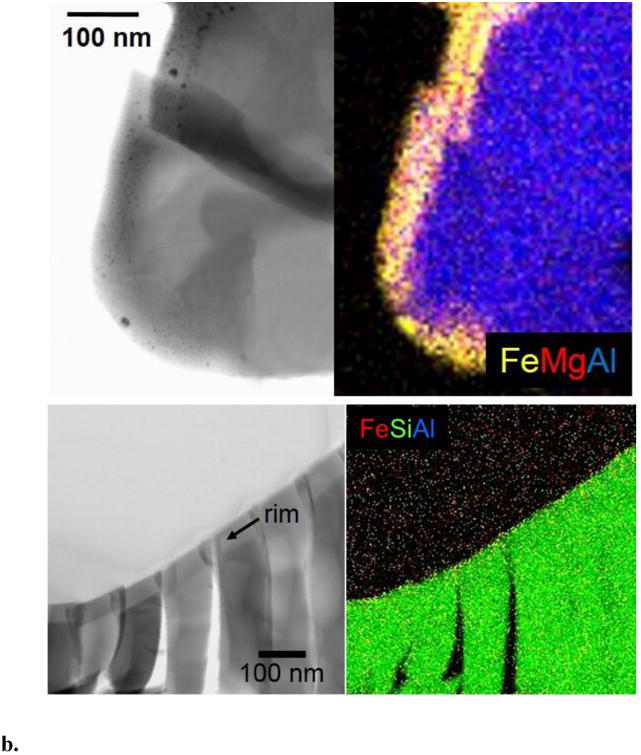
a. TEM image of a lunar agglutinate illustrating the presence of npFe0 forming two layers within the rim, but larger Fe0 in the interior. b. TEM bright field images and chemical maps of typical lunar soil rims. The plagioclase grain (top) has a depositional npFe-rich rim, which is chemically distinct from the host grain. The cristobalite grain (bottom) has an amorphous solar-wind damage rim compositionally indistinguishable from the host grain. (Images courtesy: Lindsay Keller)
Figure 3
Figure 3
a. TEM image of a lunar agglutinate illustrating the presence of npFe0 forming two layers within the rim, but larger Fe0 in the interior. b. TEM bright field images and chemical maps of typical lunar soil rims. The plagioclase grain (top) has a depositional npFe-rich rim, which is chemically distinct from the host grain. The cristobalite grain (bottom) has an amorphous solar-wind damage rim compositionally indistinguishable from the host grain. (Images courtesy: Lindsay Keller)
Figure 4
Figure 4
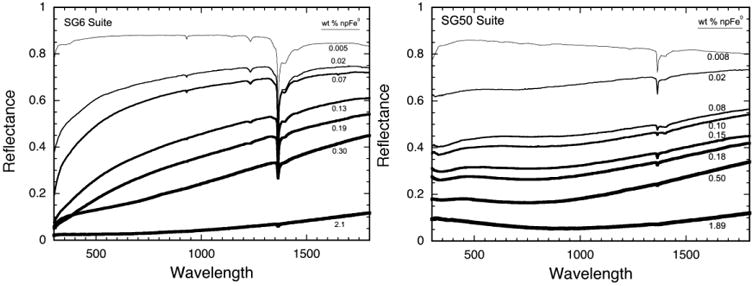
Silica gels impregnated with varying amounts of optically active iron particles. The SG6 suite, which contains metallic iron with a range of ∼10-25 nm diameter, shows significant reddening, while the SG50 suite, with a range of 20-200 nm particles, shows significant darkening, but little reddening. (These and related spectra from [Noble et al., 2007] can be found in the RELAB data files as samples SN-CMP-014 to SN-CMP-145.)
Figure 5
Figure 5
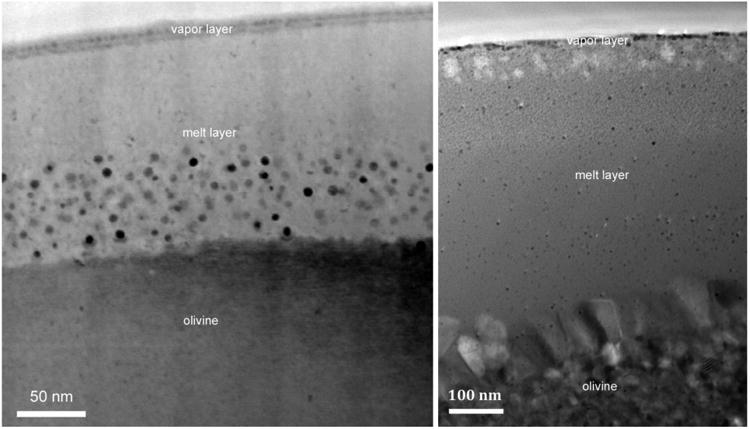
TEM analysis demonstrates that nanophase iron is produced in the melt and vapor of both experimentally laser irradiated (left) [Noble et al., 2011] and natural micrometeoroid impacts into olivine (right) [Noble et al., 2016].
Figure 6
Figure 6
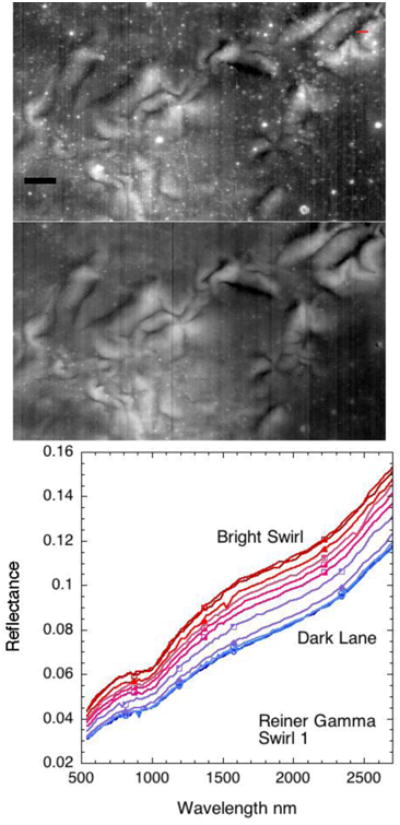
M3 images and spectra across a lunar swirl region south west of central Reiner Gamma. [Left] M3 reflectance images obtained at 750 nm (top) illustrating albedo variations at visible wavelengths, and at 2200 nm (bottom) illustrating that the swirl albedo features persist into the near-infrared, but the fresh crater features do not. [Right] M3 traverse of spectra across a dark lane into the bright swirl (location shown with small red line in upper right corner of 750 nm image). The example traverse across this Reiner Gamma swirl in a mare region illustrates that the bright swirl areas exhibit properties that are quite different from immature (unweathered) soils such as found at typical mare craters (see for comparison Figure 2 above). Scale bar is 5 km. (M3 images and spectra are from M3G20090613T032520 and M3G20090613T073612.)
Figure 7
Figure 7
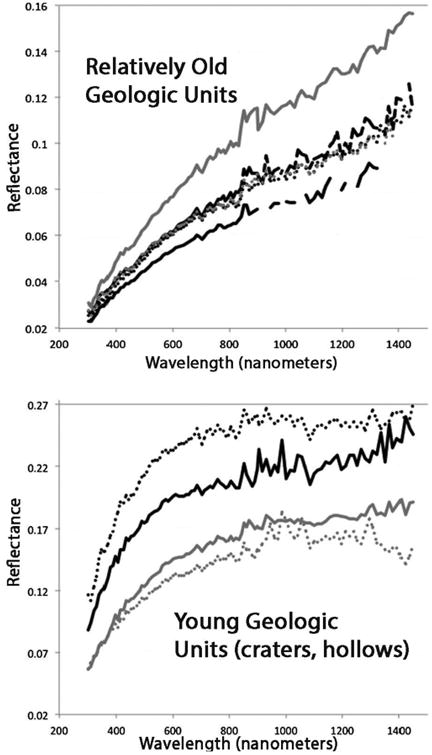
Comparison of spectra for units of Mercury obtained by Mercury Atmospheric and Surface Composition Spectrometer (MASCS) on MESSENGER [Domingue et al., 2014 and Izenberg et al., 2014]. The vertical scale for the young units is almost 2× that of the older units. Although major mineral/amorphous components of the surface are poorly understood, the optical relation between young and older units directly mimics that seen experimentally with a combination of nanophase and Britt-Pieters opaque particles [e.g., Noble et al., 2007].
Figure 8
Figure 8
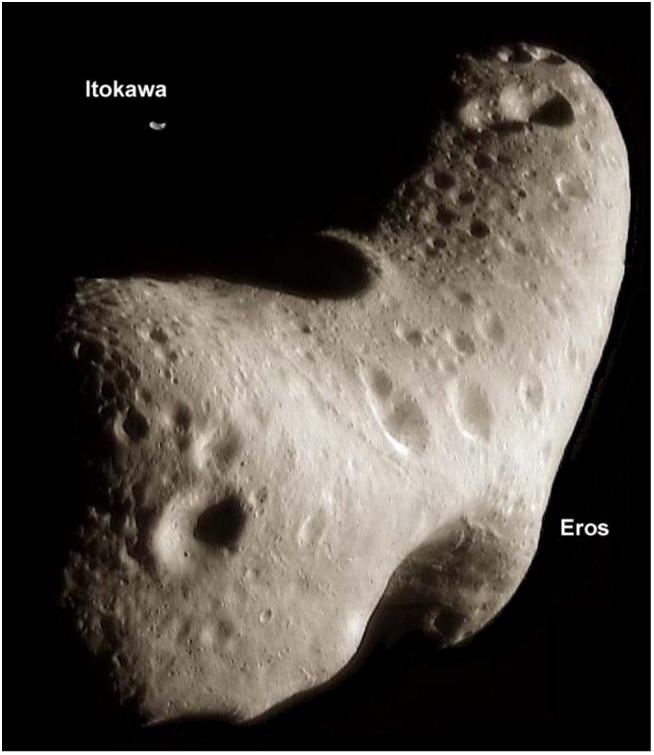
Eros and Itokawa to scale
Figure 9
Figure 9
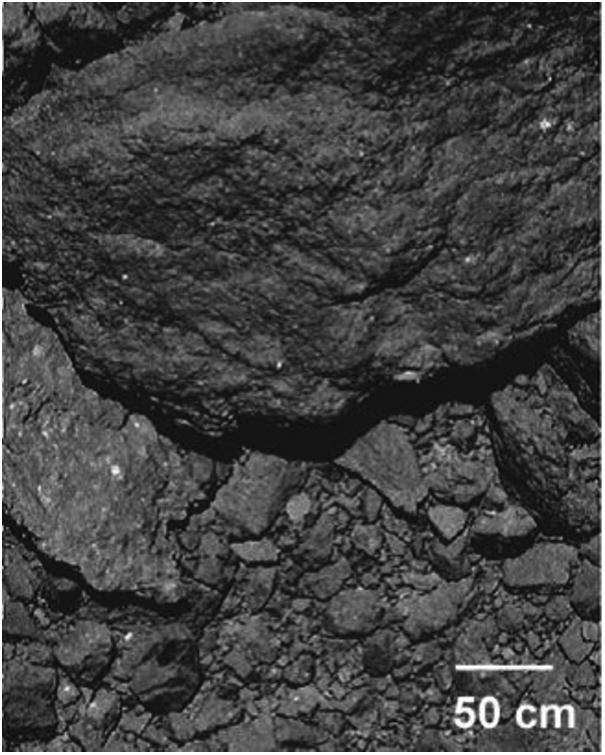
Bright spots can be seen in this close up of the rocky surface of Itokawa obtained by Hayabusa (ST_2544579522), these presumably represent recent impacts that have penetrated through the darkened patina surface to the brighter fresh rock below.
Figure 10
Figure 10
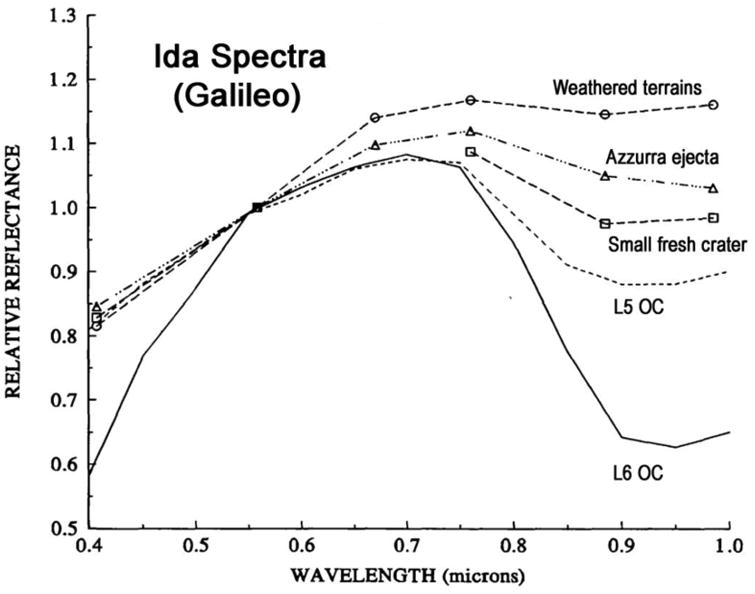
Weathering trends on Ida exhibited with 6-band reflectance spectra obtained by the Galileo mission compared with ordinary chondrite (OC) spectra. Fresh (younger) features have deeper ferrous absorption bands. The weathered terrains have a steeper continuum (red sloped) and have weaker bands. After Chapman [1996].
Figure 11
Figure 11
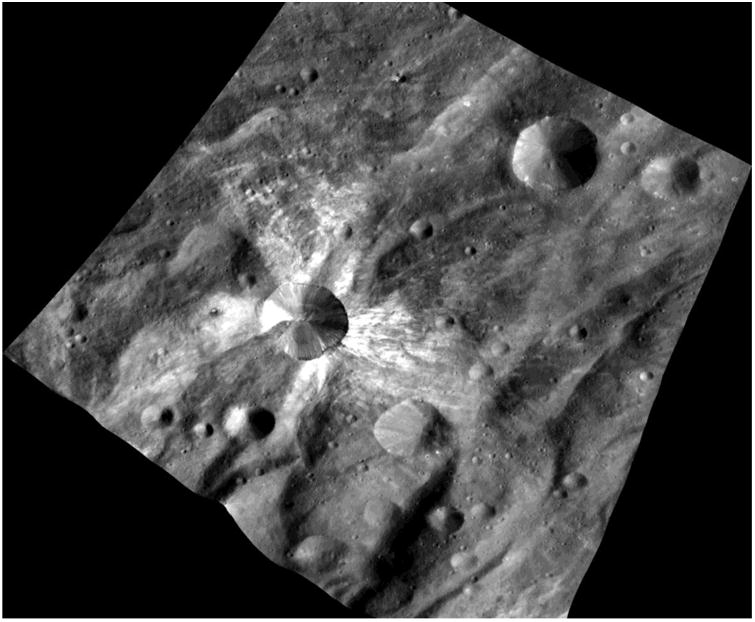
Image of the surface of Vesta obtained by Dawn Framing Camera (FC21B0010859_11293124257F1A) containing two ∼10 km craters. The crater to the southwest exhibits classic features of a fresh impact crater (sharp rim, diverse surrounding ray system). The older impact crater to the northeast exhibits more subdued features and rays have been removed by local space weathering believed to be dominated by regolith mixing and gardening.
Figure 12
Figure 12
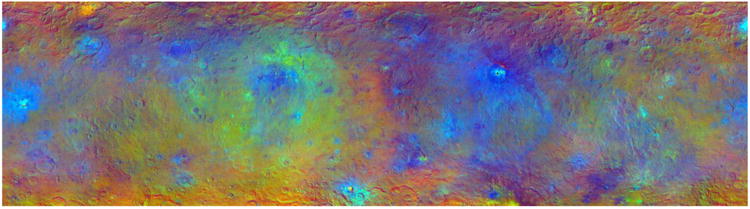
Color composite image of Ceres 60°N to 50°S latitude, 0° to 360° longitude compiled from Dawn Framing Camera data using R=965/750 nm, G=750 nm; B=440/750 nm. This representation enhances subtle color and albedo variations across the surface (a ‘blue’ spectral slope across the visible thus appears blue). Most fresh craters appear relatively blue and some exhibit extensive ray patterns.
Figure 13
Figure 13
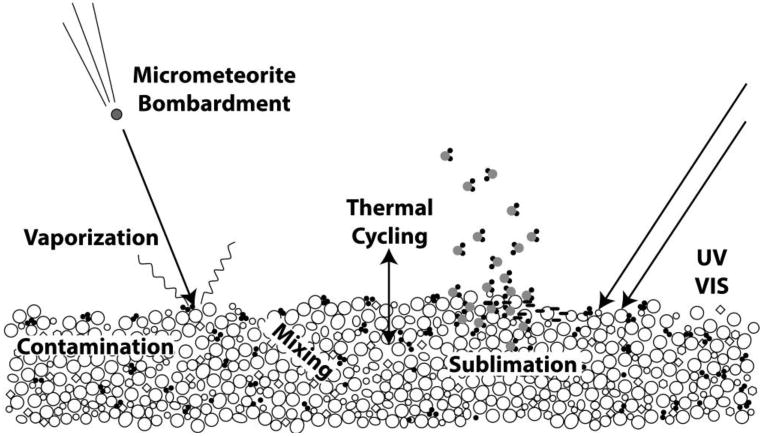
Processes involved in space weathering of Ceres. Because the environment is so unlike that at 1 AU, the dominant processes are distinctly different and include contamination and mixing with exogenic material as well as formation of a surficial lag deposit as volatile materials sublimate or are lost.
Figure 14
Figure 14
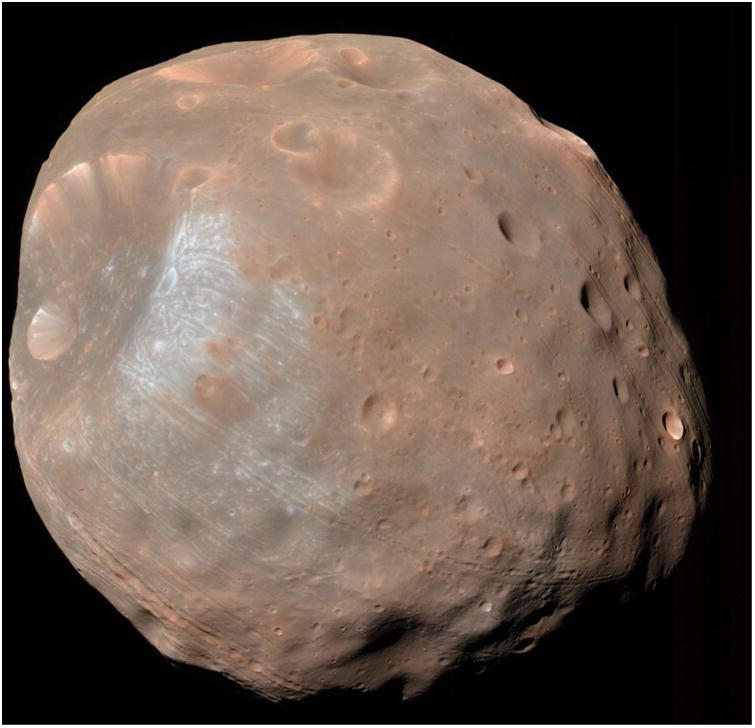
Enhanced false color image of the Mars-side of Phobos obtained by HiRISE [PSP_007769_9010_IRB] illustrating the relation between two different units that are either compositionally distinct or represent different degrees of space weathering alteration. Although spatially coherent, most of the color difference observed reflect variations in overall continuum slope with the most extensive material being a steeply sloped ‘red’ unit [e.g., Pieters et al., 2014]. Processing of this image is described in Thomas et al. [2010] from three broad band filters with effective wavelengths being ∼ R=874 nm, G=694, B=536 nm.

References

    1. Abe M, et al. Near-infrared spectral results of asteroid Itokawa from the Hayabusa spacecraft. Science. 2006;312(5778):1334–1338. doi: 10.1126/science.1125718. - DOI - PubMed
    1. Adams J, McCord T. Remote sensing of lunar surface Mineralogy: Implications from visible and near-infrared reflectivity of Apollo 11 samples. Geochim & Cosmochim Acta Supp, Proc Apollo 11 Lunar Sci Conf. 1970;3:1937–1945.
    1. Ammannito E, et al. Distribution of Phyllosilicates on the surface of Ceres. Science. 2016 In Press. - PubMed
    1. Bell JF, Davis DR, Hartmann WK, Gaffey MJ. In: Asteroids-The big picture, in Asteroids II. Gehrels T, editor. The University of Arizona Press; 1989. pp. 921–945.
    1. Bell PM, Mao HK, Weeks RA. Optical spectra and electron paramagnetic resonance of lunar and synthetic glasses - A study of the effects of controlled atmosphere, composition, and temperature. Proc Lunar Sci Conf, 7th. 1976:2543–2559.

LinkOut - more resources