. 2018:2018:PO.17.00091.
doi: 10.1200/PO.17.00091. Epub 2018 Jan 26.

Accurate RNA Sequencing From Formalin-Fixed Cancer Tissue To Represent High-Quality Transcriptome From Frozen Tissue

Affiliations

Accurate RNA Sequencing From Formalin-Fixed Cancer Tissue To Represent High-Quality Transcriptome From Frozen Tissue

Jialu Li et al. JCO Precis Oncol. 2018.

Abstract

Purpose: Accurate transcriptional sequencing (RNA-seq) from formalin-fixation and paraffin-embedding (FFPE) tumor samples presents an important challenge for translational research and diagnostic development. In addition, there are now several different protocols to prepare a sequencing library from total RNA. We evaluated the accuracy of RNA-seq data generated from FFPE samples in terms of expression profiling.

Methods: We designed a biospecimen study to directly compare gene expression results from different protocols to prepare libraries for RNA-seq from human breast cancer tissues, with randomization to fresh-frozen (FF) or FFPE conditions. The protocols were compared using multiple computational methods to assess alignment of reads to reference genome, and the uniformity and continuity of coverage; as well as the variance and correlation, of overall gene expression and patterns of measuring coding sequence, phenotypic patterns of gene expression, and measurements from representative multigene signatures.

Results: The principal determinant of variance in gene expression was use of exon capture probes, followed by the conditions of preservation (FF versus FFPE), and phenotypic differences between breast cancers. One protocol, with RNase H-based rRNA depletion, exhibited least variability of gene expression measurements, strongest correlation between FF and FFPE samples, and was generally representative of the transcriptome from standard FF RNA-seq protocols.

Conclusion: Method of RNA-seq library preparation from FFPE samples had marked effect on the accuracy of gene expression measurement compared to matched FF samples. Nevertheless, some protocols produced highly concordant expression data from FFPE RNA-seq data, compared to RNA-seq results from matched frozen samples.

Keywords: Breast cancer tissue; Coding region enrichment; Formalin-fixation and paraffin-embedding tissue; Gene expression; Library preparation; RNA sequencing.


Conflict of interest statement

Competing interests The authors declare that they have no competing interests.

Figures
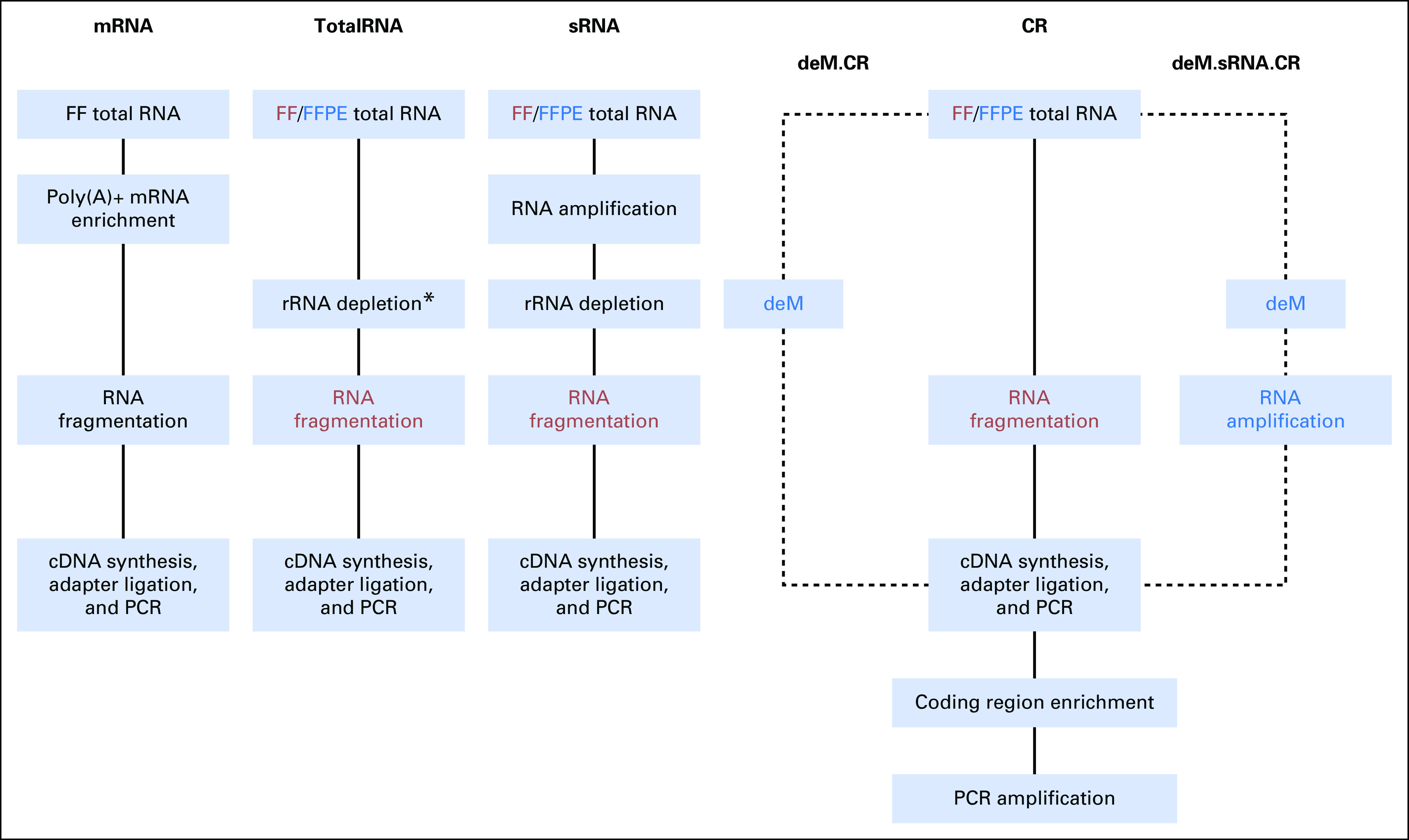
Fig 1.
Fig 1.
Workflows of RNA-seq library preparation. Red indicates steps only applied to fresh frozen (FF) samples, and blue indicates steps only applied to formalin-fixed paraffin-embedded (FFPE) samples. (*) Indicates different ribosomal RNA (rRNA) depletion methods that result in two different TotalRNA protocols, that is, RiboZero for I.TotalRNA and RNase H for K.TotalRNA protocol. CR, coding region capture protocol; deM, demodification protocol; mRNA, mRNA-targeting protocol; PCR, polymerase chain reaction; sRNA, sense RNA protocol.
Fig 2.
Fig 2.
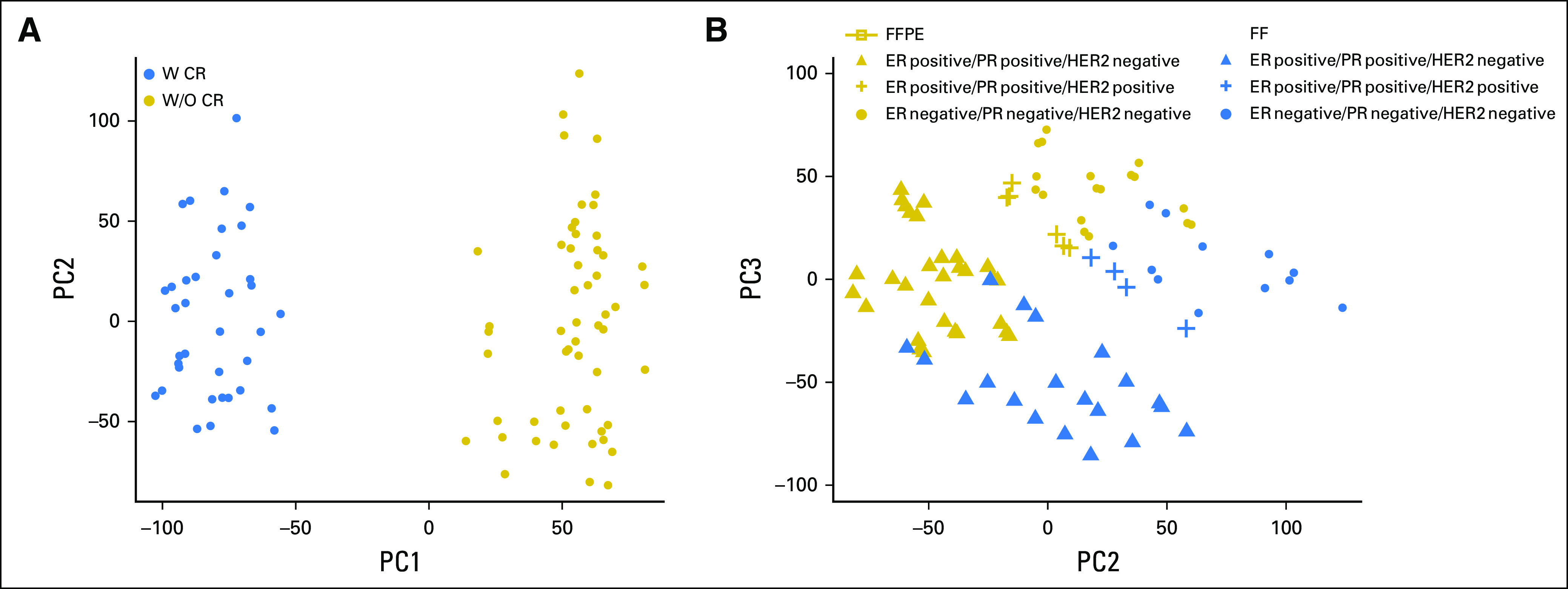
Scatter plot of the first three principal components for count per million–normalized and variance stabilizing transformed counts of 20,381 coding region (CR)-targeted poly(A)+ genes. Each point corresponds to one of 90 libraries. (A) Blue circles indicate samples prepared with CR and gold circles indicate those without CR treatment; 26.5% of total variation comes from CR treatment. (B) Blue color indicates fresh frozen (FF) samples and gold for formalin-fixed paraffin-embedded (FFPE) samples. The symbol shape indicates the different biologic group. The biologic differences and FFPE effects are captured, which accounts for 20.6% of total variation. ER, estrogen receptor; HER2, human epidermal growth factor receptor 2; PC, principal component; PR, progesterone receptor; W CR, with coding region capture; W/O CR, without coding region capture.
Fig 3.
Fig 3.
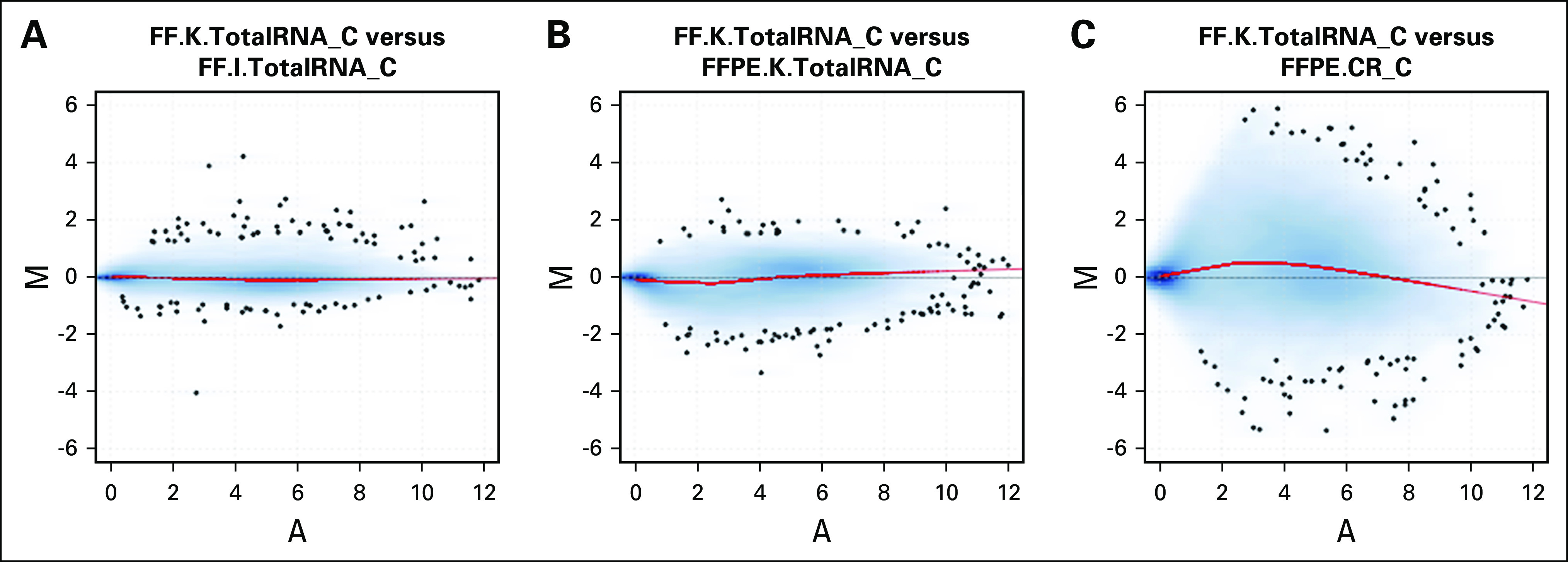
Difference in measurements as log ratio (M) versus mean average expression (A) of each gene (MA plot) of 20,381 coding region (CR)-targeted poly(A)+ genes for tumor sample C when using FF.K.TotalRNA sample C library as the reference. (A) MA plot for tumor C between FF.K.TotalRNA and FF.I.TotalRNA; (B) MA plot for tumor C between FF.K.TotalRNA and FFPE.K.TotalRNA; (C) MA plot for tumor C between FF.K.TotalRNA and FFPE.CR. M is the log2-transformed expression of a gene from first library divided by that from the second library, and A is the mean log2-transformed expression of the gene. The red curve indicates the Lowess smoother fitted to the data. FF, fresh frozen; FFPE, formalin-fixed paraffin-embedded.
Fig 4.
Fig 4.
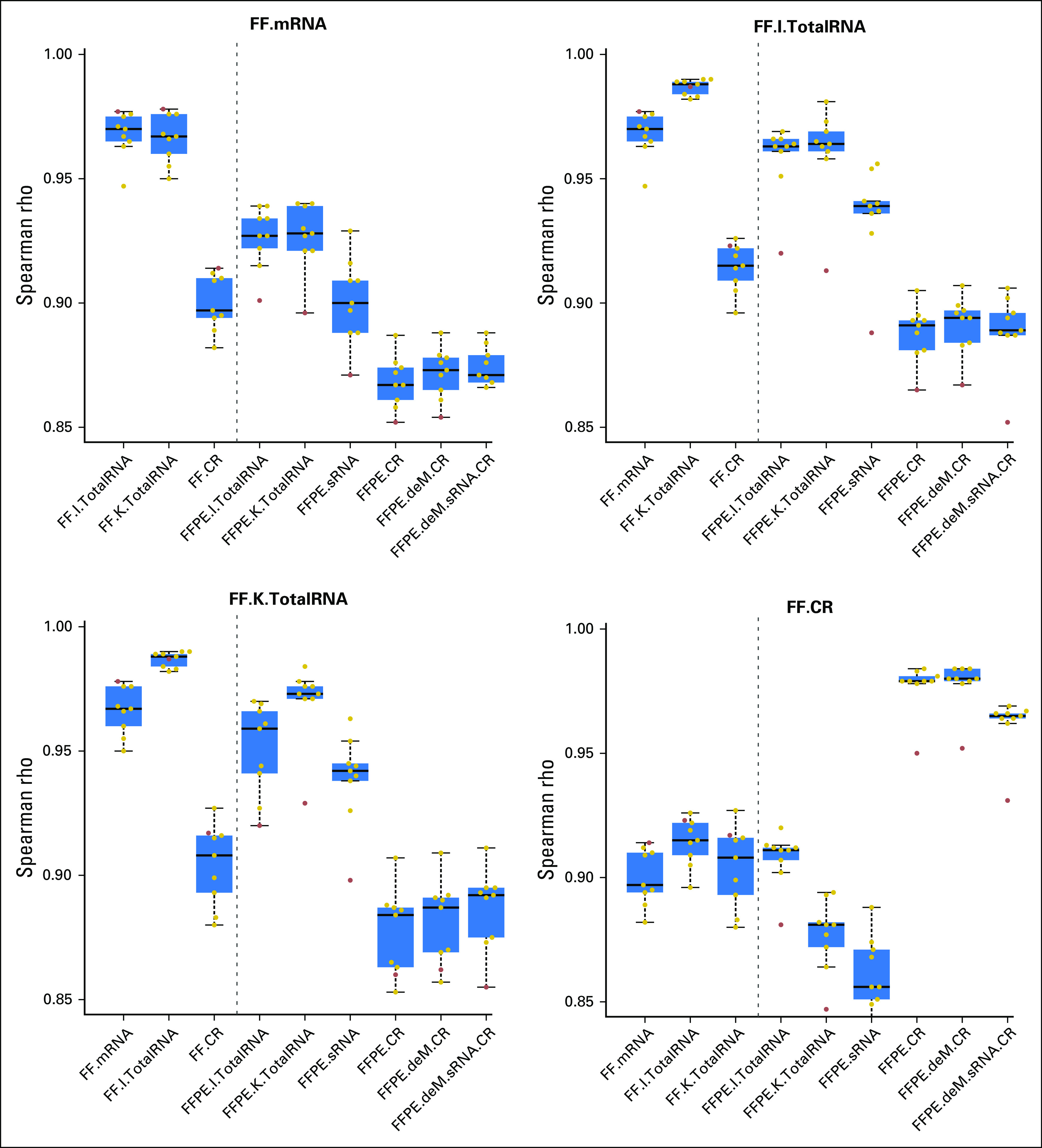
Summary of between-protocol correlation coefficients on the basis of transcripts per million. The title of each figure is the reference protocol used for comparison. Each dot is the Spearman rho estimate calculated between the reference library and the library showing on the x-axis. Each box summarizes the Spearman rho estimates from nine breast tumor samples. The red dot indicates the tumor sample N. CR, coding region protocol; deM, demodification; FF, fresh frozen; FFPE, formalin-fixed paraffin-embedded; sRNA, sense RNA protocol.

References

    1. Penland SK, Keku TO, Torrice C, et al. : RNA expression analysis of formalin-fixed paraffin-embedded tumors. Lab Invest 87:383-391, 2007 - PubMed
    1. Masuda N, Ohnishi T, Kawamoto S, et al. : Analysis of chemical modification of RNA from formalin-fixed samples and optimization of molecular biology applications for such samples. Nucleic Acids Res 27:4436-4443, 1999 - PMC - PubMed
    1. Fumagalli D, Blanchet-Cohen A, Brown D, et al. : Transfer of clinically relevant gene expression signatures in breast cancer: From Affymetrix microarray to Illumina RNA-Sequencing technology. BMC Genomics 15:1008, 2014 - PMC - PubMed
    1. Zhao W, He X, Hoadley KA, et al. : Comparison of RNA-Seq by poly (A) capture, ribosomal RNA depletion, and DNA microarray for expression profiling. BMC Genomics 15:419, 2014 - PMC - PubMed
    1. Matranga CB, Andersen KG, Winnicki S, et al. : Enhanced methods for unbiased deep sequencing of Lassa and Ebola RNA viruses from clinical and biological samples. Genome Biol 15:519, 2014 - PMC - PubMed