


VEGF-A inhibits agonist-mediated Ca2+ responses and activation of IKCa channels in mouse resistance artery endothelial cells
- PMID: 29862503
- PMCID: PMC6092303
- DOI: 10.1113/JP275793
VEGF-A inhibits agonist-mediated Ca2+ responses and activation of IKCa channels in mouse resistance artery endothelial cells
Abstract
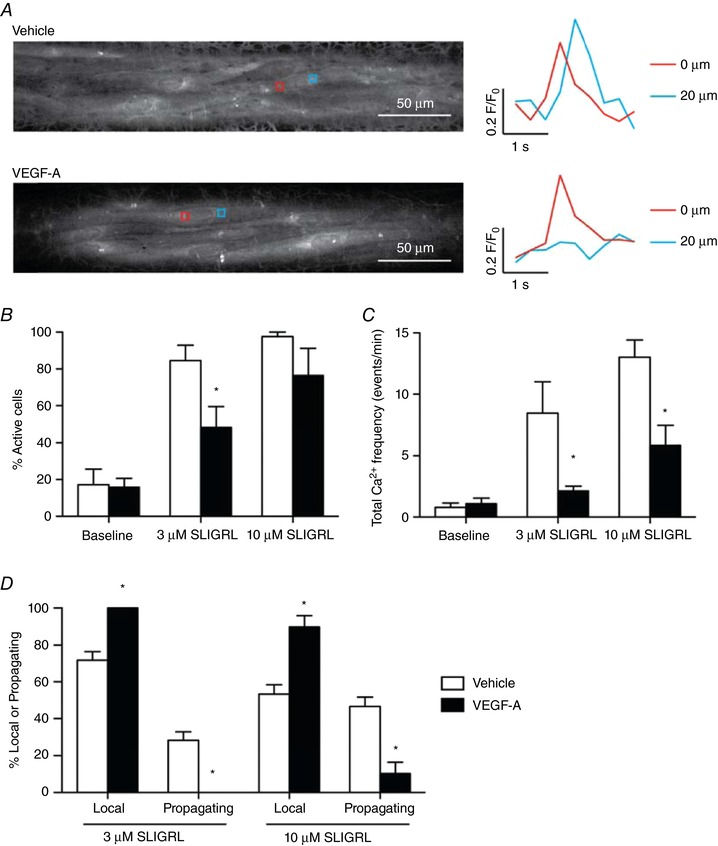
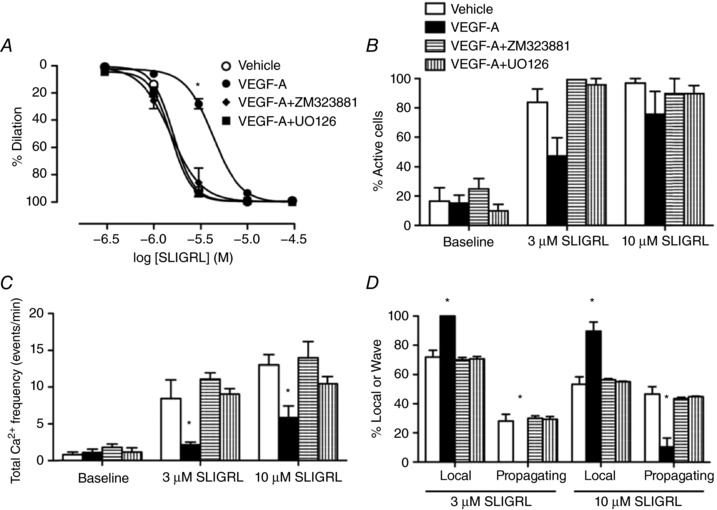
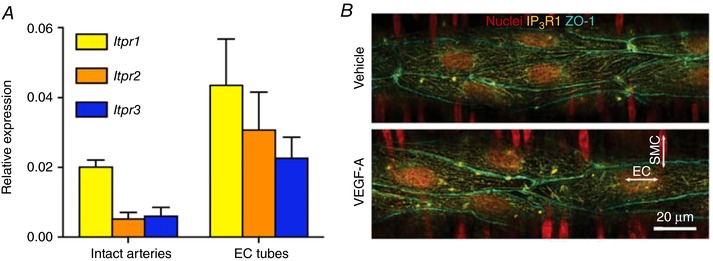
Key points: Prolonged exposure to vascular endothelial growth factor A (VEGF-A) inhibits agonist-mediated endothelial cell Ca2+ release and subsequent activation of intermediate conductance Ca2+ -activated K+ (IKCa ) channels, which underpins vasodilatation as a result of endothelium-dependent hyperpolarization (EDH) in mouse resistance arteries. Signalling via mitogen-activated protein/extracellular signal-regulated kinase kinase (MEK) downstream of VEGF-A was required to attenuate endothelial cell Ca2+ responses and the EDH-vasodilatation mediated by IKCa activation. VEGF-A exposure did not modify vasodilatation as a result of the direct activation of IKCa channels, nor the pattern of expression of inositol 1,4,5-trisphosphate receptor 1 within endothelial cells of resistance arteries. These results indicate a novel role for VEGF-A in resistance arteries and suggest a new avenue for investigation into the role of VEGF-A in cardiovascular diseases.
Abstract: Vascular endothelial growth factor A (VEGF-A) is a potent permeability and angiogenic factor that is also associated with the remodelling of the microvasculature. Elevated VEGF-A levels are linked to a significant increase in the risk of cardiovascular dysfunction, although it is unclear how VEGF-A has a detrimental, disease-related effect. Small resistance arteries are central determinants of peripheral resistance and endothelium-dependent hyperpolarization (EDH) is the predominant mechanism by which these arteries vasodilate. Using isolated, pressurized resistance arteries, we demonstrate that VEGF-A acts via VEGF receptor-2 (R2) to inhibit both endothelial cell (EC) Ca2+ release and the associated EDH vasodilatation mediated by intermediate conductance Ca2+ -activated K+ (IKCa ) channels. Importantly, VEGF-A had no direct effect against IKCa channels. Instead, the inhibition was crucially reliant on the downstream activation of the mitogen-activated protein/extracellular signal-regulated kinase kinase 1/2 (MEK1/2). The distribution of EC inositol 1,4,5-trisphosphate (IP3 ) receptor-1 (R1) was not affected by exposure to VEGF-A and we propose an inhibition of IP3 R1 through the MEK pathway, probably via ERK1/2. Inhibition of EC Ca2+ via VEGFR2 has profound implications for EDH-mediated dilatation of resistance arteries and could provide a mechanism by which elevated VEGF-A contributes towards cardiovascular dysfunction.
Keywords: MEK; VEGF-A; endothelial cell calcium; endothelium-derived hyperpolarizing factor; vasodilation.
© 2018 The Authors. The Journal of Physiology © 2018 The Physiological Society.
Figures
References
-
- Bai, G.‐R. , Yang, L.‐H. , Huang, X.‐Y. and Sun, F.‐Z. (2006). Inositol 1,4,5‐trisphosphate receptor type 1 phosphorylation and regulation by extracellular signal‐regulated kinase. Biochem Biophys Res Commun 348, 1319–1327. - PubMed
-
- Baker, P. , Krasnow, J. , Roberts, J. and Yeo, K. (1995). Elevated serum levels of vascular endothelial growth factor in patients with preeclampsia. Obstet Gynecol 86, 815–21. - PubMed
Publication types
MeSH terms
Substances
Grants and funding
LinkOut - more resources
Full Text Sources
Other Literature Sources
Miscellaneous
