


Effect of Mode of Conception on Maternal Serum Relaxin, Creatinine, and Sodium Concentrations in an Infertile Population
- PMID: 29862889
- PMCID: PMC6728556
- DOI: 10.1177/1933719118776792
Effect of Mode of Conception on Maternal Serum Relaxin, Creatinine, and Sodium Concentrations in an Infertile Population
Abstract
Objective: To investigate how the mode of conception affects maternal relaxin, creatinine, and electrolyte concentrations.
Background: Pregnancies achieved by fertility treatment often begin in a nonphysiologic endocrine milieu with no corpus luteum (CL) or with many corpora lutea. The CL produces not only estradiol and progesterone but is also the sole source of relaxin in early pregnancy, a hormone that may contribute to maternal systemic and renal vasodilation. There is limited data about maternal physiology in early pregnancy during fertility treatment, and studies have rarely considered the potential effect of the absence of the CL. To begin to address this gap in knowledge, we sought to investigate how the mode of conception affects maternal relaxin, creatinine, and electrolyte concentrations.
Methods: One hundred eighty-four women who received care at an academic infertility practice provided serum samples. Levels of relaxin 2, creatinine, and electrolytes were compared between 4 groups defined on the basis of mode of conception which corresponded to categories of CL number: (1) absence of the CL, (2) single CL, (3) multiple CL from ovarian stimulation not including in vitro fertilization (IVF), and (4) multiple CL from IVF with fresh embryo transfer.
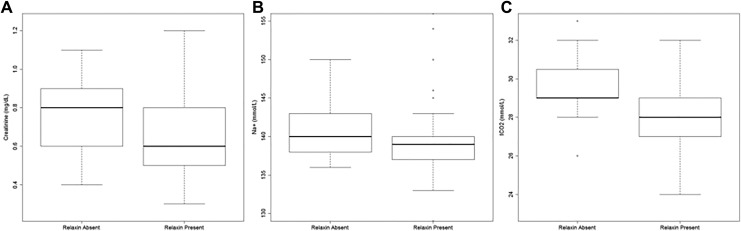
Results: Relaxin-2 levels were undetectable in patients lacking a CL. Creatinine, sodium, and total CO2 levels were significantly higher in the 0 CL group (relaxin absent) compared to all other groups (relaxin present). Compared to clomiphene, use of letrozole was associated with a lower relaxin level.
Conclusion: Early creatinine and sodium concentrations are increased in the absence of relaxin. Given the increasing utilization of frozen embryo transfer, further studies comparing programmed with natural cycles are warranted.
Keywords: assisted reproduction; corpus luteum; female infertility; pregnancy; relaxin.
Conflict of interest statement
Figures
References
-
- Chapman AB, Abraham WT, Zamudio S, et al. Temporal relationships between hormonal and hemodynamic changes in early human pregnancy. Kidney Int. 1998;54(6):2056–2063. - PubMed
-
- Capeless EL, Clapp JF. Cardiovascular changes in early phase of pregnancy. Am J Obstet Gynecol. 1989;161(6 pt 1):1449–1453. - PubMed
-
- Robson SC, Hunter S, Boys RJ, Dunlop W. Serial study of factors influencing changes in cardiac output during human pregnancy. Am J Physiol. 1989;256(4 pt 2):H1060–H1065. - PubMed
-
- Chapman AB, Zamudio S, Woodmansee W, et al. Systemic and renal hemodynamic changes in the luteal phase of the menstrual cycle mimic early pregnancy. Am J Physiol. 1997;273(5 pt 2):F777–F782. - PubMed
Publication types
MeSH terms
Substances
Grants and funding
LinkOut - more resources
Full Text Sources
Other Literature Sources
Medical
Miscellaneous
