


Does postoperative morbidity worsen the oncological outcome after radical surgery for gastrointestinal cancers? A systematic review of the literature
- PMID: 29863169
- PMCID: PMC5881350
- DOI: 10.1002/ags3.12002
Does postoperative morbidity worsen the oncological outcome after radical surgery for gastrointestinal cancers? A systematic review of the literature
Abstract
Purpose: The impact of postoperative complications on survival after radical surgery for esophageal, gastric, and colorectal cancers remains controversial. We conducted a systematic review of recent publications to examine the effect of postoperative complications on oncological outcome.
Methods: A literature search of PubMed/MEDLINE was performed using the keywords "esophageal cancer," "gastric cancer," and "colorectal cancer," obtaining 27 reports published online up until the end of April 2016. Articles focusing on (i) postoperative morbidity and oncological outcome; and (ii) body mass index (BMI), postoperative morbidity, and oncological outcome, were selected. Univariate and multivariate analyses (Cox proportional hazards model) were performed.
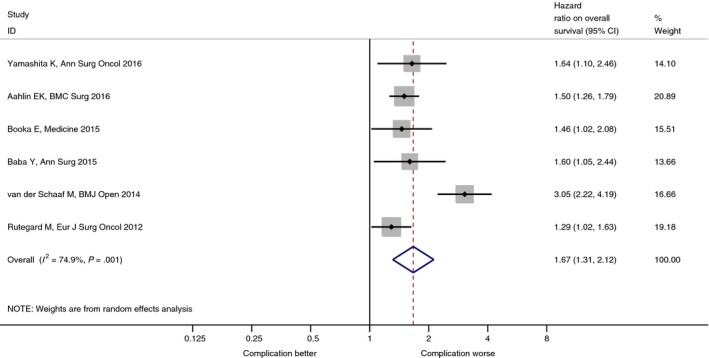
Results: Patients with postoperative complications had significantly poorer long-term survival than those without complications. Complications were associated with impaired oncological outcomes. The hazard ratios for overall survival were 1.67 (95% confidence interval [CI], 1.31-2.12), 1.59 (95% CI, 1.13-2.24), and 1.55 (95% CI, 1.28-1.87) in esophageal, gastric, and colorectal cancers, respectively. High BMI was associated with postoperative morbidity rate but not with poor oncological outcome. Low BMI was significantly associated with inferior oncological outcome.
Conclusions: Complications after radical surgery for esophageal, gastric, and colorectal cancers are associated with patient prognosis. Avoiding such complications might improve the outcomes.
Keywords: colorectal cancer; esophageal cancer; gastric cancer; oncological outcome; postoperative complication.
Figures


References
-
- Yamashita K, Makino T, Miyata H, et al. Postoperative infectious complications are associated with adverse oncologic outcomes in esophageal cancer patients undergoing preoperative chemotherapy. Ann Surg Oncol. 2016;23:2106–14. - PubMed
-
- Baba Y, Yoshida N, Shigaki H, et al. Prognostic impact of postoperative complications in 502 patients with surgically resected esophageal squamous cell carcinoma: A retrospective single‐institution study. Ann Surg. 2016;264:305–11. - PubMed
-
- Katai H, Sasako M, Fukuda H, et al. Safety and feasibility of laparoscopy‐assisted distal gastrectomy with suprapancreatic nodal dissection for clinical stage I gastric cancer: a multicenter phase II trial (JCOG 0703). Gastric Cancer. 2010;13:238–44. - PubMed
-
- Sano T, Sasako M, Yamamoto S, et al. Gastric cancer surgery: morbidity and mortality results from a prospective randomized controlled trial comparing D2 and extended para‐aortic lymphadenectomy–Japan Clinical Oncology Group study 9501. J Clin Oncol. 2004;22:2767–73. - PubMed
Publication types
LinkOut - more resources
Full Text Sources
Other Literature Sources
Miscellaneous
