


Race/Ethnicity and Retention in Traumatic Brain Injury Outcomes Research: A Traumatic Brain Injury Model Systems National Database Study
- PMID: 29863614
- PMCID: PMC6611457
- DOI: 10.1097/HTR.0000000000000395
Race/Ethnicity and Retention in Traumatic Brain Injury Outcomes Research: A Traumatic Brain Injury Model Systems National Database Study
Abstract
Objective: To investigate the contribution of race/ethnicity to retention in traumatic brain injury (TBI) research at 1 to 2 years postinjury.
Setting: Community.
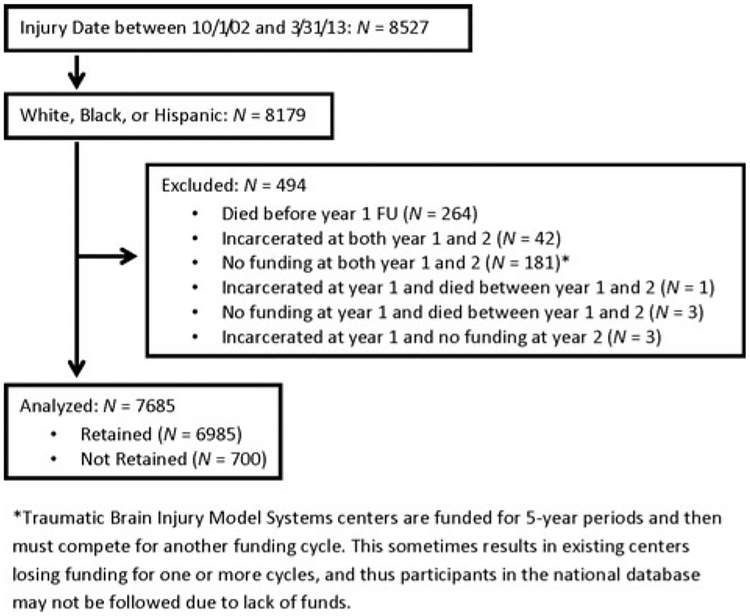
Participants: With dates of injury between October 1, 2002, and March 31, 2013, 5548 whites, 1347 blacks, and 790 Hispanics enrolled in the Traumatic Brain Injury Model Systems National Database.
Design: Retrospective database analysis.
Main measure: Retention, defined as completion of at least 1 question on the follow-up interview by the person with TBI or a proxy.
Results: Retention rates 1 to 2 years post-TBI were significantly lower for Hispanic (85.2%) than for white (91.8%) or black participants (90.5%) and depended significantly on history of problem drug or alcohol use. Other variables associated with low retention included older age, lower education, violent cause of injury, and discharge to an institution versus private residence.
Conclusions: The findings emphasize the importance of investigating retention rates separately for blacks and Hispanics rather than combining them or grouping either with other races or ethnicities. The results also suggest the need for implementing procedures to increase retention of Hispanics in longitudinal TBI research.
Conflict of interest statement
The authors declare no conflicts of interest.
References
-
- Benedictus MR, Spikman JM, Naalt JVD. Cognitive and behavioral impairment in traumatic brain injury related to outcome and return to work. Arch Phys Med Rehabil. 2010;91(9):1436–1441. - PubMed
-
- Arciniegas DB, Wortzel HS. Emotional and behavioral dyscontrol after traumatic brain injury. Psychiatr Clin North Am. 2014; 37(1):31–53. - PubMed
-
- Masel BF, Dewitt DS. Traumatic brain injury: a disease process, not an event. J Neurotrauma. 2010;27(8):1529–1540. - PubMed
-
- Andelic N, Sigurdardottir S, Schanke AK, Sandvik L, Sveen U, Roe C. Disability, physical health and mental health 1 year after traumatic brain injury. Disabil Rehabil. 2010;32(13):1122–1131. - PubMed
-
- Grauwmeijer E, Heijenbrok-Kal MH, Haitsma IK, Ribbers GM. A prospective study on employment outcome 3 years after moderate to severe traumatic brain injury. Arch Phys Med Rehabil. 2012;93(6):993–999. - PubMed
Publication types
MeSH terms
Grants and funding
- 90DP0047/ACL/ACL HHS/United States
- 90RT5007/ACL/ACL HHS/United States
- U48 DP000046/DP/NCCDPHP CDC HHS/United States
- R24 HS022134/HS/AHRQ HHS/United States
- 90DP0046/ACL/ACL HHS/United States
- 90DP0034/ACL/ACL HHS/United States
- U48 DP000036/DP/NCCDPHP CDC HHS/United States
- U48 DP000047/DP/NCCDPHP CDC HHS/United States
- 90DPTB0016/ACL/ACL HHS/United States
- 90DP0084/ACL/ACL HHS/United States
- L60 MD009326/MD/NIMHD NIH HHS/United States
- U48 DP000060/DP/NCCDPHP CDC HHS/United States
- 90DP0060/ACL/ACL HHS/United States
- U48 DP000034/DP/NCCDPHP CDC HHS/United States
- 90DP0036/ACL/ACL HHS/United States
- 90DP0033/ACL/ACL HHS/United States
- P30 AG024832/AG/NIA NIH HHS/United States
- U48 DP000033/DP/NCCDPHP CDC HHS/United States
- 90DP0032/ACL/ACL HHS/United States
- U48 DP000028/DP/NCCDPHP CDC HHS/United States
- UL1 RR029876/RR/NCRR NIH HHS/United States
- 90DP0028/ACL/ACL HHS/United States
LinkOut - more resources
Full Text Sources
Other Literature Sources
Medical
