Comparative Study
. 2018 Jun;37(6):964-974.
doi: 10.1377/hlthaff.2017.1321.

Four States With Robust Prescription Drug Monitoring Programs Reduced Opioid Dosages

Affiliations
Comparative Study

Four States With Robust Prescription Drug Monitoring Programs Reduced Opioid Dosages

Rebecca L Haffajee et al. Health Aff (Millwood). 2018 Jun.

Abstract

State prescription drug monitoring programs (PDMPs) aim to reduce risky controlled-substance prescribing, but early programs had limited impact. Several states implemented robust features in 2012-13, such as mandates that prescribers register with the program and regularly check its registry database. Some states allow prescribers to fulfill the latter requirement by designating delegates to check the registry. The effects of robust PDMP features have not been fully assessed. We used commercial claims data to examine the effects of implementing robust PDMPs in four states on overall and high-risk opioid prescribing, comparing those results to trends in similar states without robust PDMPs. By the end of 2014 the absolute mean morphine-equivalent dosages that providers dispensed declined in a range of 6-77 mg per person per quarter in the four states, relative to comparison states. Only in one of the four states, Kentucky, did the percentage of people who filled opioid prescriptions decline versus its comparator state, with an absolute reduction of 1.6 percent by the end of 2014. Robust PDMPs may be able to significantly reduce opioid dosages dispensed, percentages of patients receiving opioids, and high-risk prescribing.

Keywords: Legal/Regulatory Issues; Mental Health/Substance Abuse; Pharmaceuticals; Public Health.


Figures
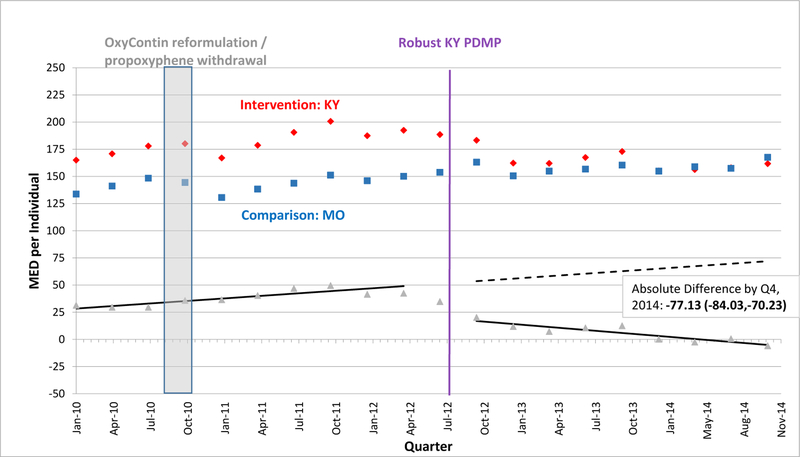
EXHIBIT 1
EXHIBIT 1
Morphine Equivalent Dosage Dispensed per Individual per Quarter in Kentucky versus Missouri, 2010–2014 SOURCE: Authors’ analysis of Optum data (OptumInsight, Eden Prairie, MN), 2010–2014. NOTES: Abbreviations: PDMP, prescription drug monitoring program; MED, morphine equivalent dosage in milligrams; Q, quarter. A fitted regression line shows the difference between adjusted intervention state (red) and comparison state (blue) quarterly values in the baseline period, and continues as a predicted regression line in the follow-up period, after robust PDMP implementation in the intervention state. We calculated regression lines using population-level interrupted time series linear models, after adjusting for individual age, gender, race/ethnicity, education-level, and poverty-level at each quarter using the STATA margins command. We provide the absolute difference between intervention and comparison state levels by the fourth quarter of 2014 with a 95% confidence interval as an estimate of policy effect. A vertical bar shows when two national interventions associated with decreases in opioid-related overdoses and prescribing occurred during the fourth quarter of 2010: reformulation of OxyContin to a tamper-resistant extended-release form and withdrawal of propoxyphene from the market.
EXHIBIT 2
EXHIBIT 2
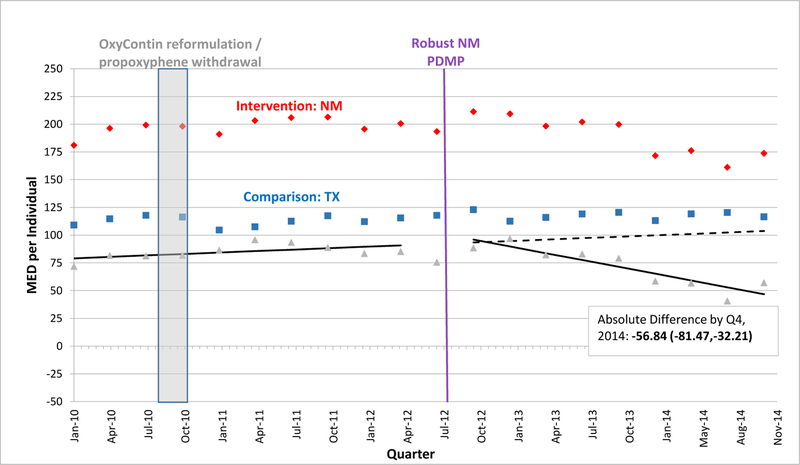
Morphine Equivalent Dosage Dispensed per Individual per Quarter in New Mexico versus Texas, 2010–2014 SOURCE: Authors’ analysis of Optum data (OptumInsight, Eden Prairie, MN), 2010–2014. NOTES: Abbreviations: PDMP, prescription drug monitoring program; MED, morphine equivalent dosage in milligrams; Q, quarter. A fitted regression line shows the difference between adjusted intervention state (red) and comparison state (blue) quarterly values in the baseline period, and continues as a predicted regression line in the follow-up period, after robust PDMP implementation in the intervention state. We calculated regression lines using population-level interrupted time series linear models, after adjusting for individual age, gender, race/ethnicity, education-level, and poverty-level at each quarter using the STATA margins command. We provide the absolute difference between intervention and comparison state levels by the fourth quarter of 2014 with a 95% confidence interval as an estimate of policy effect. A vertical bar shows when two national interventions associated with decreases in opioid-related overdoses and prescribing occurred during the fourth quarter of 2010: reformulation of OxyContin to a tamper-resistant extended-release form and withdrawal of propoxyphene from the market.
EXHIBIT 3
EXHIBIT 3
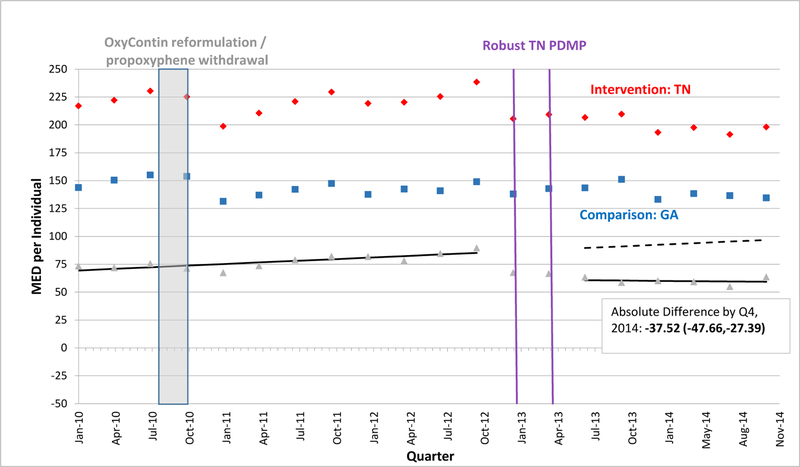
Morphine Equivalent Dosage Dispensed per Individual per Quarter in Tennessee versus Georgia, 2010–2014 SOURCE: Authors’ analysis of Optum data (OptumInsight, Eden Prairie, MN), 2010–2014. NOTES: Abbreviations: PDMP, prescription drug monitoring program; MED, morphine equivalent dosage in milligrams; Q, quarter. A fitted regression line shows the difference between adjusted intervention state (red) and comparison state (blue) quarterly values in the baseline period, and continues as a predicted regression line in the follow-up period, after robust PDMP implementation in the intervention state. We calculated regression lines using population-level interrupted time series linear models, after adjusting for individual age, gender, race/ethnicity, education-level, and poverty-level at each quarter using the STATA margins command. We provide the absolute difference between intervention and comparison state levels by the fourth quarter of 2014 with a 95% confidence interval as an estimate of policy effect. A vertical bar shows when two national interventions associated with decreases in opioid-related overdoses and prescribing occurred during the fourth quarter of 2010: reformulation of OxyContin to a tamper-resistant extended-release form and withdrawal of propoxyphene from the market.
EXHIBIT 4
EXHIBIT 4
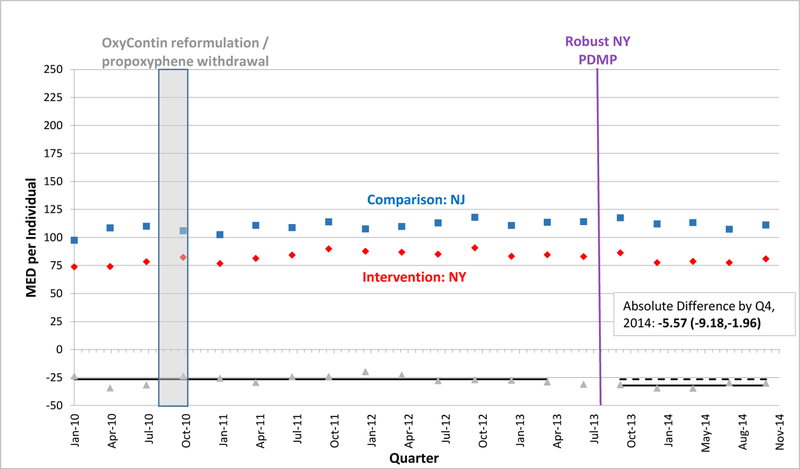
Morphine Equivalent Dosage Dispensed per Individual per Quarter in New York versus New Jersey, 2010–2014 SOURCE: Authors’ analysis of Optum data (OptumInsight, Eden Prairie, MN), 2010–2014. NOTES: Abbreviations: PDMP, prescription drug monitoring program; MED, morphine equivalent dosage in milligrams; Q, quarter. A fitted regression line shows the difference between adjusted intervention state (red) and comparison state (blue) quarterly values in the baseline period, and continues as a predicted regression line in the follow-up period, after robust PDMP implementation in the intervention state. We calculated regression lines using population-level interrupted time series linear models, after adjusting for individual age, gender, race/ethnicity, education-level, and poverty-level at each quarter using the STATA margins command. We provide the absolute difference between intervention and comparison state levels by the fourth quarter of 2014 with a 95% confidence interval as an estimate of policy effect. A vertical bar shows when two national interventions associated with decreases in opioid-related overdoses and prescribing occurred during the fourth quarter of 2010: reformulation of OxyContin to a tamper-resistant extended-release form and withdrawal of propoxyphene from the market.

References

    1. Centers for Disease Control & Prevention. Vital signs: changes in opioid prescribing in the United States, 2006–2015. Morbid & Mortality Wkly Rep 2017;66(26):697–704. - PMC - PubMed
    1. Rudd RA, Aleshire N, Zibbell JE, Gladden RM. Increases in drug and opioid overdose deaths. Morbid & Mortality Wkly Rep 2016;64(50):1378–82. - PubMed
    1. Office of National Drug Control Policy, Executive Office of the President. 2010 national survey on drug use and health: highlights September 2011. https://www.whitehouse.gov/sites/default/files/ondcp/Fact_Sheets/nsduh_f.... Accessed May 17, 2016.
    1. Centers for Disease Control & Prevention. Prescription opioid overdose data Dec. 16, 2016. https://www.cdc.gov/drugoverdose/data/overdose.html. Accessed April 10, 2017.
    1. Substance Abuse and Mental Health Services Administration. Results from the 2013 national survey on drug use and health: summary of national findings, NSDUH Series H-48, HHS Publication No. (SMA) 14–4863 Rockville, MD: Substance Abuse and Mental Health Services Administration; (2014).

Publication types

MeSH terms

LinkOut - more resources