Review
. 2019;30(1):41-47.
doi: 10.1080/09537104.2018.1476681. Epub 2018 Jun 4.

RAP GTPases and platelet integrin signaling

Affiliations
Review

RAP GTPases and platelet integrin signaling

Lucia Stefanini et al. Platelets. 2019.

Abstract

Platelets are highly specialized cells that continuously patrol the vasculature to ensure its integrity (hemostasis). At sites of vascular injury, they are able to respond to trace amounts of agonists and to rapidly transition from an anti-adhesive/patrolling to an adhesive state (integrin inside-out activation) required for hemostatic plug formation. Pathological conditions that disturb the balance in the underlying signaling processes can lead to unwanted platelet activation (thrombosis) or to an increased bleeding risk. The small GTPases of the RAP subfamily, highly expressed in platelets, are critical regulators of cell adhesion, cytoskeleton remodeling, and MAP kinase signaling. Studies by our group and others demonstrate that RAP GTPases, in particular RAP1A and RAP1B, are the key molecular switches that turn on platelet activation/adhesiveness at sites of injury. In this review, we will summarize major findings on the role of RAP GTPases in platelet biology with a focus on the signaling pathways leading to the conversion of integrins to a high-affinity state.

Keywords: Hemostasis; RAP1; integrin activation; signal transduction; small GTPases.


Conflict of interest statement

Conflict of interest

The authors report no declarations of interest.

Figures
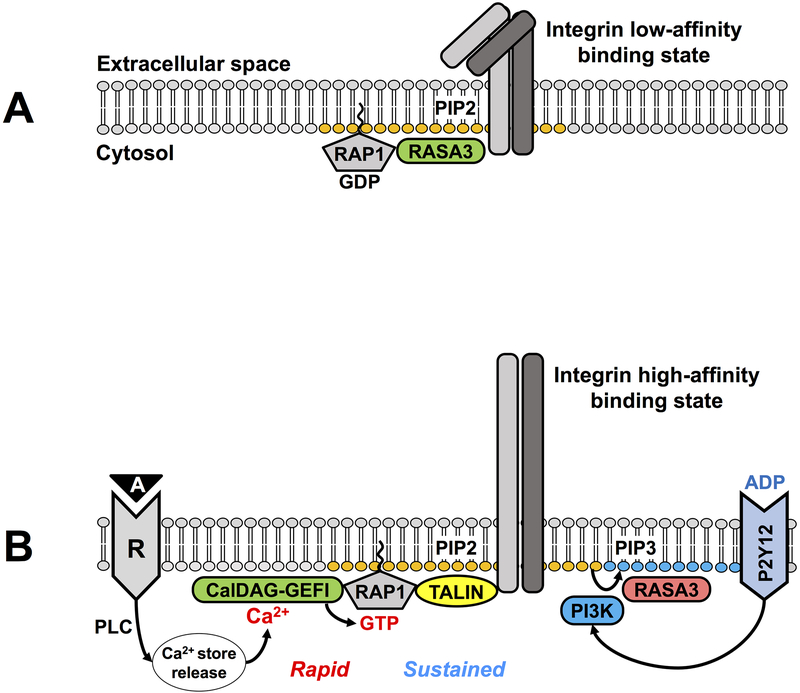
Figure 1.
Figure 1.. Working model or RAP1-dependent integrin affinity regulation.
A) In circulating/patrolling platelets the GTPase-activating protein RASA3 is active at the plasma membrane to counteract any spurious RAP1 activation and maintain integrins in a low affinity binding state for their ligands. B) Upon injury, platelet receptors (R) immediately respond to agonists (A) produced at the site of damage by mobilizing calcium ions (Ca2+) from the intracellular stores. The Ca2+-sensor CALDAG-GEFI, mediates the rapid activation of RAP1. Sustained RAP1 activation is achieved by turning off RASA3, following stimulation of the ADP (adenosine diphosphate) receptor P2Y12, and generation of PIP3 (phosphatidylinositol 3,4,5-trisphosphate) by the lipid kinase PI3K (phosphatidylinositol-4,5-bisphosphate 3-kinase). Once active, RAP1-GTP recruits TALIN to PIP2 (phosphatidylinositol 4,5-bisphosphate)-rich areas of the plasma membrane in proximity of the integrins. TALIN binding to the integrin cytoplasmic tail triggers the conversion of integrins to a high affinity binding state for their ligands, which is required for platelet adhesion and aggregation at sites of injury.
Figure 2.
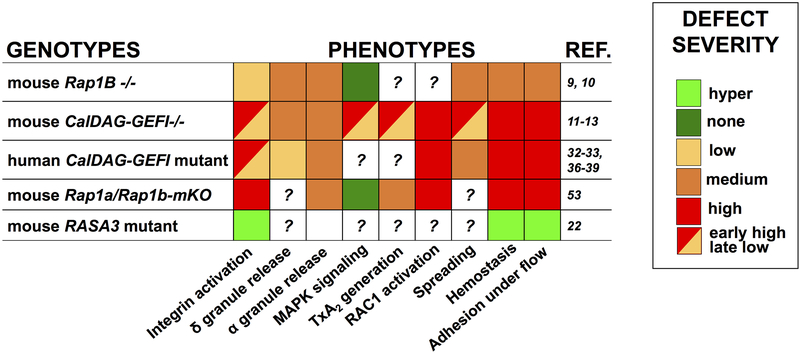
Figure 2.. Comparison of the platelet phenotype in the absence of functional RAP1 proteins or of their upstream regulators.
Table showing the effect of Rap1b deficiency (mouse Rap1b−/−), Caldaggef1 deficiency (mouse CalDAG-GEFI −/−), mutations in CalDAG-GEFI identified in human patients (human CalDAG-GEFI mutant), combined deficiency of Rap1a and Rap1b in the platelet-megakaryocytic lineage (mouse Rap1a/Rap1b-mKO) and expression of a Rasa3 mutant (H794L, mouse RASA3 mutant) on integrin activation, RAC1 activation, spreading, MAPK signaling, alpha (α) and dense (δ) granule secretion, TxA2 (thromboxane A2) production, hemostasis and adhesion under flow. The color code reflects the severity of the defect according to the legend shown on the left. Light green indicates hyperactivation. The question mark indicates ‘not known’.
Figure 3.
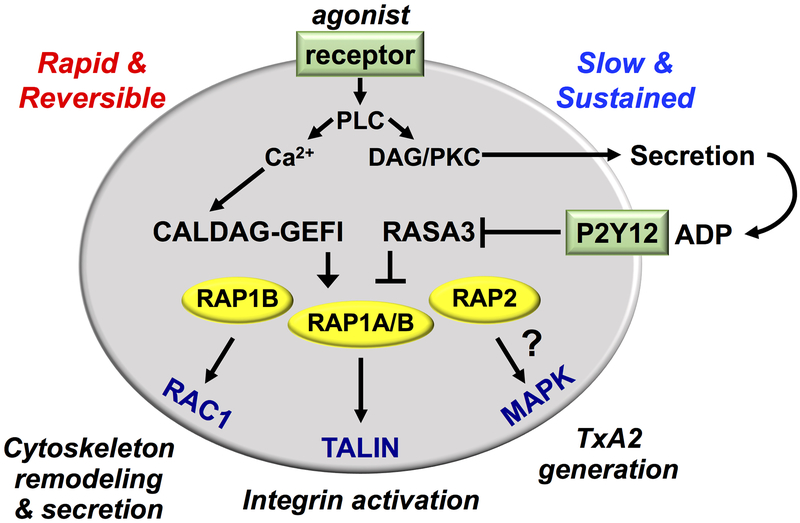
Figure 3.. Schematic summary of RAP signaling in platelets.
RAP GTPases are a central signaling node regulating platelet activation. Their upstream regulators, CalDAG-GEFI and RASA3 are critical signal integrators for second messengers generated in response to agonist receptor engagement at sites of injury. While CALDAG-GEFI is critical for rapid RAP activation in response to trace amounts of agonists, sustained RAP activation is ensured by ADP-mediated P2Y12 signaling that turns off the RAP inhibitor RASA3. Once active, RAP GTPases drive platelet activation at sites of vascular injury by switching on multiple platelet responses. Our ongoing studies indicate that both RAP1A and RAP1B control integrin inside-out activation by recruiting TALIN, while RAP1B alone regulates granule secretion, probably though its effect on RAC1 activation. Furthermore, indirect observations suggest that RAP2 GTPases may be regulating MAPK signaling and MAPK-dependent responses such as TxA2 generation.

References

    1. Burkhart JM, Vaudel M, Gambaryan S, Radau S, Walter U, Martens L, Geiger J, Sickmann A, Zahedi RP. The first comprehensive and quantitative analysis of human platelet protein composition allows the comparative analysis of structural and functional pathways. Blood 2012; 120: e73–82. - PubMed
    1. Zeiler M, Moser M, Mann M. Copy Number Analysis of the Murine Platelet Proteome Spanning the Complete Abundance Range. Molecular & Cellular Proteomics 2014; 13: 3435–45. - PMC - PubMed
    1. Rowley JW, Oler AJ, Tolley ND, Hunter BN, Low EN, Nix DA, Yost CC, Zimmerman GA, Weyrich AS. Genome-wide RNA-seq analysis of human and mouse platelet transcriptomes. Blood 2011; 118: e101–11. - PMC - PubMed
    1. Simon LM, Edelstein LC, Nagalla S, Woodley AB, Chen ES, Kong X, Ma L, Fortina P, Kunapuli S, Holinstat M, McKenzie SE, Dong J-F, Shaw CA, Bray PF. Human platelet microRNA-mRNA networks associated with age and gender revealed by integrated plateletomics. Blood 2014; 123: e37–45. - PMC - PubMed
    1. Caron E Cellular functions of the Rap1 GTP-binding protein: a pattern emerges. Journal of Cell Science 2003; 116: 435–40. - PubMed

MeSH terms

LinkOut - more resources