. 2018 Sep:174:107-112.
doi: 10.1016/j.exer.2018.05.033. Epub 2018 Jun 1.

WNT7A/B promote choroidal neovascularization

Affiliations

WNT7A/B promote choroidal neovascularization

Joseph B Lin et al. Exp Eye Res. 2018 Sep.

Abstract

Perturbations in WNT signaling are associated with congenital eye disorders, including familial exudative vitreoretinopathy and Norrie disease. More recently, activation of the WNT pathway has also been shown to be associated with age-related macular degeneration (AMD). In this study, we identified that in choroidal neovascular membranes from AMD patients, β-catenin is activated specifically in the vascular endothelium, suggesting that WNT promotes pathologic angiogenesis by directly affecting vascular endothelial cells. WNT7B has been shown to be important during eye development for regression of the fetal hyaloid vasculature. However, it has not yet been established whether WNT7A and/or WNT7B are involved in neovascular AMD pathogenesis. Here, we show that WNT7A and WNT7B increase the proliferation of human dermal microvascular endothelial cells in a dose-dependent manner. Both WNT7A and WNT7B also stimulated vascular sprouting from mouse choroidal explants in vitro. To evaluate in vivo relevance, we generated mice systemically deficient in Wnt7a and/or Wnt7b. Genetic deletion of both Wnt7a and Wnt7b decreased the severity of laser injury-induced choroidal neovascularization (CNV), while individual deletion of either Wnt7a or Wnt7b did not have a significant effect on CNV, suggesting that WNT7A and WNT7B have redundant pro-angiogenic roles in vivo. Cumulatively, these findings identify specific WNT isoforms that may play a pathologic role in CNV as observed in patients with neovascular AMD. Although the source of increased WNT7A and/or WNT7B in CNV requires further investigation, WNT signaling may be a potential target for therapeutic intervention if these results are demonstrated to be relevant in human disease.

Keywords: Age-related macular degeneration; Angiogenesis; Choroidal neovascularization; WNT7A; WNT7B; β-catenin.


Conflict of interest statement

Conflicts of Interest

Declarations of interest: none.

Figures
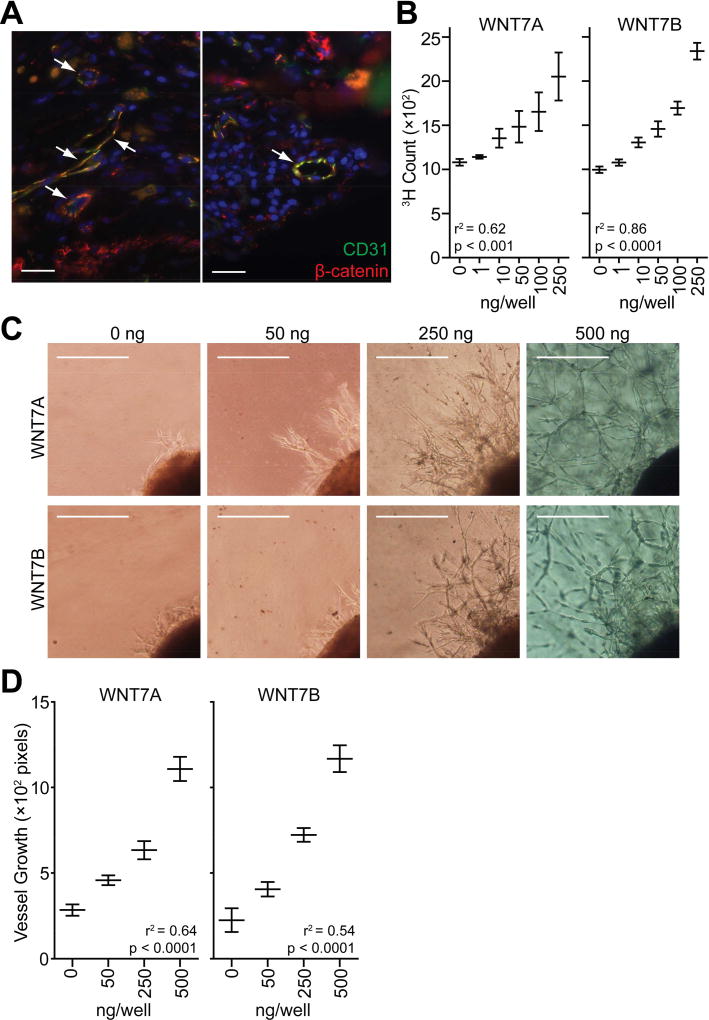
Fig. 1
Fig. 1
WNT7A and WNT7B promote vascular proliferation in vitro. (A) Tissue sections prepared from choroidal neovascular membranes excised from patients with wet AMD were probed with antibodies specific for active non-phosphorylated β-catenin (red) and CD31 (green) by immunohistochemistry. Areas of co-localized β-catenin and CD31 staining are indicated in yellow. White arrows indicate blood vessels. DAPI (blue) was used to counterstain cell nuclei. Scale bars: 25 µm. (B) HMVEC proliferation was stimulated by recombinant human WNT7A and WNT7B (1-way ANOVA with post hoc test for linear trend). Graphs indicate the mean ± SEM of 3 independent experiments. (C–D) WNT7A and WNT7B promote vascular sprouting from mouse choroidal explants (1-way ANOVA with post hoc test for linear trend). Representative images are shown in (C; scale bars: 75 µm). Quantifications shown in (D) represent the mean ± SEM vessel growth measured in 4–14 explants.
Fig. 2
Fig. 2
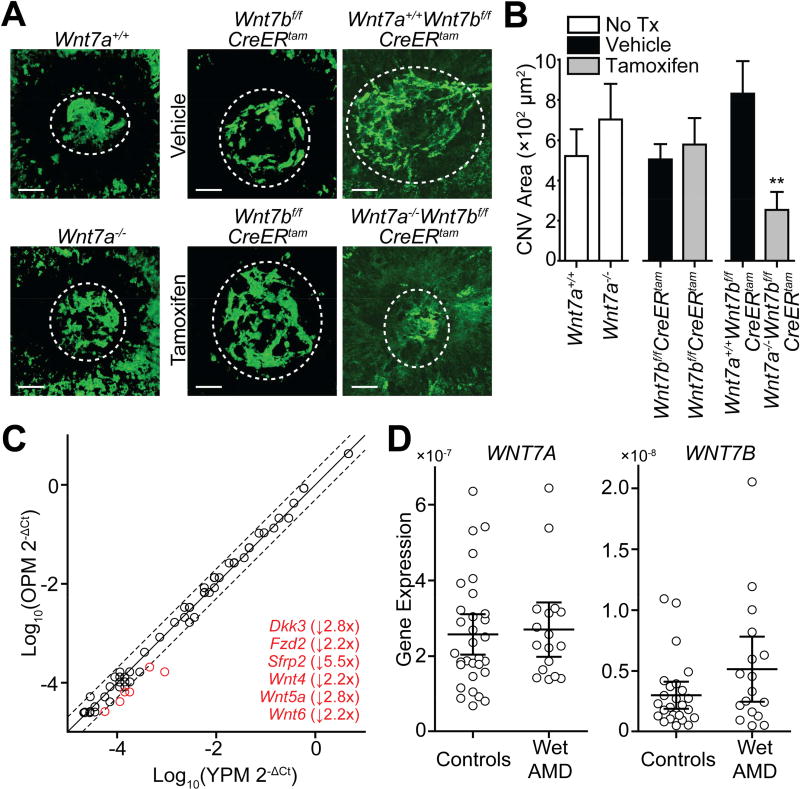
WNT7A and WNT7B promote laser injury-induced CNV in mice but appear to function independent of monocytes in wet AMD. (A–B) Double knockout mice lacking systemic Wnt7a and Wnt7b expression demonstrated significantly decreased area of laser injury-induced CNV (Mann-Whitney U tests). Representative images are shown in (A; scale bars: 50 µm). Quantifications are provided in (B); each bar represents the mean ± SEM CNV area in 9–29 eyes. (C) Aged mouse peritoneal macrophages exhibit dysregulation of 6 WNT-related genes (>2.0-fold change cutoff as indicated by dashed lines). Thioglycollate-elicited peritoneal macrophages from old (17 months old, n=3) and young (1.5 months old, n=3) female mice were pooled, and we averaged 3 measurements per gene for each age group. Each open circle represents a single gene in the array. An inset list of downregulated genes (in red) is provided. (D) Expression of WNT7A and WNT7B is unchanged in PBMCs isolated from wet AMD patients as compared to healthy controls (Mann-Whitney U tests). Each open circle represents the mean of 2–3 PCR reactions performed for each case or control. Lines indicate the means with 95% confidence intervals for each group. (**, p<0.01; OPM, old peritoneal macrophages; Tx, treatment; YPM, young peritoneal macrophages).

References

    1. Apte RS, Richter J, Herndon J, Ferguson TA. Macrophages inhibit neovascularization in a murine model of age-related macular degeneration. PLoS Med. 2006;3:e310. doi: 10.1371/journal.pmed.0030310. - DOI - PMC - PubMed
    1. Berger W, van de Pol D, Warburg M, Gal A, Bleeker-Wagemakers L, de Silva H, Meindl A, Meitinger T, Cremers F, Ropers HH. Mutations in the candidate gene for Norrie disease. Hum. Mol. Genet. 1992;1:461–465. - PubMed
    1. Chen ZY, Battinelli EM, Fielder A, Bundey S, Sims K, Breakefield XO, Craig IW. A mutation in the Norrie disease gene (NDP) associated with X-linked familial exudative vitreoretinopathy. Nat. Genet. 1993;5:180–183. doi: 10.1038/ng1093-180. - DOI - PubMed
    1. Dace DS, Apte RS. Effect of senescence on macrophage polarization and angiogenesis. Rejuvenation Res. 2008;11:177–185. doi: 10.1089/rej.2007.0614. - DOI - PubMed
    1. Daneman R, Agalliu D, Zhou L, Kuhnert F, Kuo CJ, Barres BA. Wnt/beta-catenin signaling is required for CNS, but not non-CNS, angiogenesis. Proc. Natl. Acad. Sci. U. S. A. 2009;106:641–646. doi: 10.1073/pnas.0805165106. - DOI - PMC - PubMed

Publication types