


VEGF Upregulation in Viral Infections and Its Possible Therapeutic Implications
- PMID: 29865171
- PMCID: PMC6032371
- DOI: 10.3390/ijms19061642
VEGF Upregulation in Viral Infections and Its Possible Therapeutic Implications
Abstract
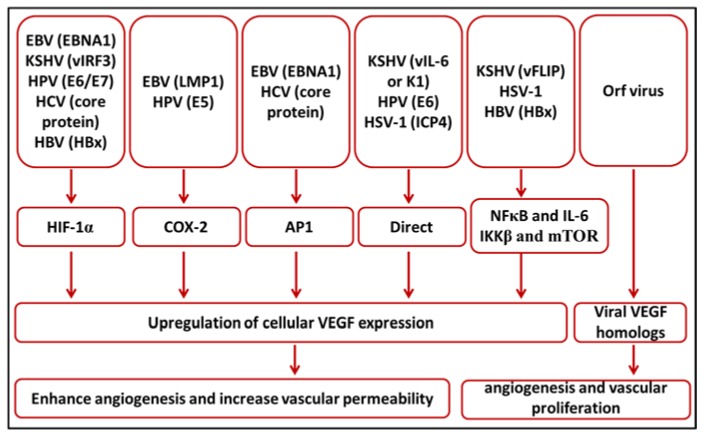
Several viruses are recognized as the direct or indirect causative agents of human tumors and other severe human diseases. Vascular endothelial growth factor (VEGF) is identified as a principal proangiogenic factor that enhances the production of new blood vessels from existing vascular network. Therefore, oncogenic viruses such as Kaposi's sarcoma herpesvirus (KSHV) and Epstein-Barr virus (EBV) and non-oncogenic viruses such as herpes simplex virus (HSV-1) and dengue virus, which lack their own angiogenic factors, rely on the recruitment of cellular genes for angiogenesis in tumor progression or disease pathogenesis. This review summarizes how human viruses exploit the cellular signaling machinery to upregulate the expression of VEGF and benefit from its physiological functions for their own pathogenesis. Understanding the interplay between viruses and VEGF upregulation will pave the way to design targeted and effective therapeutic approaches for viral oncogenesis and severe diseases.
Keywords: Dengue fever virus; Epstein-Barr virus (EBV); Hantavirus; Hepatitis B Viruses (HBV); Hepatitis C Viruses (HCV); Herpes Simplex Virus (HSV); Kaposi’s sarcoma herpesvirus (KSHV); angiogenesis; therapeutics; vascular endothelial growth factor (VEGF); vascular endothelial growth factor receptor (VEGFR).
Conflict of interest statement
The author declares no conflict of interest.
Figures
References
-
- Evans I. An Overview of VEGF-Mediated Signal Transduction. Methods Mol. Biol. 2015;1332:91–120. - PubMed
Publication types
MeSH terms
Substances
LinkOut - more resources
Full Text Sources
Other Literature Sources
Medical
