. 2018 Jun 5;19(1):434.
doi: 10.1186/s12864-018-4743-5.

Distinctive characters of Nostoc genomes in cyanolichens

Affiliations

Distinctive characters of Nostoc genomes in cyanolichens

Andrey N Gagunashvili et al. BMC Genomics. .

Abstract

Background: Cyanobacteria of the genus Nostoc are capable of forming symbioses with a wide range of organism, including a diverse assemblage of cyanolichens. Only certain lineages of Nostoc appear to be able to form a close, stable symbiosis, raising the question whether symbiotic competence is determined by specific sets of genes and functionalities.

Results: We present the complete genome sequencing, annotation and analysis of two lichen Nostoc strains. Comparison with other Nostoc genomes allowed identification of genes potentially involved in symbioses with a broad range of partners including lichen mycobionts. The presence of additional genes necessary for symbiotic competence is likely reflected in larger genome sizes of symbiotic Nostoc strains. Some of the identified genes are presumably involved in the initial recognition and establishment of the symbiotic association, while others may confer advantage to cyanobionts during cohabitation with a mycobiont in the lichen symbiosis.

Conclusions: Our study presents the first genome sequencing and genome-scale analysis of lichen-associated Nostoc strains. These data provide insight into the molecular nature of the cyanolichen symbiosis and pinpoint candidate genes for further studies aimed at deciphering the genetic mechanisms behind the symbiotic competence of Nostoc. Since many phylogenetic studies have shown that Nostoc is a polyphyletic group that includes several lineages, this work also provides an improved molecular basis for demarcation of a Nostoc clade with symbiotic competence.

Keywords: Cyanobacteria; Lichen; Nostoc; Symbiosis; Symbiotic competence.


Conflict of interest statement

Ethics approval and consent to participate

All samples were collected in Iceland with appropriate permissions and in collaboration with the Icelandic Institute of Natural History.

Competing interests

The authors declare that they have no competing interests.

Publisher’s Note

Springer Nature remains neutral with regard to jurisdictional claims in published maps and institutional affiliations.

Figures
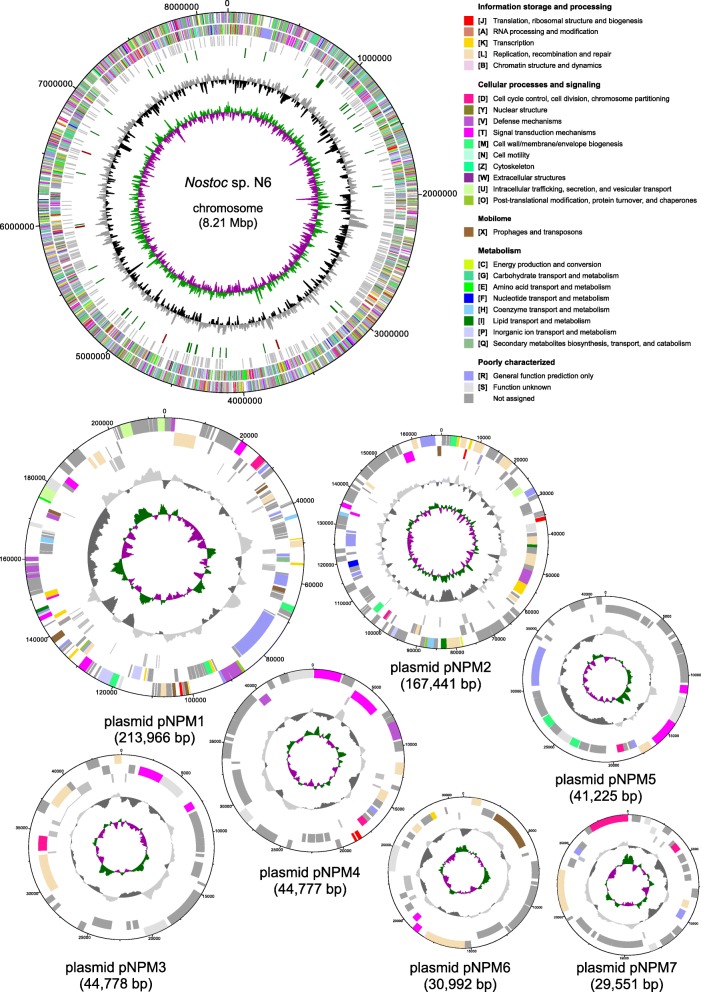
Fig. 1
Fig. 1
Chromosome and seven circular plasmids of the Nostoc sp. N6 genome. The outermost and second circles indicate genes in forward and reverse orientation color-coded by their COG categories. The third circles show pseudogenes. The fourth circle of the chromosome shows the rRNA genes (brown) and tRNA genes (green). The two innermost circles show GC content in gray and black and the GC skew in green (+) and purple (–)
Fig. 2
Fig. 2
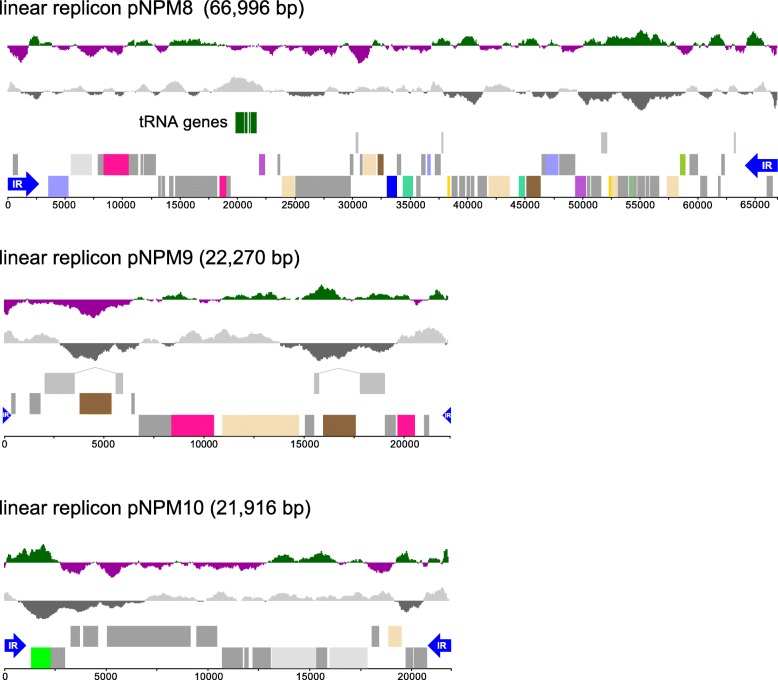
Linear replicons of Nostoc sp. N6. The lowermost and second lines indicate genes in forward and reverse orientation color-coded by their COG categories (see Figure 1). The third lines show pseudogenes. The two uppermost lines show GC content in gray and black and the GC skew in green (+) and purple (–). Blue arrows represent terminal inverted repeats (IR)
Fig. 3
Fig. 3
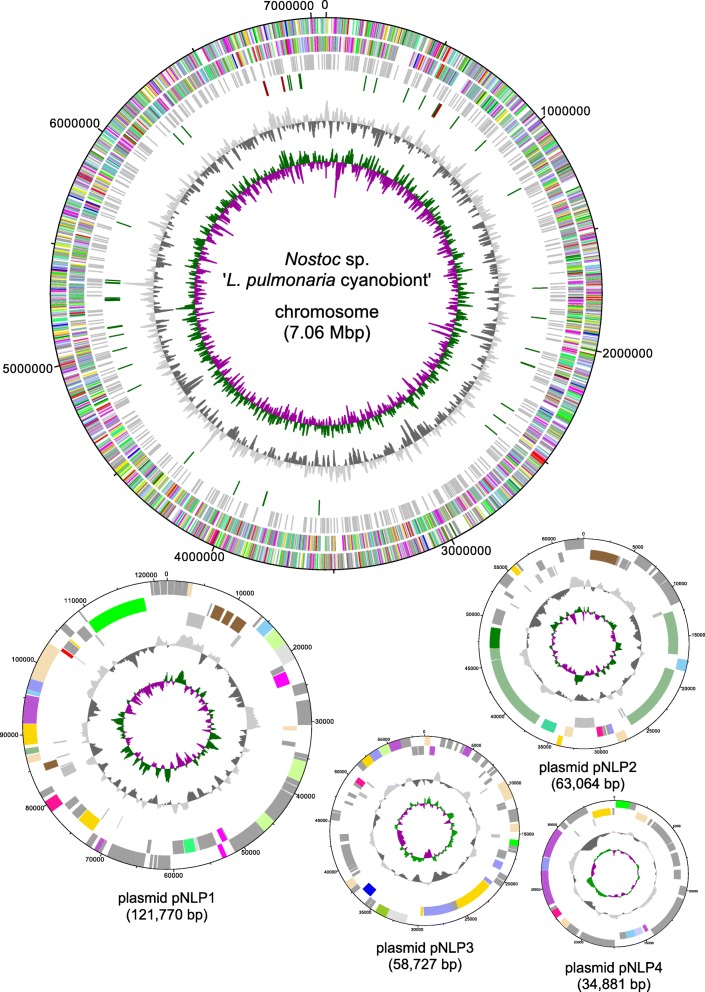
Chromosome and four plasmids of the Nostoc sp. ‘L. pulmonaria cyanobiont’ genome. The outermost and second circles indicate genes in forward and reverse orientation color-coded by their COG categories. The third circles show pseudogenes. The fourth circle of the chromosome shows the rRNA genes (brown) and tRNA genes (green). The two innermost circles show GC content in gray and black and the GC skew in green (+) and purple (–)
Fig. 4
Fig. 4
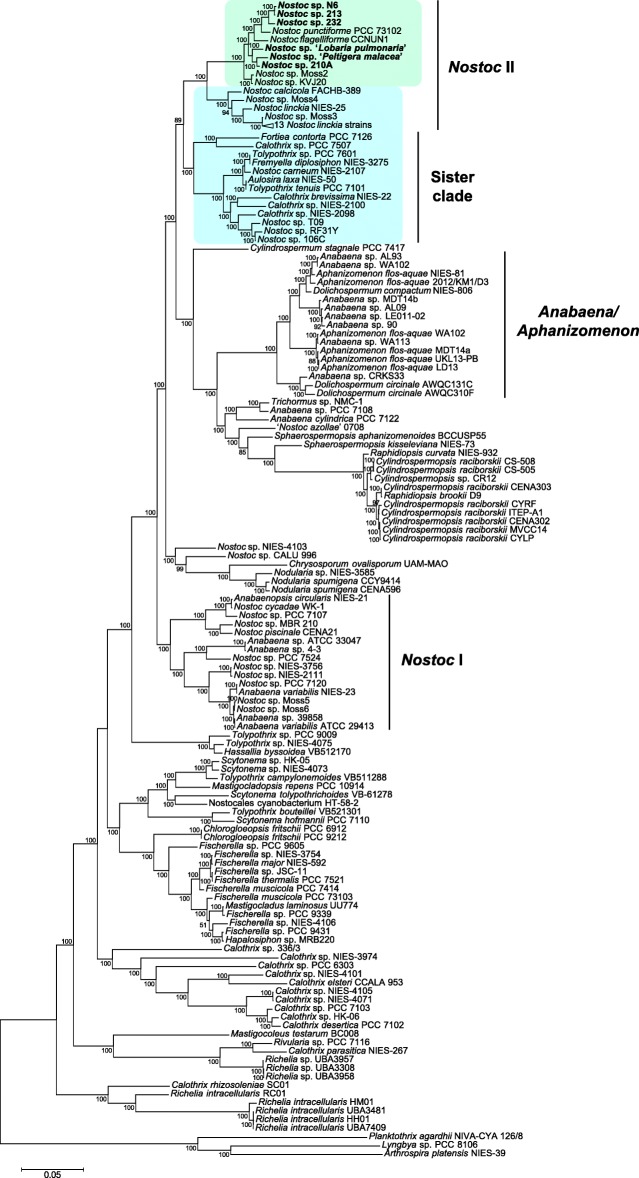
Maximum liklelihood phylogenomic tree of Nostocales strains based on 31 single-copy core bacterial phylogenetic markers [135]. Arthrospira platensis NIES-39, Lyngbya sp. PCC 8106 and Planktothrix agardhii NIVA-CYA 126/8 from the order Oscillatoriales were used as the outgroup. Numbers at branch nodes are bootstrap percentages based on 100 replicates (only values >50 are shown). Scale bar indicates 5% sequence divergence. Selected clades are named according to [29]. Predominantly symbiotic clade is highlighted with green, paraphyletic group is highlighted with blue. Lichen-associated strains are shown in bold
Fig. 5
Fig. 5
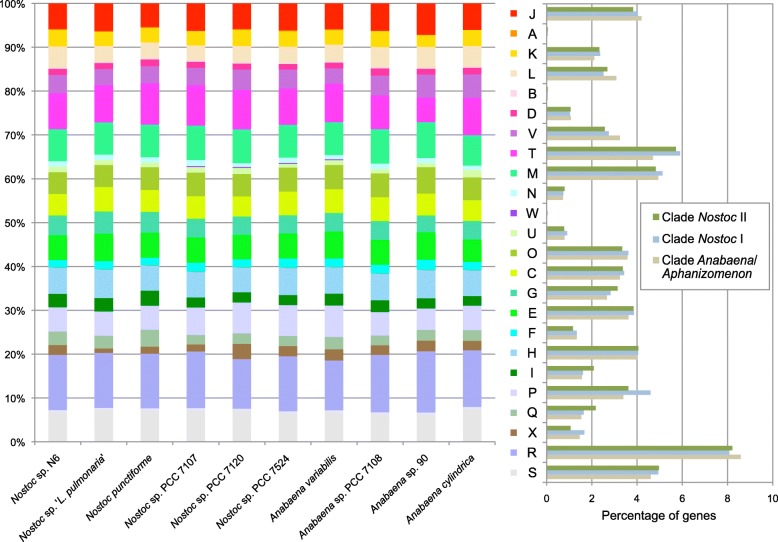
COG category distribution of the proteins encoded in the genomes of selected Nostoc and Anabaena strains. The ordinate axes indicate the percentage of genes in each COG functional category relative to the genes of all COG categories (left) and percentage COG category distribution among different clades (right)
Fig. 6
Fig. 6
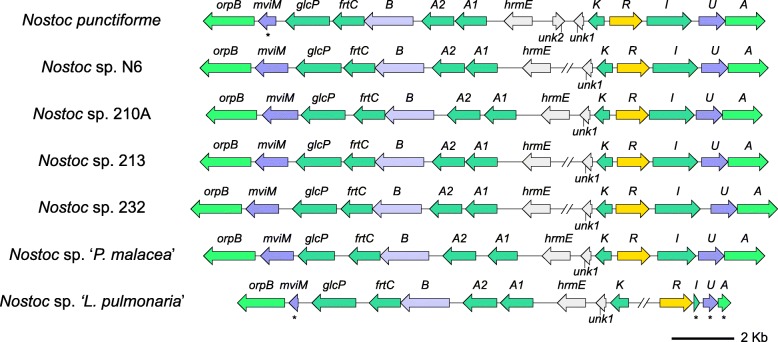
Hormogonium regulating and sugar transporter loci in symbiotic Nostoc strains. Pseudogenes are denoted with an asterisk. orpB, carbohydrate-selective porin; mviM, inositol-2-dehydrogenase; glpC, glucose permease; frtA1A2BC, ABC-type fructose transporters; hrmE, inositol oxygenase; hrmK, gluconate kinase; hrmR, LacI family transcriptional regulator; hrmI, glucuronate isomerase; hrmU, D-mannonate oxidoreductase; hrmA and unk, unknown. A broken genome line indicates 2 separate loci
Fig. 7
Fig. 7
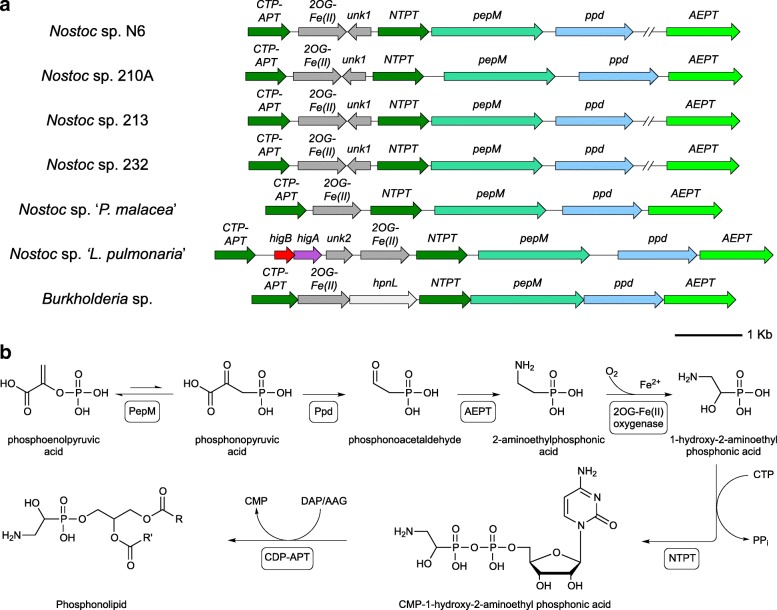
Phosphonate biosynthetic gene clusters of lichen cyanobionts (a) and proposed encoded biosynthetic pathway (b) (adapted from [75]). A homologous gene cluster from Burkholderia is shown for comparison. CTP-APT, CDP-alcohol phosphatidyltransferase; OG-Fe(II), 2-oxoglutarate non-heme Fe(II) dependent oxidase; unk, conserved hypothetical proteins; NTPT, NTP transferase; pepM, phosphoenolpyruvate phosphomutase; ppd, phosphonopyruvate decarboxylase; AEPT, 2-aminoethylphosphonate aminotransferase; hpnL, putative membrane protein; higBA, toxin-antitoxin module. A broken genome line indicates separate loci

References

    1. Nash TH. Lichen Biology. Cambridge: Cambridge University Press; 2008.
    1. Rikkinen J. Cyanolichens: an evolutionary overview. In: Rai AK, editor. Cyanobacteria in Symbiosis. New York: Springer; 2002.
    1. Gargas A, DePriest PT, Grube M, Tehler A. Multiple origins of lichen symbioses in fungi suggested by ssu rdna phylogeny. Science. 1995;268(5216):1492–5. doi: 10.1126/science.7770775. - DOI - PubMed
    1. Aptroot A. Aspects of the integration of the taxonomy of lichenized and non-lichenized pyrenocarpous ascomycetes. The Lichenologist. 1998;30(4-5):501–14. doi: 10.1006/lich.1998.0151. - DOI
    1. Lutzoni F, Pagel M, Reeb V. Major fungal lineages are derived from lichen symbiotic ancestors. Nature. 2001;411(6840):937–40. doi: 10.1038/35082053. - DOI - PubMed

Substances

LinkOut - more resources