. 2018 May 17:8:160.
doi: 10.3389/fcimb.2018.00160. eCollection 2018.

Group A Streptococcus M1T1 Intracellular Infection of Primary Tonsil Epithelial Cells Dampens Levels of Secreted IL-8 Through the Action of SpyCEP

Affiliations

Group A Streptococcus M1T1 Intracellular Infection of Primary Tonsil Epithelial Cells Dampens Levels of Secreted IL-8 Through the Action of SpyCEP

Amelia T Soderholm et al. Front Cell Infect Microbiol. .

Abstract

Streptococcus pyogenes (Group A Streptococcus; GAS) commonly causes pharyngitis in children and adults, with severe invasive disease and immune sequelae being an infrequent consequence. The ability of GAS to invade the host and establish infection likely involves subversion of host immune defenses. However, the signaling pathways and innate immune responses of epithelial cells to GAS are not well-understood. In this study, we utilized RNAseq to characterize the inflammatory responses of primary human tonsil epithelial (TEpi) cells to infection with the laboratory-adapted M6 strain JRS4 and the M1T1 clinical isolate 5448. Both strains induced the expression of genes encoding a wide range of inflammatory mediators, including IL-8. Pathway analysis revealed differentially expressed genes between mock and JRS4- or 5448-infected TEpi cells were enriched in transcription factor networks that regulate IL-8 expression, such as AP-1, ATF-2, and NFAT. While JRS4 infection resulted in high levels of secreted IL-8, 5448 infection did not, suggesting that 5448 may post-transcriptionally dampen IL-8 production. Infection with 5448ΔcepA, an isogenic mutant lacking the IL-8 protease SpyCEP, resulted in IL-8 secretion levels comparable to JRS4 infection. Complementation of 5448ΔcepA and JRS4 with a plasmid encoding 5448-derived SpyCEP significantly reduced IL-8 secretion by TEpi cells. Our results suggest that intracellular infection with the pathogenic GAS M1T1 clone induces a strong pro-inflammatory response in primary tonsil epithelial cells, but modulates this host response by selectively degrading the neutrophil-recruiting chemokine IL-8 to benefit infection.

Keywords: IL-8 protease; PrtS; ScpC; Streptococcus pyogenes; intracellular infection.


Figures
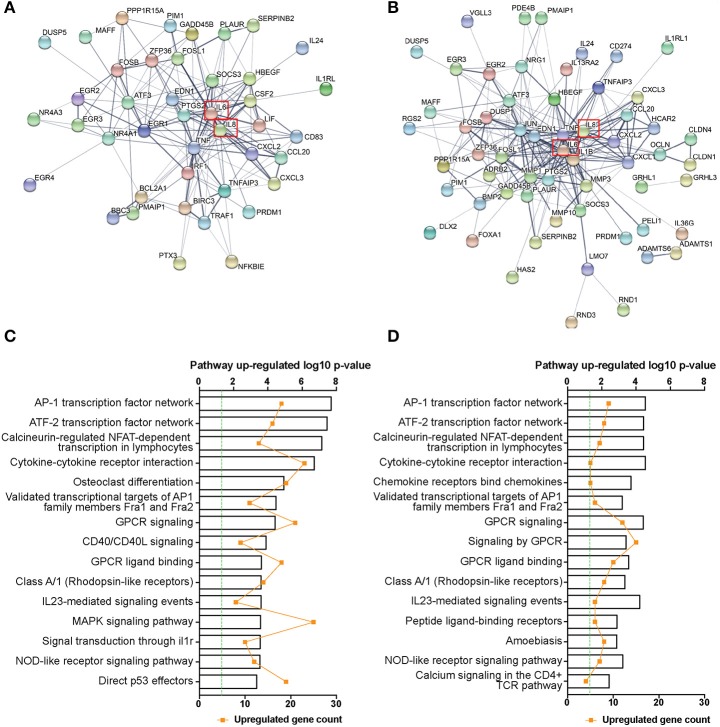
Figure 1
Figure 1
RNAseq transcriptome network and pathway enrichment of 5448- and JRS4 GAS-infected TEpi cells in comparison to mock cells. Protein-protein interaction network of the top 100 differentially expressed genes (at an adjusted P < 0.05) for (A) 5448-infected TEpi cells in comparison to mock TEpi cells and (B) JRS4-infected TEpi cells in comparison to mock TEpi cells, generated using STRINGdb (http://string-db.org/). IL-8 is highlighted (red box). Network edges show the confidence of interactions, where the line thickness indicates the strength of data support. Active interaction sources include textmining, experiments, databases, co-expression, neighborhood, gene fusion and co-occurrence. Minimum required interaction score of medium confidence (0.400). Non-protein coding genes and disconnected nodes are not shown. Node color is arbitrary. (C) Pathway over-representation analysis of all differentially expressed genes (adjusted P < 0.05, Log2FC >1 or <-1) for 5448 infected TEpi cells in comparison to mock cells and (D) JRS4-infected TEpi cells in comparison to mock cells was performed using Innatedb.com. Fold-change cutoff (±) 1.0 and P-value cutoff 0.05. Hypergeometric analysis algorithm was used, with Benjamini–Hochberg correction method. Top 15 up-regulated pathways shown. Green line indicates threshold for significance. Metadata from analysis results shown in Tables S1, S2.
Figure 2
Figure 2
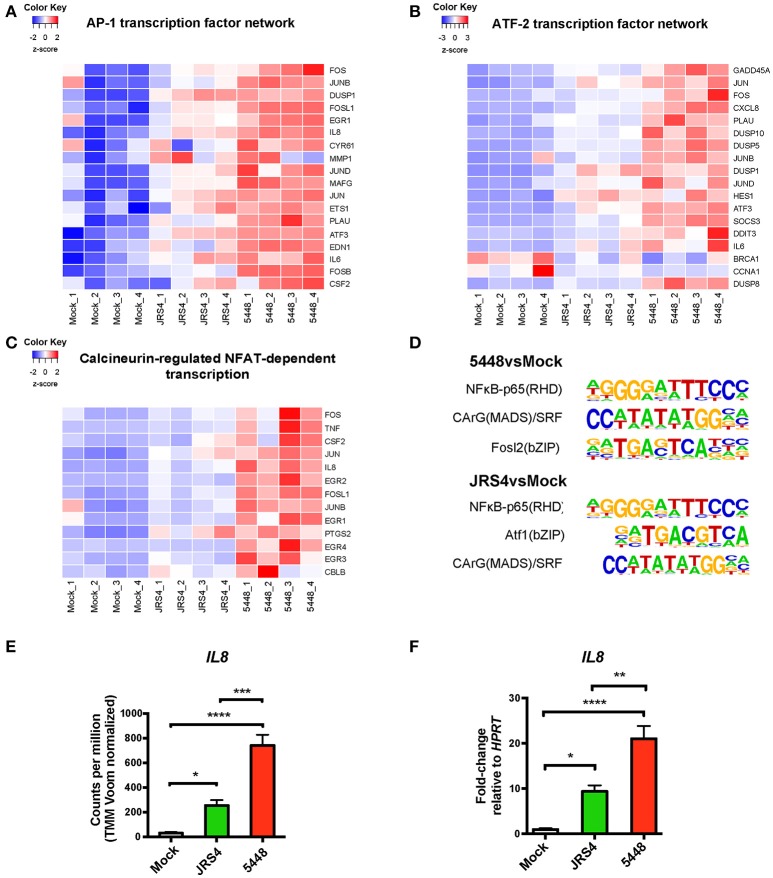
Regulated IL-8 expression in 5448 and JRS4 GAS-infected TEpi cells in comparison to mock cells. Heat maps of differentially expressed genes from top pathways enriched by Innatedb.com that induce IL-8 gene transcription. (A) AP1 transcription factor network, (B) ATF-2 transcription factor network, and (C) Calcineurin-regulated NFAT-dependent transcription. (D) Known transcription factor motifs enriched from top 400 differentially expressed genes for 5448-infected TEpi cells and JRS4-infected TEpi cells using HOMER motif analysis. 5448vsmock: NF-κB-p65 Rel homology domain (RHD) target sequences with motif = 42. CArG(MADS-domain)/Serum response factor (SRF) target sequences with motif = 21. Fosl2/basic Leucine Zipper (bZIP) target sequences with motif = 21. JRS4vsmock: NF-κB-p65(RHD) target sequences with motif = 38. Atf1/(bZIP) target sequences with motif = 58. CArG (MADS) target sequences with motif = 19. (E) RNAseq IL8 read counts. (F) qPCR of IL-8 mRNA levels, normalized to HPRT. Data in (E,F) (mean ± s.e.m.) are combined from at least three independent experiments performed in triplicate and analyzed by one-way ANOVA with Tukey's post-test. *P < 0.05; **P < 0.01; ***P < 0.001; ****P < 0.0001.
Figure 3
Figure 3
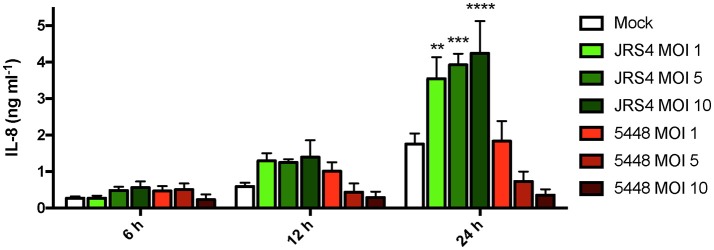
5448-infected TEpi cells show reduced levels of IL-8 detected. IL-8 produced by TEpi cells intracellularly infected with GAS strains 5448 and JRS4, as measured by ELISA. Data are plotted as the mean ± s.e.m. and are combined from three independent experiments performed in triplicate and analyzed by two-way ANOVA with Tukey's post-test. Significance is shown relative to mock at each timepoint. **P < 0.01; ***P < 0.001; ****P < 0.0001.
Figure 4
Figure 4
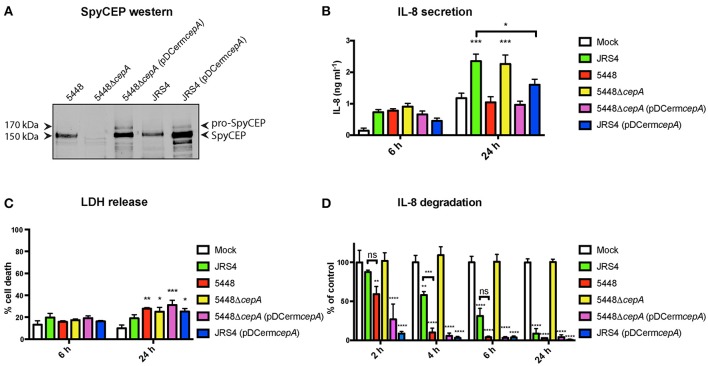
SpyCEP expression by 5448 results in reduced IL-8 secretion by TEpi cells during GAS intracellular infection. (A) Western blot analysis of cell wall extracts for detection of SpyCEP. Equivalent protein concentrations were loaded for 5448, JRS4, and 5448ΔcepA (100 μg), whilst 5 μg was loaded for 5448ΔcepA (pDCermcepA) and JRS4 (pDCermcepA). (B) IL-8 present in supernatants due to secretion by TEpi cells following GAS intracellular infection at 6 and 24 h post-infection, measured by ELISA. (C) Cell death measured by percentage of LDH released from TEpi cells at 6 and 24 h post-infection. (D) GAS strains were incubated with recombinant IL-8 at 37°C. SpyCEP activity correlates with IL-8 degradation as assessed by ELISA. For (B–D), data are plotted as the mean ± s.e.m. and represent three independent experiments performed in triplicate and analyzed by two-way ANOVA with Tukey's post-test. Significance shown is relative to mock at each timepoint, unless otherwise indicated. *P < 0.05; **P < 0.01; ***P < 0.001; ****P < 0.0001.

References

    1. Agren K., Brauner A., Andersson J. (1998). Haemophilus influenzae and Streptococcus pyogenes group A challenge induce a Th1 type of cytokine response in cells obtained from tonsillar hypertrophy and recurrent tonsillitis. ORL J. Otorhinolaryngol. Relat. Spec. 60, 35–41. 10.1159/000027560 - DOI - PubMed
    1. Andreoni F., Ogawa T., Ogawa M., Madon J., Uchiyama S., Schuepbach R. A., et al. . (2014). The IL-8 protease SpyCEP is detrimental for Group A Streptococcus host-cells interaction and biofilm formation. Front. Microbiol. 5:339. 10.3389/fmicb.2014.00339 - DOI - PMC - PubMed
    1. Barnett T. C., Liebl D., Seymour L. M., Gillen C. M., Lim J. Y., Larock C. N., et al. . (2013). The globally disseminated M1T1 clone of group A Streptococcus evades autophagy for intracellular replication. Cell Host Microbe 14, 675–682. 10.1016/j.chom.2013.11.003 - DOI - PMC - PubMed
    1. Bell S., Howard A., Wilson J. A., Abbot E. L., Smith W. D., Townes C. L., et al. (2012). Streptococcus pyogenes infection of tonsil explants is associated with a human beta-defensin 1 response from control but not recurrent acute tonsillitis patients. Mol. Oral Microbiol. 27, 160–171. 10.1111/j.2041-1014.2012.640.x - DOI - PubMed
    1. Bestebroer J., De Haas C. J., Van Strijp J. A. (2010). How microorganisms avoid phagocyte attraction. FEMS Microbiol. Rev. 34, 395–414. 10.1111/j.1574-6976.2009.00202.x - DOI - PubMed

Publication types

MeSH terms