Review
. 2018 May 15:6:140.
doi: 10.3389/fped.2018.00140. eCollection 2018.

Echocardiographic Evaluation of Transitional Circulation for the Neonatologists

Affiliations
Review

Echocardiographic Evaluation of Transitional Circulation for the Neonatologists

Yogen Singh et al. Front Pediatr. .

Erratum in

Abstract

The hemodynamic changes during the first few breaths after birth are probably the most significant and drastic adaptation in the human life. These changes are critical for a smooth transition of fetal to neonatal circulation. With the cord clamping, lungs take over as the source of oxygenation from placenta. A smooth transition of circulation is a complex mechanism and primarily depends upon the drop in pulmonary vascular resistance (PVR) and increase in systemic vascular resistance (SVR). Understanding the normal transition physiology and the adverse adaptation is of utmost importance to the clinicians looking after neonates. It may have a significant influence on the presentation of congenital heart defects (CHDs) in infants. Bedside echocardiography may help in understanding the transition physiology, especially the hemodynamic changes and shunting across ductus arteriosus and foramen ovale, and it may play an important role in making judicious clinical decisions based upon the altered physiology.

Keywords: PDA; PPHN; adverse adaptation of transitional circulation; fetal to neonatal transition; hemodynamic assessment; patent ductus arteriosus; persistent pulmonary hypertension; transitional circulation.


Figures

Figure 1
Figure 1
Schematic diagram showing events during transition of circulation: fetal to neonatal circulation. PVR, pulmonary vascular resistance; PBF, pulmonary blood flow; FO, foramen ovale; DA, ductus arteriosus; PaO2, arterial partial pressure of oxygen; L, left; R, right; PG, prostaglandin.
Figure 2
Figure 2
Pathophysiology of persistent pulmonary hypertension of newborn (PPHN). Acute pulmonary hypertension is the commonest adverse adaptation during cardiovascular transition after birth. PVR, pulmonary vascular resistance; PBF, pulmonary blood flow; MAS, meconium aspiration syndrome; RDS, respiratory distress syndrome; CDH, congenital diaphragmatic hernia.
Figure 3
Figure 3
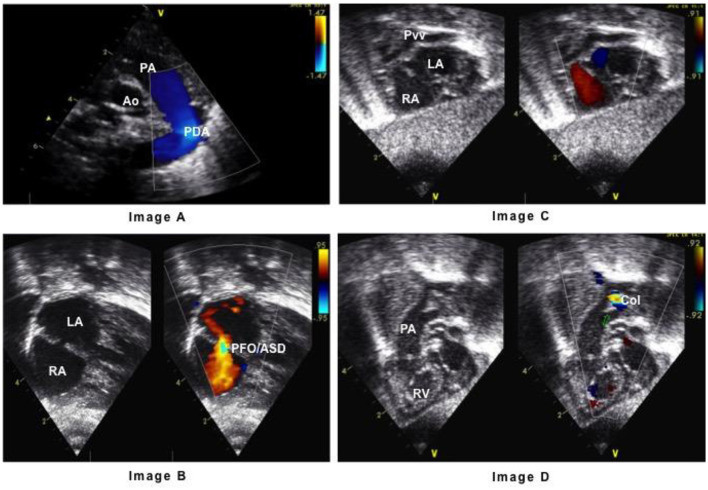
Echocardiography parasternal short axis view in systemic duct-dependent circulation with right-to-let shunt across the patent ductus arteriosus (Image A). Echocardiography subcostal view in transposition of the great arteries (TGA) with left-to-right interatrial mixing between the pulmonary and systemic circulation (Image B). Echocardiography subcostal view in total anomalous pulmonary venous return (TAPVR) with right-to-left interatrial mixing of the pulmonary and systemic circulation (Image C). The level of obstruction of pulmonary venous collector is usually at the branch pulmonary arteries (arrow, Image D). Ao, aorte; ASD, atrial septal defect; Col, pulmonary venous collector; LA, left atrium; PA, pulmonary artery; PFO, patent foramen ovale; PDA, patent ductus arteriosus; Pvv, pulmonary veins; RA, right atrium.
Figure 4
Figure 4
(A) Echocardiographic assessment during transitional circulation. Image “a” shows mild right ventricular dominance (physiological); Image “b” shows bidirectional shunt across foramen ovale; Image “c” shows left to right shunt across ductus arteriosus; and Image “d” shows right to left shunt across ductus arteriosus. Image “c” and image “d” are still frames from bidirectional shunt during early transitional circulation (which may be normal as compared to adverse adaptation in Figure 1C). (B) Echocardiographic assessment during adverse adaptation of transitional circulation in a preterm infant with sepsis at 8 h of age. Image “a” shows dilatation of right side of the heart in apical 4-chamber view with inter-atrial septum bowed toward left atrium (LA); Image “b” shows pure right to left shunt across ductus arteriosus (DA) because of high pulmonary vascular resistance (PVR) and low systemic vascular resistance (SVR); Image “c” shows small LA from decreased pulmonary return (decreased pulmonary blood flow due to high PVR and right to left shunt across DA; and Image “d” shows decreased left ventricle cardiac output (from decreased LV preload and impaired LV function).
Figure 5
Figure 5
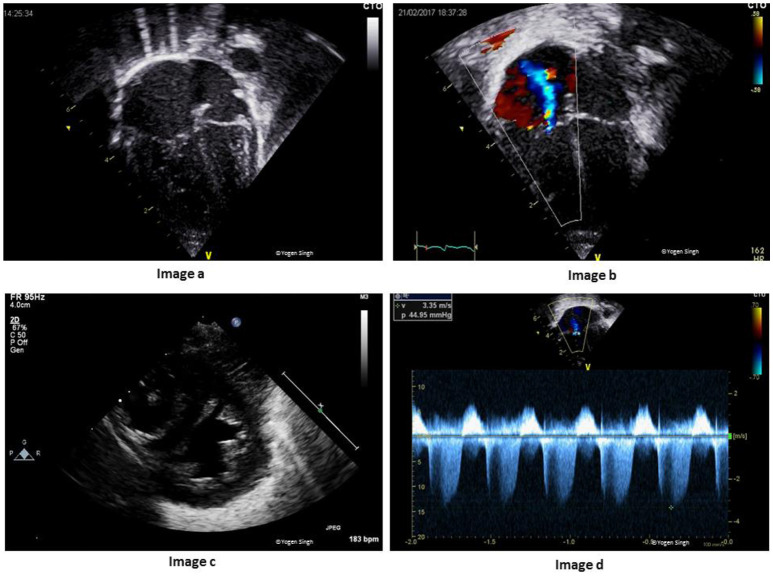
Echocardiographic assessment of pulmonary hypertension in adverse adaptation of transitional circulation. Image “a” shows right ventricular hypertrophy and mild dilatation in apical 4-chamber view; Image “b” shows tricuspid jet on color flow mapping; Image “c” shows hypertrophy of right ventricular and bowing of interventricular septum in parasternal short axis view; and Image “d” shows Doppler assessment of tricuspid regurgitation (TR) to assesses pressure gradient between right ventricle and right atrium. Pulmonary artery systolic pressure can be estimated by adding right atrial pressure to the pressure gradient measured by TR velocity.
Figure 6
Figure 6
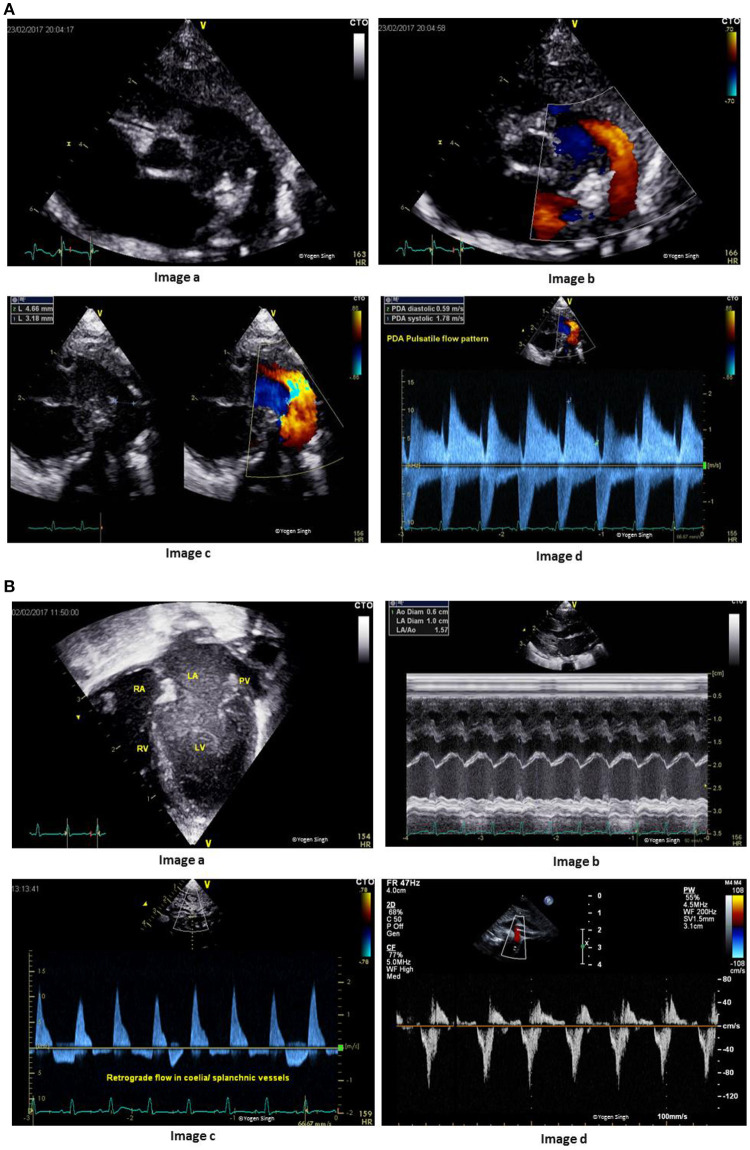
(A) Assessment of patent ductus arteriosus (PDA). Image “a” shows PDA on 2D imaging; Image “b” shows PDA on color flow mapping; Image “c” assessment of PDA size on 2D and color flow mapping; and Image “d” shows pulsatile flow pattern on Doppler assessment. (B) Hemodynamic assessment of PDA for assessing pulmonary hyperperfusion and systemic hypoperfusion. Image “a” shows volume overloading left side of the heart in apical 4-chamber view; Image “b” shows measurement of left atrium to aorta ratio (LA:Ao ratio); Image “c” shows retrograde flow in splanchnic vessels; and Image “d” retrograde flow in descending aorta (“steal phenomenon”) in a hemodynamically significant large PDA.

References

    1. Hooper SB, Harding R. Role of aeration in the physiological adaptation of the lung to air-breathing at birth. Curr Respir Med Rev. (2005) 1:185–95. 10.2174/1573398054023037 - DOI
    1. Rudolph AM. Fetal and neonatal pulmonary circulation. Ann Rev Physiol. (1979) 41:383–95. - PubMed
    1. Gao Y, Raj JU. Regulation of the pulmonary circulation in the fetus and newborn. Physiol Rev. (2010) 90:1291–335. 10.1152/physrev.00032.2009 - DOI - PubMed
    1. Kiserud T. Physiology of the fetal circulation. Semin Fetal Neonatal Med. (2005) 10:493–503. 10.1016/j.siny.2005.08.007 - DOI - PubMed
    1. Rychik J. Fetal cardiovascular physiology. Pediatr Cardiol. (2007) 25:201–9. 10.1007/s00246-003-0586-0 - DOI - PubMed