Penalized PET Reconstruction Using Deep Learning Prior and Local Linear Fitting
- PMID: 29870375
- PMCID: PMC6375088
- DOI: 10.1109/TMI.2018.2832613
Penalized PET Reconstruction Using Deep Learning Prior and Local Linear Fitting
Abstract
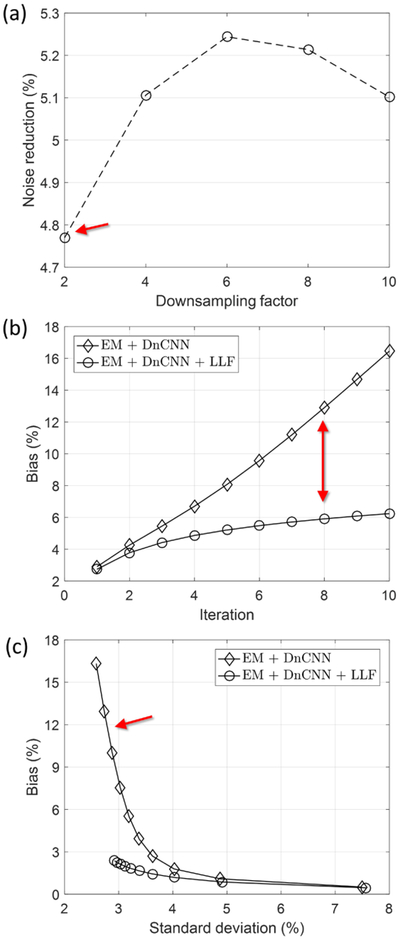
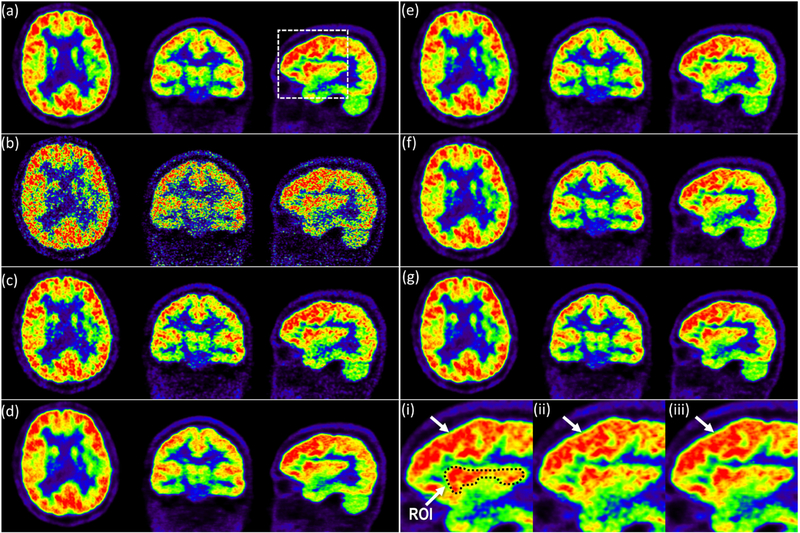
Motivated by the great potential of deep learning in medical imaging, we propose an iterative positron emission tomography reconstruction framework using a deep learning-based prior. We utilized the denoising convolutional neural network (DnCNN) method and trained the network using full-dose images as the ground truth and low dose images reconstructed from downsampled data by Poisson thinning as input. Since most published deep networks are trained at a predetermined noise level, the noise level disparity of training and testing data is a major problem for their applicability as a generalized prior. In particular, the noise level significantly changes in each iteration, which can potentially degrade the overall performance of iterative reconstruction. Due to insufficient existing studies, we conducted simulations and evaluated the degradation of performance at various noise conditions. Our findings indicated that DnCNN produces additional bias induced by the disparity of noise levels. To address this issue, we propose a local linear fitting function incorporated with the DnCNN prior to improve the image quality by preventing unwanted bias. We demonstrate that the resultant method is robust against noise level disparities despite the network being trained at a predetermined noise level. By means of bias and standard deviation studies via both simulations and clinical experiments, we show that the proposed method outperforms conventional methods based on total variation and non-local means penalties. We thereby confirm that the proposed method improves the reconstruction result both quantitatively and qualitatively.
Figures





References
-
- Wang G, “A perspective on deep imaging,” IEEE Access, vol. 4, pp. 8914–8924, 2016.
-
- Kang E, Min J, and Ye JC, “A deep convolutional neural network using directional wavelets for low-dose X-ray CT reconstruction,” Medical Physics, vol. 44, no. 10, 2017. - PubMed
-
- Yang Q, Yan P, Kalra MK, and Wang G, “CT Image Denoising with Perceptive Deep Neural Networks,” arXiv preprint arXiv:1702.07019, 2017.
-
- Wu D, Kim K, Fakhri GE, and Li Q, “A Cascaded Convolutional Nerual Network for X-ray Low-dose CT Image Denoising,” arXiv preprint arXiv:1705.04267, 2017.
-
- McCollough C, “TU-FG-207A-04: Overview of the Low Dose CT Grand Challenge (http://www.aapm.org/GrandChallenge/LowDoseCT/),” Medical Physics, vol. 43, no. 6, pp. 3759–3760, 2016.
Publication types
MeSH terms
Grants and funding
LinkOut - more resources
Full Text Sources
Other Literature Sources