Review
. 2018 Oct 26;430(22):4547-4556.
doi: 10.1016/j.jmb.2018.05.040. Epub 2018 Jun 2.

Protein Clusters in Phosphotyrosine Signal Transduction

Affiliations
Review

Protein Clusters in Phosphotyrosine Signal Transduction

Bruce J Mayer et al. J Mol Biol. .

Abstract

Signal transduction systems based on tyrosine phosphorylation are central to cell-cell communication in multicellular organisms. Typically, in such a system, the signal is initiated by activating tyrosine kinases associated with transmembrane receptors, which induces tyrosine phosphorylation of the receptor and/or associated proteins. The phosphorylated tyrosines then serve as docking sites for the binding of various downstream effector proteins. It has long been observed that the cooperative association of the receptors and effectors produces higher-order protein assemblies (clusters) following signal activation in virtually all phosphotyrosine signal transduction systems. However, mechanistic studies on how such clustering processes affect signal transduction outcomes have only emerged recently. Here we review current progress in decoding the biophysical consequences of clustering on the behavior of the system, and how clustering affects how these receptors process information.

Keywords: multi-protein complex; signal transduction.


Figures

Fig. 1
Fig. 1
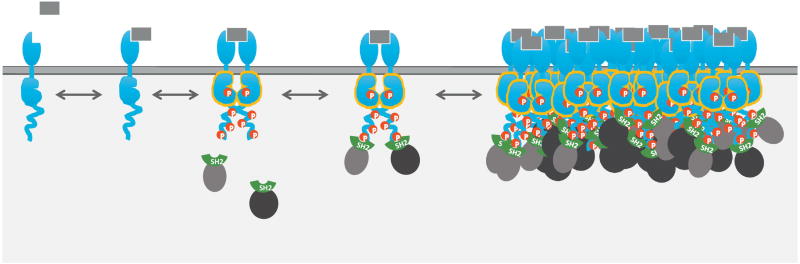
Signaling by receptor tyrosine kinases. As depicted from the left, binding of ligand (gray rectangle) to the extracellular domain of the receptor stabilizes receptor dimers. The intracellular catalytic domains then phosphorylate their dimer partner, stabilizing the active conformation and promoting phosphorylation of additional sites on the receptor. These phosphosites serve to recruit SH2 domain-containing effectors from the cytosol. Activated receptors typically cluster together into dynamic higher-order assemblies (right). While signaling clusters may be relatively stable, individual phosphorylation and binding events are highly transient, lasting only a few seconds
Fig. 2
Fig. 2
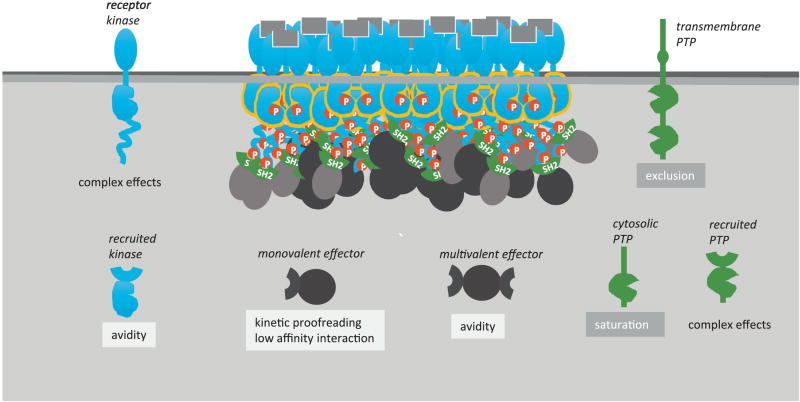
Points of regulation by clustering discussed in this review. Light color background suggested an upregulation of the underlying molecular interactions (binding, enzymatic activity etc.); dark color suggests a downregulation.
Fig 3
Fig 3
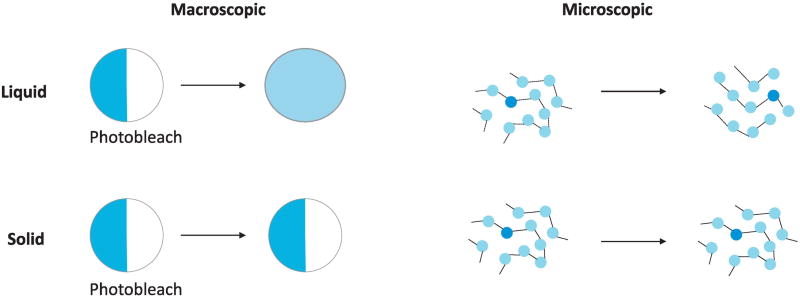
Experimental tests to distinguish protein liquid droplet from gel can be based on either macroscopic properties (left) or microscopic properties (right). Left: FRAP experiment with partial photobleaching of the droplet can test whether the materials within the droplet can flow via diffusion (liquid) or not (gel). Right: In liquid, non-covalent bonds (dashed lines) between protein molecules (represented by the spheres) are broken and reformed frequently, allowing individual molecules to move and rebind to different partners. This type of molecular dynamics is not observed in a gel, where binding is stable (solid lines).
Fig 4
Fig 4
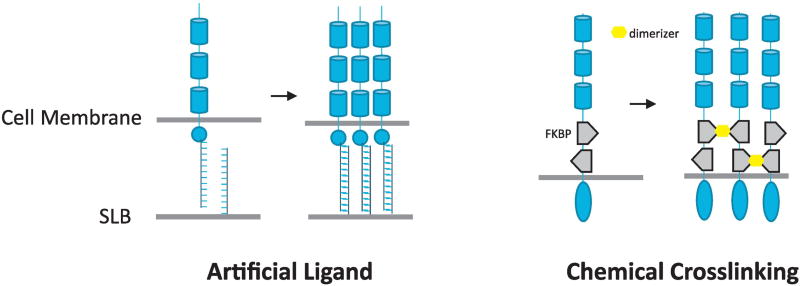
Various protein engineering strategies have been used in the literature to exert experimental control of receptor oligmerization states. (Left) DNA-based artificial ligand allows fine tuning of receptor-ligand interaction between a cell and supported lipid bilayer (SLB). (Right) FKBP-based chemical dimerization system has been used to define the cross-linking topology of artificial receptors.
Fig. 5
Fig. 5
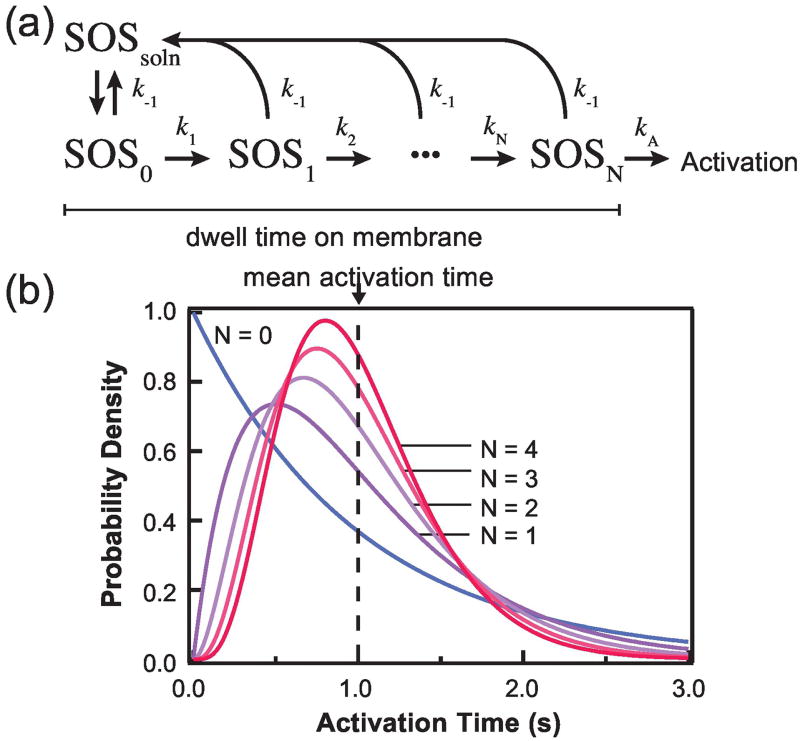
Activation mechanism dictates the waiting time distribution of the activation step in signal transduction (adopted from (Huang et al 2016)). In the example of SOS activation (A), the distribution (B) is exponential if the activation is a single-step reaction (N=0); otherwise, in the more common case of complex, multi-step activation, the distribution has a non-zero mode (N>0). The latter cases would exhibit a kinetic proofreading effect.

References

    1. Lim WA, Pawson T. Phosphotyrosine signaling: evolving a new cellular communication system. Cell. 2010;142:661–667. doi: 10.1016/j.cell.2010.08.023. - DOI - PMC - PubMed
    1. Pawson T. Protein modules and signalling networks. Nature. 1995;373:573–580. doi: 10.1038/373573a0. - DOI - PubMed
    1. Schlessinger J, Lemmon MA. SH2 and PTB domains in tyrosine kinase signaling. Sci. STKE Signal Transduct. Knowl. Environ. 2003;2003:RE12. doi: 10.1126/stke.2003.191.re12. - DOI - PubMed
    1. Nolen B, Taylor S, Ghosh G. Regulation of protein kinases; controlling activity through activation segment conformation. Mol. Cell. 2004;15:661–675. doi: 10.1016/j.molcel.2004.08.024. - DOI - PubMed
    1. Lemmon MA, Schlessinger J. Cell signaling by receptor tyrosine kinases. Cell. 2010;141:1117–1134. doi: 10.1016/j.cell.2010.06.011. - DOI - PMC - PubMed

LinkOut - more resources