


Suubi4Her: a study protocol to examine the impact and cost associated with a combination intervention to prevent HIV risk behavior and improve mental health functioning among adolescent girls in Uganda
- PMID: 29871619
- PMCID: PMC5989412
- DOI: 10.1186/s12889-018-5604-5
Suubi4Her: a study protocol to examine the impact and cost associated with a combination intervention to prevent HIV risk behavior and improve mental health functioning among adolescent girls in Uganda
Abstract
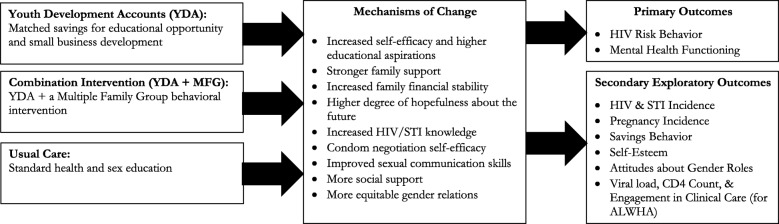
Background: Asset-based economic empowerment interventions, which take an integrated approach to building human, social, and economic capital, have shown promise in their ability to reduce HIV risk for young people, including adolescent girls, in sub-Saharan Africa. Similarly, community and family strengthening interventions have proven beneficial in addressing mental health and behavioral challenges of adolescents transitioning to adulthood. Yet, few programs aimed at addressing sexual risk have applied combination interventions to address economic stability and mental health within the traditional framework of health education and HIV counseling/testing. This paper describes a study protocol for a 5-year, NIMH-funded, cluster randomized-controlled trial to evaluate a combination intervention aimed at reducing HIV risk among adolescent girls in Uganda. The intervention, titled Suubi4Her, combines savings-led economic empowerment through youth development accounts (YDA) with an innovative family strengthening component delivered via Multiple Family Groups (MFG).
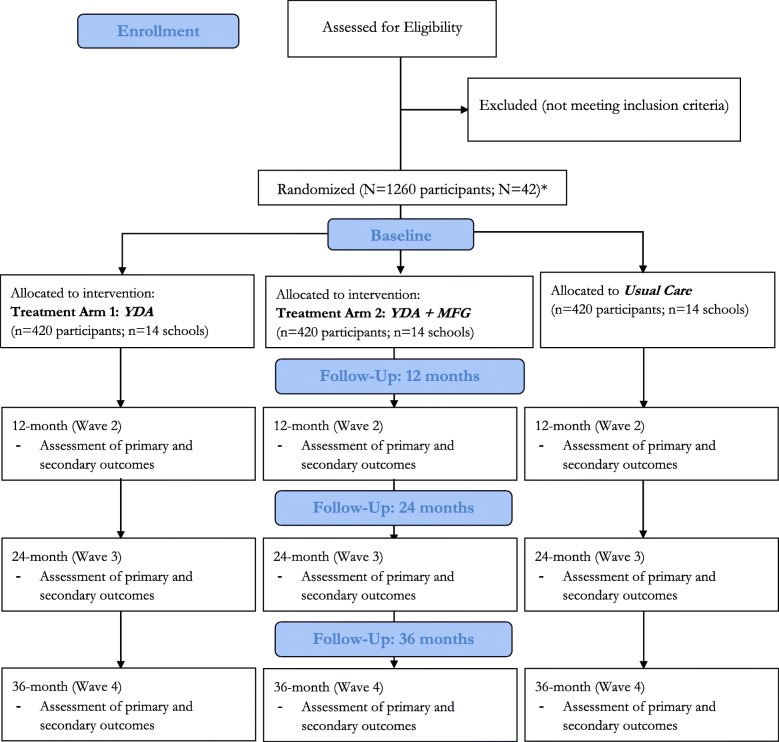
Methods: Suubi4Her will be evaluated via a three-arm cluster randomized-controlled trial design (YDA only, YDA + MFG, Usual Care) in 42 secondary schools in the Central region of Uganda, targeting a total of 1260 girls (ages 15-17 at enrollment). Assessments will occur at baseline, 12, 24, and 36 months. This study addresses two primary outcomes: 1) change in HIV risk behavior and 2) change in mental health functioning. Secondary exploratory outcomes include HIV and STI incidence, pregnancy, educational attainment, financial savings behavior, gender attitudes, and self-esteem. For potential scale-up, cost effectiveness analysis will be employed to compare the relative costs and outcomes associated with each study arm.
Conclusions: Suubi4Her will be one of the first prospective studies to examine the impact and cost of a combination intervention integrating economic and social components to reduce known HIV risk factors and improve mental health functioning among adolescent girls, while concurrently exploring mental health as a mediator in HIV risk reduction. The findings will illuminate the pathways that connect economic needs, mental health, family support, and HIV risk. If successful, the results will promote holistic HIV prevention strategies to reduce risk among adolescent girls in Uganda and potentially the broader sub-Saharan Africa region.
Trial registration: Clinical Trials NCT03307226 (Registered: 10/11/17).
Keywords: Adolescent girls; Assets; Combination interventions; Economic empowerment; Family strengthening; HIV.
Conflict of interest statement
Ethics approval and consent to participate
All study procedures were approved by the Washington University in St. Louis Review Board (#201703102) and by in-country local IRBs in Uganda: Uganda Virus Research Institute (UVRI – GC/127/17/07/619)), and Uganda National Council of Science and Technology (UNCST – SS4406). Written informed assent and consent will be obtained from adolescent participants and their caregivers, respectively, as part of study registration.
Competing interests
The authors declare that they have no competing interests.
Publisher’s Note
Springer Nature remains neutral with regard to jurisdictional claims in published maps and institutional affiliations.
Figures
References
-
- UNAIDS. The gap report [internet]. UNAIDS; 2014. Available from: http://www.unaids.org/en/resources/documents/2014/20140716_UNAIDS_gap_re.... Accessed 16 Nov. 2017.
-
- UNICEF . Adolescents and young people. UNICEF. 2017. Turning the tide against AIDS will require more concentrated focus on adolescents and young people [internet]
-
- Sherraden M. Assets and the poor: a new American welfare policy. Armonk, NY: ME Sharpe; 1991.
-
- Sherraden M. Stakeholding: notes on a theory of welfare based on assets. Soc Serv Rev. 1990;64(4):580–601. doi: 10.1086/603797. - DOI
-
- Cho H, Hallfors DD, Mbai II, Itindi J, Milimo BW, Halpern CT, Iritani BJ. Keeping adolescent orphans in school to prevent human immunodeficiency virus infection: evidence from a randomized controlled trial in Kenya. J Adolesc Health. 2011;48(5):523–526. doi: 10.1016/j.jadohealth.2010.08.007. - DOI - PMC - PubMed
Publication types
MeSH terms
Associated data
Grants and funding
LinkOut - more resources
Full Text Sources
Other Literature Sources
Medical
