


Impediments to communication and relationships between infertility care providers and patients
- PMID: 29871622
- PMCID: PMC5989459
- DOI: 10.1186/s12905-018-0572-6
Impediments to communication and relationships between infertility care providers and patients
Abstract
Background: Infertility patients generally see provider-patient communication and relationships as important, but as often insufficient, raising critical questions regarding why these gaps persist, and how they might best be addressed.
Methods: Semi-structured interviews of approximately one hour each were conducted with 37 ART providers and patients (17 physicians, 10 other health providers, and 10 patients) and were thematically analyzed.
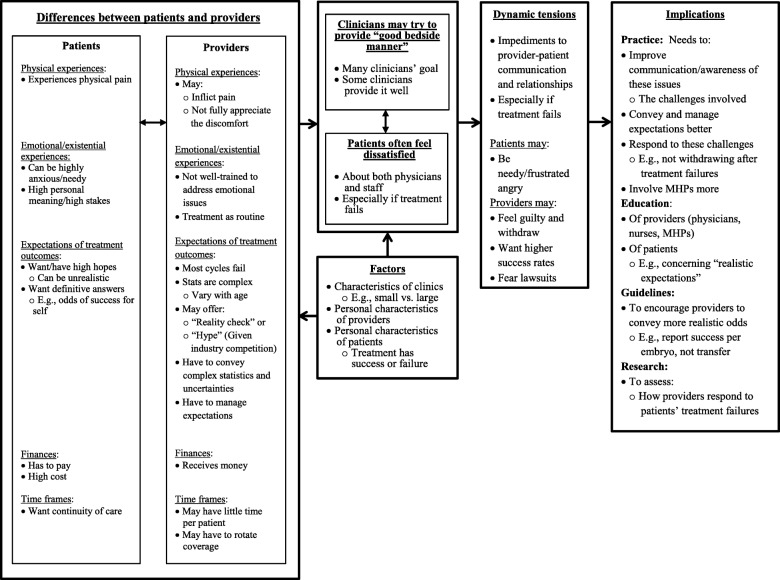
Results: Patients see clinicians' interactions as ranging widely from good to bad, related to several specific barriers and factors. Patients and providers may differ in their physical and emotional experiences, expectations concerning treatment outcomes and uncertainties, and time frames and finances, generating dynamic processes and tensions. Characteristics of particular providers, clinics and patients can also vary. Infertility patients tend to find only one outcome acceptable - a "take home baby" - rather than partial success, as is the case with many other diseases. Yet most IVF cycles fail. Many patients must pay considerable out-of-pocket expenses for infertility treatment, exacerbating disappointments and frustrations. Providers often work in competitive, entrepreneurial markets, and "hype" their potential success. After treatment failures, providers may feel guilty and withdraw from patients. Yet these behaviors can antagonize patients more than physicians realize, aggravating patient stresses. Several providers described how they understood patients' needs and perceptions more fully only after becoming infertility patients themselves. Interactions with not only physicians, but other providers (e.g., nurses and staff) can play key roles. Patients may be willing to understand these impediments, but providers often communicate these obstacles and reasons poorly or not at all, furthering tensions.
Conclusions: These data, the first to examine several critical aspects of challenges that infertility providers and patients face in communication and relationships, suggest that several key dynamic processes and factors may be involved, and need to be addressed. While prior research has shown that infertility patients value, but often feel disappointed in relationships with clinicians, the present data highlight several specific impediments, and thus have critical implications for future practice, research, guidelines and education.
Keywords: Education; Empathy; Ethics; Fertilization; In vitro; Infertility treatment; Medical; Patient-centered care; Policy; Provider-patient communication; Provider-patient relationships.
Conflict of interest statement
Ethics approval and consent to participate
Since interviews were all conducted by phone, rather than in person, an information sheet was sent to all participants who then gave verbal consent to participate. The Columbia University Department of Psychiatry Institutional Review Board approved the study and all procedures involved.
Competing interests
The author declares that he has no competing interests.
Publisher’s Note
Springer Nature remains neutral with regard to jurisdictional claims in published maps and institutional affiliations.
Figures
References
-
- Dancet EA, Nelen WL, Sermeus W, De Leeuw L, Kremer JA, D'Hooghe TM. The patients’ perspective on fertility care: a systematic review. Hum Reprod Update. 2010; 10.1093/humupd/dmq004. - PubMed
-
- Berwick DM. What 'patient-centered' should mean: confessions of an extremist. Health Aff (Millwood). 2009; 10.1377/hlthaff.28.4.w555. - PubMed
-
- Dancet EA, van Empel IW, Rober P, Nelen WL, Kremer JA, D'Hooghe TM. Patient-centred infertility care: a qualitative study to listen to the patient's voice. Hum Reprod. 2011; 10.1093/humrep/der022. - PubMed
-
- van Empel IW, Nelen WL, Tepe ET, van Laarhoven EA, Verhaak CM, Kremer JA. Weaknesses, strengths and needs in fertility care according to patients. Hum Reprod. 2010; 10.1093/humrep/dep362. - PubMed
Publication types
MeSH terms
Grants and funding
LinkOut - more resources
Full Text Sources
Other Literature Sources
Medical
Research Materials
