


eHealth as the Next-Generation Perinatal Care: An Overview of the Literature
- PMID: 29871855
- PMCID: PMC6008510
- DOI: 10.2196/jmir.9262
eHealth as the Next-Generation Perinatal Care: An Overview of the Literature
Abstract
Background: Unrestricted by time and place, electronic health (eHealth) provides solutions for patient empowerment and value-based health care. Women in the reproductive age are particularly frequent users of internet, social media, and smartphone apps. Therefore, the pregnant patient seems to be a prime candidate for eHealth-supported health care with telemedicine for fetal and maternal conditions.
Objective: This study aims to review the current literature on eHealth developments in pregnancy to assess this new generation of perinatal care.
Methods: We conducted a systematic literature search of studies on eHealth technology in perinatal care in PubMed and EMBASE in June 2017. Studies reporting the use of eHealth during prenatal, perinatal, and postnatal care were included. Given the heterogeneity in study methods, used technologies, and outcome measurements, results were analyzed and presented in a narrative overview of the literature.
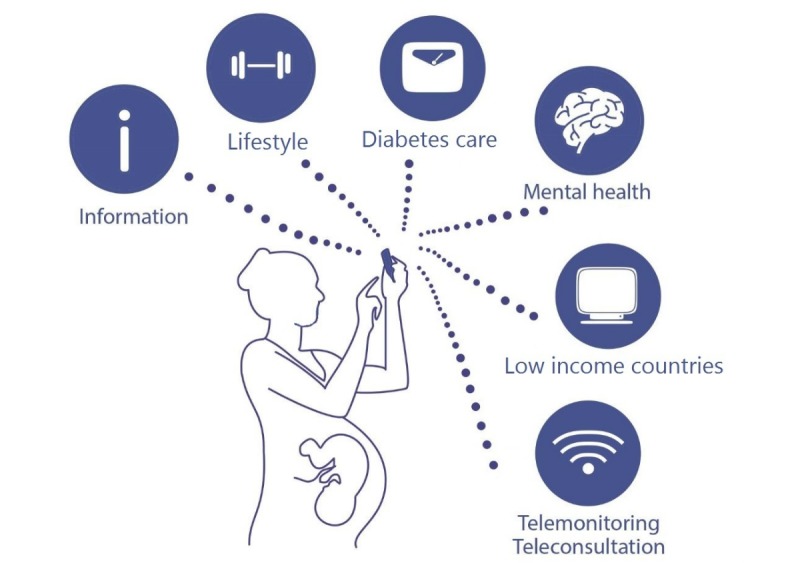
Results: The literature search provided 71 studies of interest. These studies were categorized in 6 domains: information and eHealth use, lifestyle (gestational weight gain, exercise, and smoking cessation), gestational diabetes, mental health, low- and middle-income countries, and telemonitoring and teleconsulting. Most studies in gestational diabetes and mental health show that eHealth applications are good alternatives to standard practice. Examples are interactive blood glucose management with remote care using smartphones, telephone screening for postnatal depression, and Web-based cognitive behavioral therapy. Apps and exercise programs show a direction toward less gestational weight gain, increase in step count, and increase in smoking abstinence. Multiple studies describe novel systems to enable home fetal monitoring with cardiotocography and uterine activity. However, only few studies assess outcomes in terms of fetal monitoring safety and efficacy in high-risk pregnancy. Patients and clinicians report good overall satisfaction with new strategies that enable the shift from hospital-centered to patient-centered care.
Conclusions: This review showed that eHealth interventions have a very broad, multilevel field of application focused on perinatal care in all its aspects. Most of the reviewed 71 articles were published after 2013, suggesting this novel type of care is an important topic of clinical and scientific relevance. Despite the promising preliminary results as presented, we accentuate the need for evidence for health outcomes, patient satisfaction, and the impact on costs of the possibilities of eHealth interventions in perinatal care. In general, the combination of increased patient empowerment and home pregnancy care could lead to more satisfaction and efficiency. Despite the challenges of privacy, liability, and costs, eHealth is very likely to disperse globally in the next decade, and it has the potential to deliver a revolution in perinatal care.
Keywords: ambulatory monitoring; antenatal care; diabetes, gestational; eHealth; fetal monitoring; obstetrics; patient-centered care; perinatal care; pregnancy; pregnancy complications; pregnancy, high risk; remote consultation; telemedicine.
©Josephus FM van den Heuvel, T Katrien Groenhof, Jan HW Veerbeek, Wouter W van Solinge, A Titia Lely, Arie Franx, Mireille N Bekker. Originally published in the Journal of Medical Internet Research (http://www.jmir.org), 05.06.2018.
Conflict of interest statement
Conflicts of Interest: None declared.
Figures
References
-
- World Health Organization . mHealth: New Horizons for Health Through Mobile Technologies. Global Observatory for eHealth Series, Volume 3. Geneva, Switzerland: WHO; 2011.
-
- Lettieri E, Fumagalli LP, Radaelli G, Bertele' P, Vogt J, Hammerschmidt R, Lara J, Carriazo A, Masella C. Empowering patients through eHealth: a case report of a pan-European project. BMC Health Serv Res. 2015 Aug 05;15:309. doi: 10.1186/s12913-015-0983-0. https://bmchealthservres.biomedcentral.com/articles/10.1186/s12913-015-0... 10.1186/s12913-015-0983-0 - DOI - PMC - PubMed
Publication types
MeSH terms
LinkOut - more resources
Full Text Sources
Other Literature Sources
Medical
