


Cognitive Function Deficits Associated With Long-Duration Type 1 Diabetes and Vascular Complications
- PMID: 29871904
- PMCID: PMC6054500
- DOI: 10.2337/dc17-1955
Cognitive Function Deficits Associated With Long-Duration Type 1 Diabetes and Vascular Complications
Abstract
Objective: Patients with type 1 diabetes now live long enough to experience cognitive decline. During middle age, they show mild cognitive deficits, but it is unknown whether severity increases with aging or whether cognitive profiles are similar to those of age-matched peers with and without diabetes.
Research design and methods: We tested and compared cognition in 82 individuals with 50 or more years of type 1 diabetes (Medalists), 31 age-matched individuals with type 2 diabetes, and 30 age-matched control subjects without diabetes. Medical histories and biospecimens were collected. We also evaluated the association of complications with cognition in Medalists only.
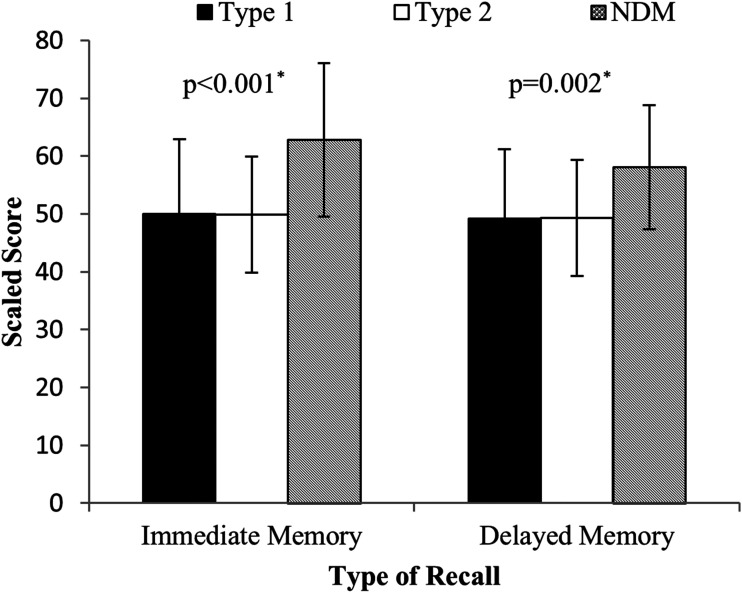
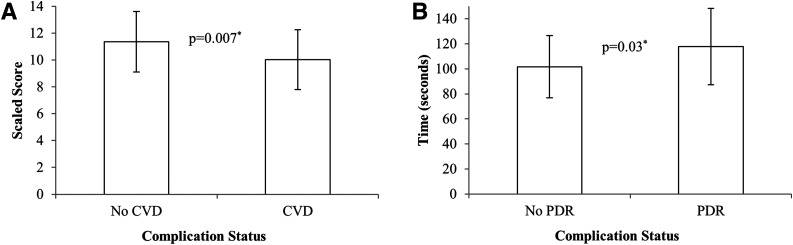
Results: Compared with control subjects, both individuals with type 1 diabetes and individuals with type 2 diabetes performed worse on immediate and delayed recall (P ≤ 0.002) and psychomotor speed in both hands (P ≤ 0.01) and showed a trend toward worse executive function (P = 0.05). In Medalists, cardiovascular disease was associated with decreased executive function and proliferative diabetic retinopathy with slower psychomotor speed.
Conclusions: Both patients with type 1 and patients with type 2 diabetes showed overall worse cognition than control subjects. Further, in Medalists, a relationship between complications and cognition was seen. Although both groups with diabetes showed similar deficit patterns, the underlying mechanisms may be different. Now that patients with type 1 diabetes are living longer, efforts should be made to evaluate cognition and to identify modifying behaviors to slow decline.
© 2018 by the American Diabetes Association.
Figures
References
-
- Krolewski AS. Epidemiology of late complications of diabetes. In Joslin's Diabetes Mellitus. 13th ed. Kahn CR, Weir GC, Eds. Philadelphia, PA, Lea & Febiger, 1994, p. 605–619
-
- Biessels GJ, Strachan MW, Visseren FL, Kappelle LJ, Whitmer RA. Dementia and cognitive decline in type 2 diabetes and prediabetic stages: towards targeted interventions. Lancet Diabetes Endocrinol 2014;2:246–255 - PubMed
-
- Brands AM, Biessels GJ, de Haan EH, Kappelle LJ, Kessels RP. The effects of type 1 diabetes on cognitive performance: a meta-analysis. Diabetes Care 2005;28:726–735 - PubMed
-
- Buckner RL. Memory and executive function in aging and AD: multiple factors that cause decline and reserve factors that compensate. Neuron 2004;44:195–208 - PubMed
-
- Elias MF, Beiser A, Wolf PA, Au R, White RF, D’Agostino RB. The preclinical phase of Alzheimer disease: a 22-year prospective study of the Framingham Cohort. Arch Neurol 2000;57:808–813 - PubMed
Publication types
MeSH terms
Grants and funding
LinkOut - more resources
Full Text Sources
Other Literature Sources
Medical
