


Identification of a Genomic Region between SLC29A1 and HSP90AB1 Associated with Risk of Bevacizumab-Induced Hypertension: CALGB 80405 (Alliance)
- PMID: 29871907
- PMCID: PMC6168379
- DOI: 10.1158/1078-0432.CCR-17-1523
Identification of a Genomic Region between SLC29A1 and HSP90AB1 Associated with Risk of Bevacizumab-Induced Hypertension: CALGB 80405 (Alliance)
Abstract
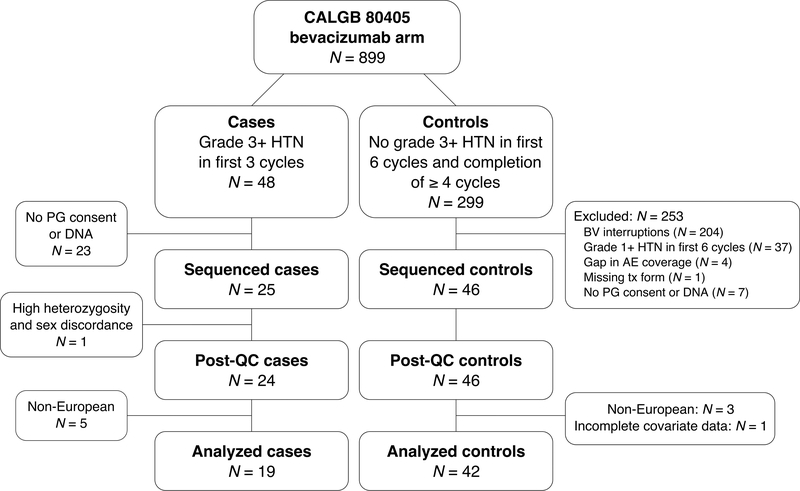
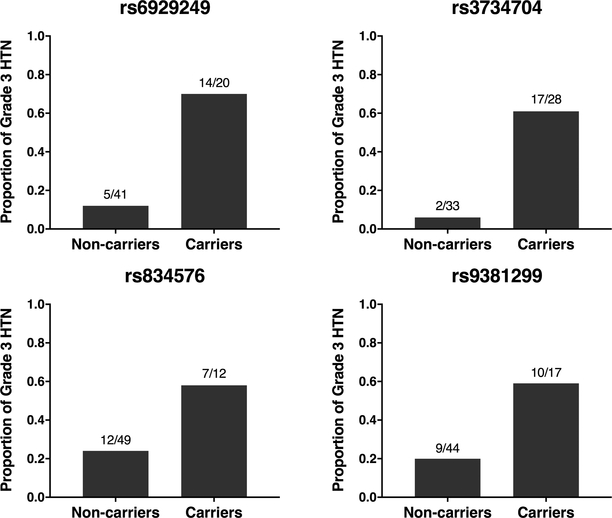
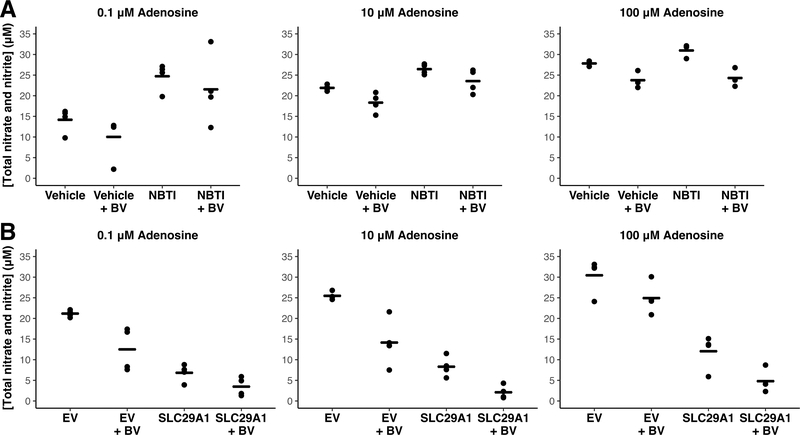
Purpose: Bevacizumab is a VEGF-specific angiogenesis inhibitor indicated as an adjunct to chemotherapy for the treatment of multiple cancers. Hypertension is commonly observed during bevacizumab treatment, and high-grade toxicity can limit therapy or lead to cardiovascular complications. The factors that contribute to interindividual variability in blood pressure rise during bevacizumab treatment are not well understood.Experimental Design: To identify genomic regions associated with bevacizumab-induced hypertension risk, sequencing of candidate genes and flanking regulatory regions was performed on 61 patients treated with bevacizumab (19 cases developed early-onset grade 3 hypertension and 42 controls had no reported hypertension in the first six cycles of treatment). SNP-based tests for common variant associations and gene-based tests for rare variant associations were performed in 174 candidate genes.Results: Four common variants in independent linkage disequilibrium blocks between SLC29A1 and HSP90AB1 were among the top associations. Validation in larger bevacizumab-treated cohorts supported association between rs9381299 with early grade 3+ hypertension (P = 0.01; OR, 2.4) and systolic blood pressure >180 mm Hg (P = 0.02; OR, 2.1). rs834576 was associated with early grade 3+ hypertension in CALGB 40502 (P = 0.03; OR, 2.9). These SNP regions are enriched for regulatory elements that may potentially increase gene expression. In vitro overexpression of SLC29A1 in human endothelial cells disrupted adenosine signaling and reduced nitric oxide levels that were further lowered upon bevacizumab exposure.Conclusions: The genomic region between SLC29A1 and HSP90AB1 and its role in regulating adenosine signaling are key targets for further investigation into the pathogenesis of bevacizumab-induced hypertension. Clin Cancer Res; 24(19); 4734-44. ©2018 AACR.
©2018 American Association for Cancer Research.
Figures
References
-
- Ferrara N, Hillan KJ, Gerber HP, Novotny W. Discovery and development of bevacizumab, an anti-VEGF antibody for treating cancer. Nat Rev Drug Discov. 2004;3:391–400. - PubMed
-
- Ferrara N, Adamis AP. Ten years of anti-vascular endothelial growth factor therapy. Nat Rev Drug Discov. 2016;15:385–403. - PubMed
-
- Zhu X, Wu S, Dahut WL, Parikh CR. Risks of proteinuria and hypertension with bevacizumab, an antibody against vascular endothelial growth factor: systematic review and meta-analysis. Am J Kidney Dis. 2007;49:186–93. - PubMed
-
- Ranpura V, Pulipati B, Chu D, Zhu X, Wu S. Increased risk of high-grade hypertension with bevacizumab in cancer patients: a meta-analysis. Am J Hypertens. 2010;23:460–8. - PubMed
-
- Schneider BP, Wang M, Radovich M, Sledge GW, Badve S, Thor A, et al. Association of vascular endothelial growth factor and vascular endothelial growth factor receptor-2 genetic polymorphisms with outcome in a trial of paclitaxel compared with paclitaxel plus bevacizumab in advanced breast cancer: ECOG 2100. J Clin Oncol. 2008;26:4672–8. - PMC - PubMed
Publication types
MeSH terms
Substances
Grants and funding
- U10 CA045808/CA/NCI NIH HHS/United States
- U10 CA180821/CA/NCI NIH HHS/United States
- U24 CA114725/CA/NCI NIH HHS/United States
- P30 CA082103/CA/NCI NIH HHS/United States
- U10 CA047559/CA/NCI NIH HHS/United States
- U10 CA180882/CA/NCI NIH HHS/United States
- U10 CA180820/CA/NCI NIH HHS/United States
- U10 CA180838/CA/NCI NIH HHS/United States
- U10 CA180888/CA/NCI NIH HHS/United States
- T32 GM007175/GM/NIGMS NIH HHS/United States
- U10 CA047577/CA/NCI NIH HHS/United States
- U10 CA180826/CA/NCI NIH HHS/United States
- U10 CA180836/CA/NCI NIH HHS/United States
- UG1 CA180830/CA/NCI NIH HHS/United States
- UG1 CA189858/CA/NCI NIH HHS/United States
- UG1 CA189828/CA/NCI NIH HHS/United States
- U10 CA041287/CA/NCI NIH HHS/United States
- S10 OD018164/OD/NIH HHS/United States
- F31 GM113350/GM/NIGMS NIH HHS/United States
- U10 CA180830/CA/NCI NIH HHS/United States
- U10 CA138561/CA/NCI NIH HHS/United States
LinkOut - more resources
Full Text Sources
Other Literature Sources
Medical
Molecular Biology Databases
Miscellaneous
