. 2018 Jun 19;115(25):6464-6469.
doi: 10.1073/pnas.1718003115. Epub 2018 Jun 5.

Small RNA profiling in Mycobacterium tuberculosis identifies MrsI as necessary for an anticipatory iron sparing response

Affiliations

Small RNA profiling in Mycobacterium tuberculosis identifies MrsI as necessary for an anticipatory iron sparing response

Elias R Gerrick et al. Proc Natl Acad Sci U S A. .

Abstract

One key to the success of Mycobacterium tuberculosis as a pathogen is its ability to reside in the hostile environment of the human macrophage. Bacteria adapt to stress through a variety of mechanisms, including the use of small regulatory RNAs (sRNAs), which posttranscriptionally regulate bacterial gene expression. However, very little is currently known about mycobacterial sRNA-mediated riboregulation. To date, mycobacterial sRNA discovery has been performed primarily in log-phase growth, and no direct interaction between any mycobacterial sRNA and its targets has been validated. Here, we performed large-scale sRNA discovery and expression profiling in M. tuberculosis during exposure to five pathogenically relevant stresses. From these data, we identified a subset of sRNAs that are highly induced in multiple stress conditions. We focused on one of these sRNAs, ncRv11846, here renamed mycobacterial regulatory sRNA in iron (MrsI). We characterized the regulon of MrsI and showed in mycobacteria that it regulates one of its targets, bfrA, through a direct binding interaction. MrsI mediates an iron-sparing response that is required for optimal survival of M. tuberculosis under iron-limiting conditions. However, MrsI is induced by multiple host-like stressors, which appear to trigger MrsI as part of an anticipatory response to impending iron deprivation in the macrophage environment.

Keywords: Mycobacterium tuberculosis; RNA-Seq; iron sparing; riboregulation; small RNA.


Conflict of interest statement

The authors declare no conflict of interest.

Figures
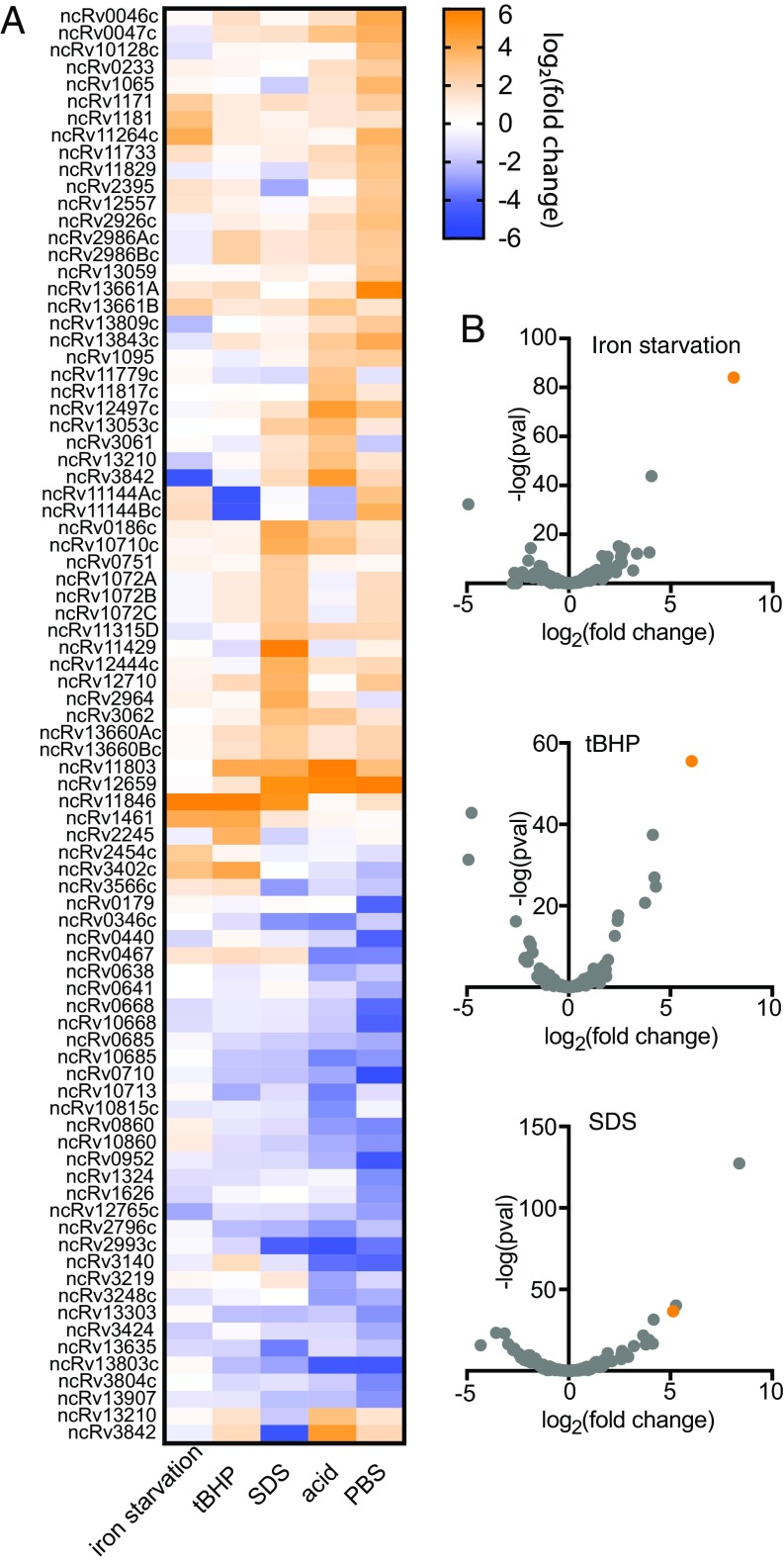
Fig. 1.
Fig. 1.
Differential sRNA-seq in M. tuberculosis. (A) Heat map of the 82 M. tuberculosis sRNAs significantly differentially expressed across three biological replicates (P < 0.05; fold change ≥6) in at least one stress condition. (B) Volcano plots of sRNA differential expression in iron starvation for 24 h (Top), tBHP-mediated oxidative stress for 4 h (Middle), and SDS-mediated membrane stress for 4 h (Bottom). The orange data point in each graph is ncRv11846/MrsI.
Fig. 2.
Fig. 2.
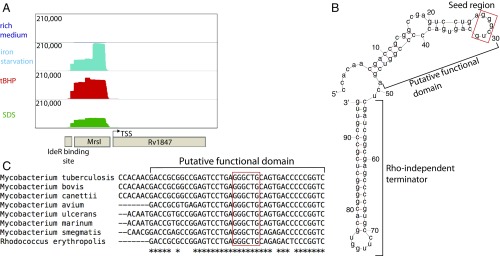
ncRv11846/MrsI is a promiscuously induced, highly structured and conserved sRNA. (A) Read distribution around the ncRv11846/MrsI locus in sRNA-seq data in rich medium and MrsI-inducing stress conditions. The linear scale (shown on the left) shows the number of reads. (B) Predicted minimum free energy secondary structure of ncRv11846/MrsI (mFold). The putative functional domain and rho-independent terminator are marked. The red box denotes the 6-nt seed region. (C) Alignment of the putative functional domain of ncRv11846/MrsI homologs from selected actinobacterial species. The red box denotes the sRNA seed region.
Fig. 3.
Fig. 3.
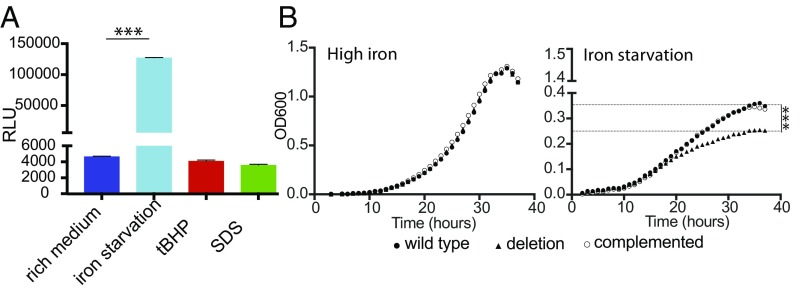
ncRv11846/MrsI is induced during iron limitation in M. smegmatis and is involved in adaptation to iron starvation. (A) The promoter of the ncRv11846/MrsI homolog in M. smegmatis was fused to a luciferase reporter, and cells were exposed to stress before measuring luciferase activity (***P < 0.0001, unpaired t test). Error bars represent SD of three replicates. (B) Growth curves of MrsI strains in medium with (Left) and without (Right) iron. Dashed lines indicate the final optical density reached for strains with and without mrsI (***P < 0.0001, unpaired t test).
Fig. 4.
Fig. 4.
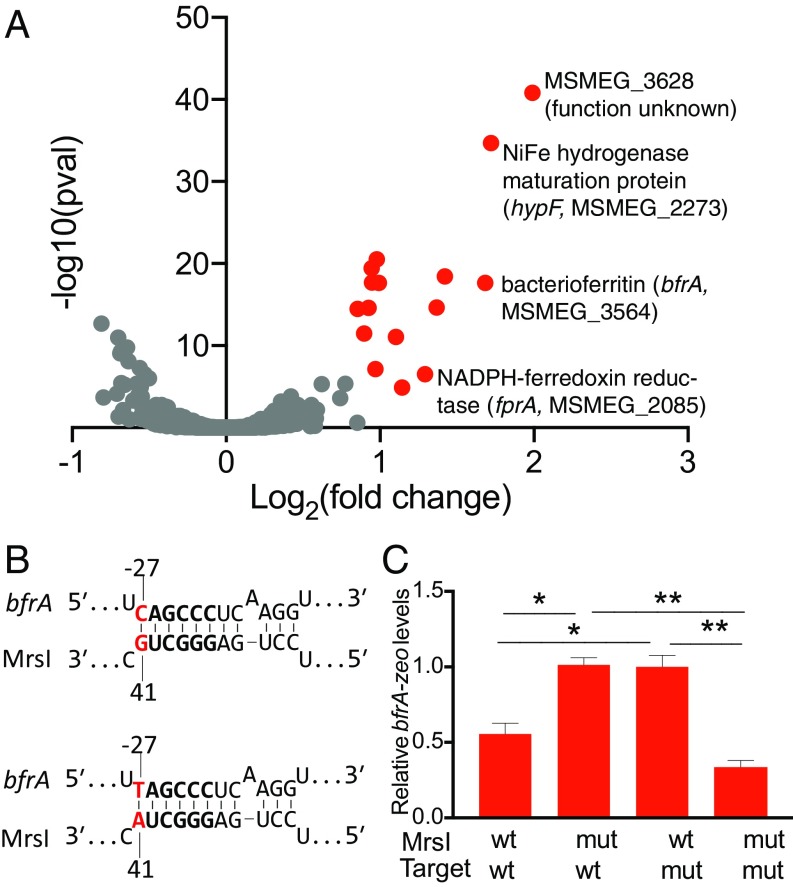
MrsI is an iron-sparing sRNA in M. smegmatis and binds directly to the bfrA mRNA. (A) Volcano plot of transcriptomics for WT and ∆mrsI M. smegmatis after 6 h of iron starvation. Red data points indicate genes with elevated levels in the deletion strain compared with WT and complemented strains (fold change >1.5; P < 0.05). (B) Schematic of the WT-WT (Top) and mut-mut (Bottom) binding interaction between MrsI and the target bfrA. The MrsI seed region is in bold, and the bases mutated for the compensatory mutation assay are in red. (C) MrsI regulates bfrA directly. The promoter and 5′ UTR of bfrA were fused to the zeoR gene, and reciprocal mutations were made in the putative interaction sites on MrsI and bfrA-zeoR. Levels of bfrA-zeoR in each strain were measured by RT-qPCR (*P < 0.05 and **P < 0.005, unpaired t test). Error bars represent SD of three replicates.
Fig. 5.
Fig. 5.
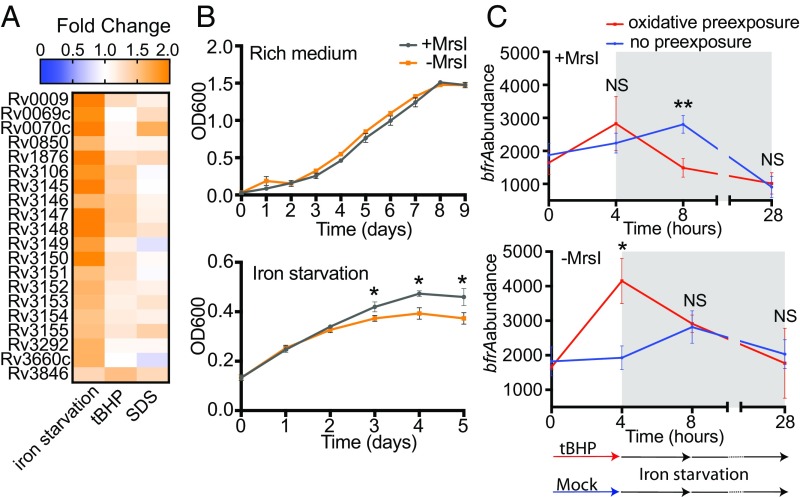
MrsI mediates an anticipatory iron-sparing response in M. tuberculosis. (A) Heat map of genes putatively directly regulated by MrsI in MrsI-inducing stress conditions. (B) Growth curves of M. tuberculosis mrsI knockdown strain with and without CRIPSRi induction in rich medium (Top) and during iron starvation (Bottom; *P < 0.05, unpaired t test). Error bars represent SD of three replicates. (C) Levels of the MrsI target bfrA with and without preexposure to oxidative stress in M. tuberculosis. Three biological replicates of the MrsI knockdown strain were grown with or without oxidative stress for 4 h before iron starvation for 24 h (gray region). Levels of bfrA were measured by using Nanostring. Samples with and without MrsI knockdown (Bottom and Top, respectively) are shown (*P < 0.05 and **P < 0.005, unpaired t test). Error bars represent the SD of three biological replicates.

References

    1. Stallings CL, Glickman MS. Is Mycobacterium tuberculosis stressed out? A critical assessment of the genetic evidence. Microbes Infect. 2010;12:1091–1101. - PMC - PubMed
    1. Liu PT, Stenger S, Tang DH, Modlin RL. Cutting edge: Vitamin D-mediated human antimicrobial activity against Mycobacterium tuberculosis is dependent on the induction of cathelicidin. J Immunol. 2007;179:2060–2063. - PubMed
    1. Purdy GE, Niederweis M, Russell DG. Decreased outer membrane permeability protects mycobacteria from killing by ubiquitin-derived peptides. Mol Microbiol. 2009;73:844–857. - PMC - PubMed
    1. Schaible UE, Kaufmann SH. Iron and microbial infection. Nat Rev Microbiol. 2004;2:946–953. - PubMed
    1. Saiga H, et al. Lipocalin 2-dependent inhibition of mycobacterial growth in alveolar epithelium. J Immunol. 2008;181:8521–8527. - PubMed

Publication types

MeSH terms

LinkOut - more resources