


Somatic mutations in benign breast disease tissue and risk of subsequent invasive breast cancer
- PMID: 29872146
- PMCID: PMC6008400
- DOI: 10.1038/s41416-018-0089-7
Somatic mutations in benign breast disease tissue and risk of subsequent invasive breast cancer
Abstract
Background: Insights into the molecular pathogenesis of breast cancer might come from molecular analysis of tissue from early stages of the disease.
Methods: We conducted a case-control study nested in a cohort of women who had biopsy-confirmed benign breast disease (BBD) diagnosed between 1971 and 2006 at Kaiser Permanente Northwest and who were followed to mid-2015 to ascertain subsequent invasive breast cancer (IBC); cases (n = 218) were women with BBD who developed subsequent IBC and controls, individually matched (1:1) to cases, were women with BBD who did not develop IBC in the same follow-up interval as that for the corresponding case. Targeted sequence capture and sequencing were performed for 83 genes of importance in breast cancer.
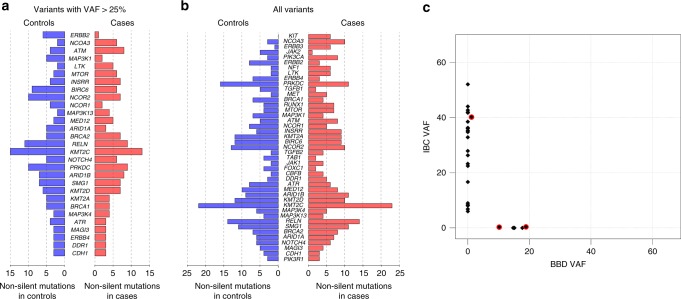
Results: There were no significant case-control differences in mutation burden overall, for non-silent mutations, for individual genes, or with respect either to the nature of the gene mutations or to mutational enrichment at the pathway level. For seven subjects with DNA from the BBD and ipsilateral IBC, virtually no mutations were shared.
Conclusions: This study, the first to use a targeted multi-gene sequencing approach on early breast cancer precursor lesions to investigate the genomic basis of the disease, showed that somatic mutations detected in BBD tissue were not associated with breast cancer risk.
Conflict of interest statement
The authors declare no competing interests.
Figures
References
-
- Rohan TE, Kandel RA. Breast. In: Franco EL, Rohan TE, editors. Cancer Precursors: Epidemiology, Detection, and Prevention. New York:: Springer-Verlag; 2002. pp. 232–248.
-
- Lakhani SR, et al. International Agency for Research on Cancer (IARC): WHO Classification of Tumours of the Breast. Lyon: IARC; 2012.
Publication types
MeSH terms
Substances
Grants and funding
LinkOut - more resources
Full Text Sources
Other Literature Sources
Medical
