Randomized Controlled Trial
. 2018 May 25:13:1713-1726.
doi: 10.2147/COPD.S165593. eCollection 2018.

Effectiveness of water-based Liuzijue exercise on respiratory muscle strength and peripheral skeletal muscle function in patients with COPD

Affiliations
Randomized Controlled Trial

Effectiveness of water-based Liuzijue exercise on respiratory muscle strength and peripheral skeletal muscle function in patients with COPD

Weibing Wu et al. Int J Chron Obstruct Pulmon Dis. .

Abstract

Objects: The purpose of this study was to quantitatively assess the effects of water-based Liuzijue exercise on patients with COPD and compare it with land-based Liuzijue exercise.

Materials and methods: Participants were randomly allocated to one of three groups: the water-based Liuzijue exercise group (WG), the land-based Liuzijue exercise group (LG), and the control group (CG). CG participants accepted no exercise intervention, while training groups performed Liuzijue exercise according to Health Qigong Liuzijue (People's Republic of China) in different environments for 60-min sessions twice a week for 3 months.

Results: Of the 50 patients enrolled, 45 (90%) completed the 3-month intervention. The CG showed decreased expiratory muscle strength, extensor and flexor endurance ratio (ER) of the elbow joints and flexor peak torque (PT), total work (TW), and ER of the knee joints (p<0.05). Both training groups showed improved respiratory muscle strength, which differed from the CG (p<0.001). In addition, extensor and flexor TW of the elbow joints in the training groups were increased (p<0.01), and the WG differed from the CG in extensor TW and ER and flexor TW (p<0.01), while the LG differed from the CG in flexor TW and extensor ER (p<0.05). PT, PT/body weight (BW), and TW in the knee joint extensor in the training groups were increased as well (PT and PT/BW: p<0.05, TW: p<0.01), and the WG differed from the CG in terms of knee joints outcomes, while the LG differed from the CG in flexor TW only (p<0.05).

Conclusion: Water-based Liuzijue exercise has beneficial effects on COPD patients' respiratory muscle strength and peripheral skeletal muscle function, and additional benefits may exist in endurance of upper limbs and strength and endurance of lower limbs when compared with land-based Liuzijue exercise.

Keywords: COPD; Liuzijue exercise; isokinetic muscle strength; quantitative assessment; respiratory muscle strength; water-based exercise.


Conflict of interest statement

Disclosure The authors report no conflicts of interest in this work.

Figures
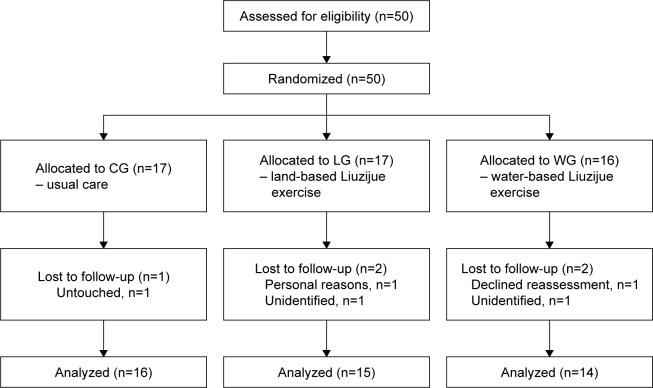
Figure 1
Figure 1
Study flow diagram. Abbreviations: CG, control group; LG, land-based Liuzijue exercise group; WG, water-based Liuzijue exercise group.
Figure 2
Figure 2
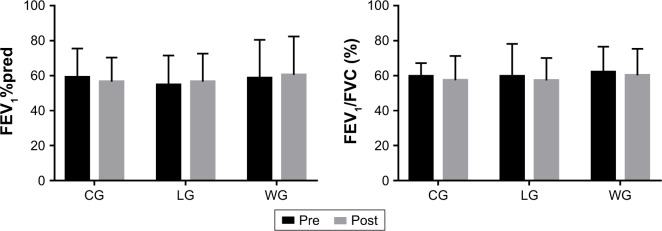
Pulmonary function before and after the 3-month intervention. Notes: Data are expressed as mean ± SD. No differences were observed between the groups at baseline and after the intervention. Within-groups comparison was made by the paired-sample t-test. Abbreviations: %pred, percentage of predicted values; CG, control group; FEV1, forced expiratory volume in the first second; FVC, forced vital capacity; LG, land-based Liuzijue exercise group; post, postintervention; pre, preintervention; WG, water-based Liuzijue exercise group.
Figure 3
Figure 3
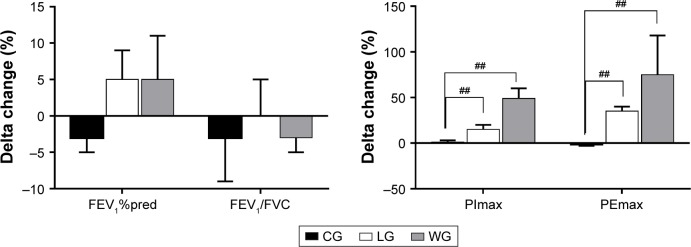
Changes of pulmonary function and respiratory muscle strength after the 3-month intervention. Notes: Delta changes (%) = ([post − pre]/pre) ×100, and they are expressed as mean ± SEM. Between-group comparisons used the one-way analysis of variance or the nonparametric Kruskal–Wallis test and are expressed as a p-value. The level of significance was set at p<0.05, and ##p<0.01 means it was significant when compared to the control group. Abbreviations: %pred, percentage of predicted values; CG, control group; FEV1, forced expiratory volume in the first second; FVC, forced vital capacity; LG, land-based Liuzijue exercise group; PEmax, maximal expiratory pressure; PImax, maximal inspiratory pressure; WG, water-based Liuzijue exercise group.
Figure 4
Figure 4
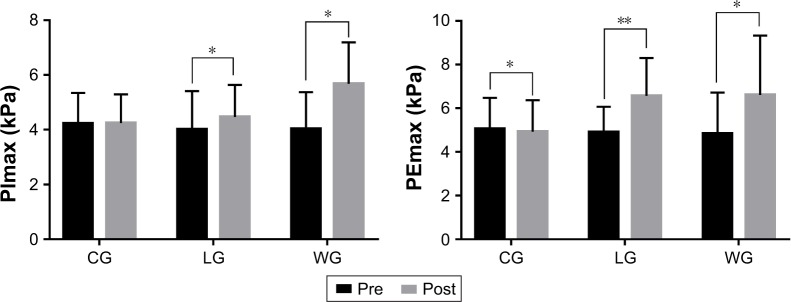
Respiratory muscle strength before and after the 3-month intervention. Notes: Data are expressed as mean ± SD. No differences were observed between the groups at baseline. Within-groups comparison was made by the paired-sample t-test. *p<0.05, comparisons were significant within groups. **p<0.01, comparisons were significant within groups. Abbreviations: CG, control group; LG, land-based Liuzijue exercise group; PEmax, maximal expiratory pressure; PImax, maximal inspiratory pressure; post, postintervention; pre, preintervention; WG, water-based Liuzijue exercise group.
Figure 5
Figure 5
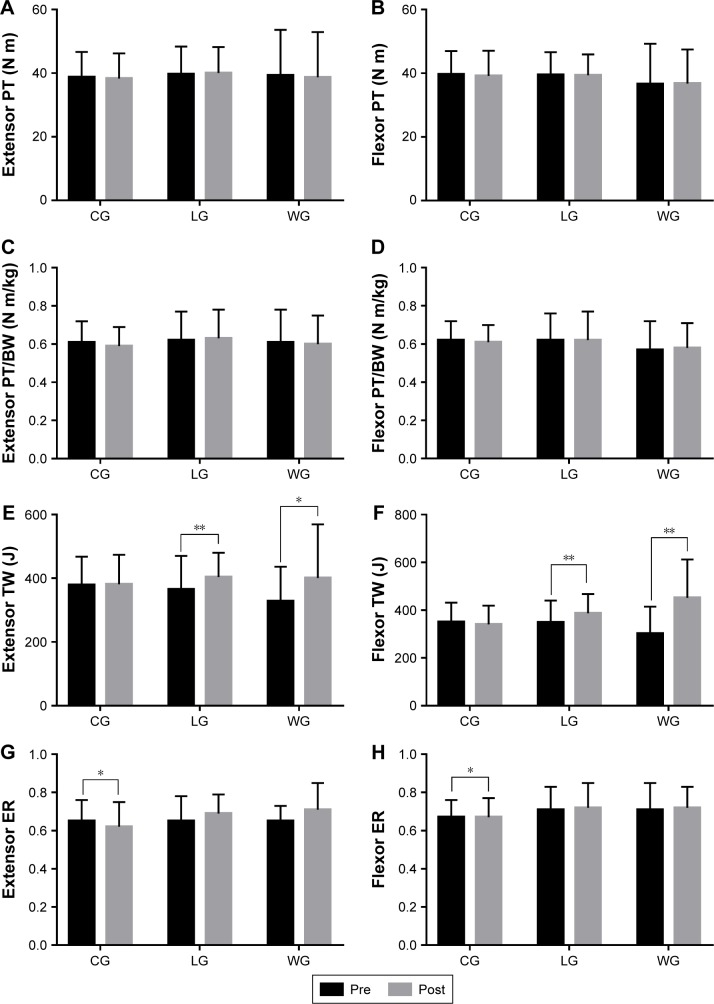
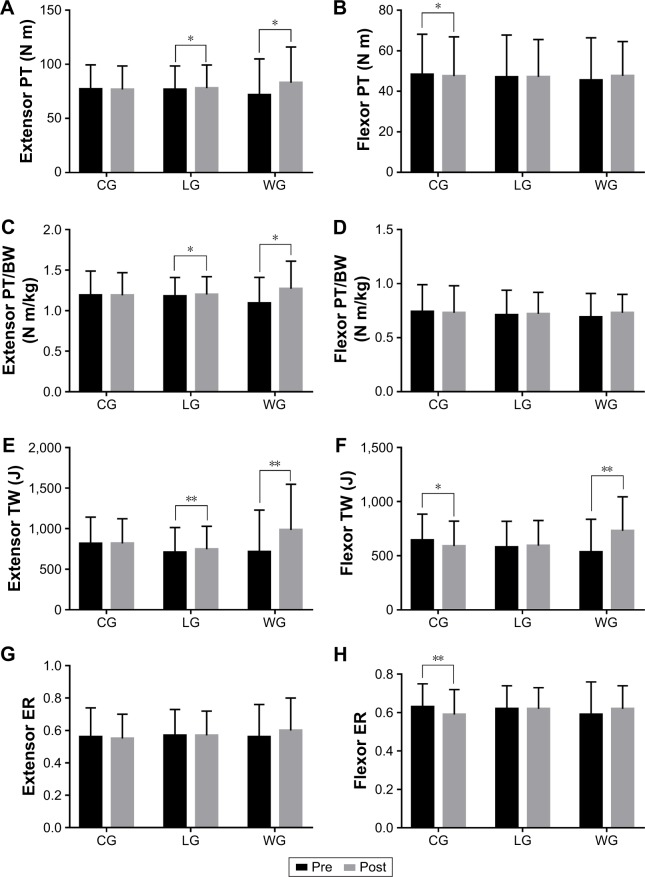
Muscle function of elbow joints before and after the 3-month intervention. Notes: (AD) Within-groups comparisons in CG, LG, and WG of the elbow extensor and flexor PT and PT/BW to reflect the changes of muscle strength after intervention; (EH) Within-groups comparisons in CG, LG, and WG of the elbow extensor and flexor TW and ER to reflect the changes of muscle endurance after intervention. Data are expressed as mean ± SD. No differences were observed between the groups at baseline. Within-groups comparisons were made with the paired-sample t-test. *p<0.05, comparisons were significant within groups, **p<0.01, comparisons were significant within groups. Abbreviations: BW, body weight; CG, control group; ER, endurance ratio; LG, land-based Liuzijue exercise group; post, postintervention; pre, preintervention; PT, peak torque; TW, total work; WG, water-based Liuzijue exercise group.
Figure 6
Figure 6
Muscle function of knee joints before and after the 3-month intervention. Notes: (AD) Within-groups comparisons in CG, LG, and WG of the knee extensor and flexor PT and PT/BW to reflect the changes of muscle strength after intervention; (EH) Within-groups comparisons in CG, LG, and WG of the knee extensor and flexor TW and ER to reflect the changes of muscle endurance after intervention. Data are expressed as mean ± SD. No differences were observed between the groups at baseline. Within-groups comparisons were made with the paired-sample t-test. *p<0.05, comparisons were significant within groups. **p<0.01, comparisons were significant within groups. Abbreviations: BW, body weight; CG, control group; ER, endurance ratio; LG, land-based Liuzijue exercise group; post, postintervention; pre, preintervention; PT, peak torque; TW, total work; WG, water-based Liuzijue exercise group.
Figure 7
Figure 7
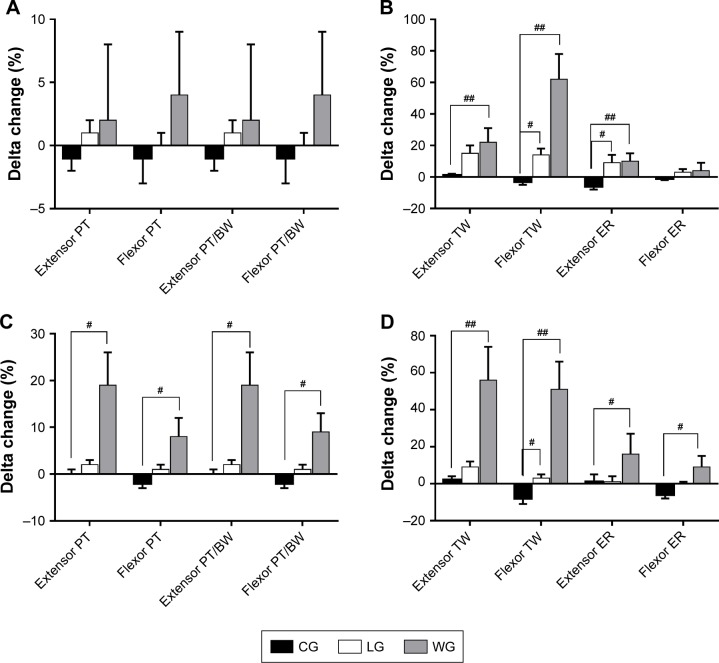
Changes of elbow and knee joints of muscle function after 3-month intervention. Muscle function of elbow joints are shown in A and B, while knee joints are shown in C and D. Notes: Delta changes (%) = ([post − pre]/pre) ×100, and they are expressed as mean ± SEM. Between-group comparisons used the one-way analysis of variance or the nonparametric Kruskal–Wallis test and are expressed as a p-value. The level of significance was set at p<0.05, and #p<0.05 and ##p<0.01 mean it was significant when compared to the CG. Abbreviations: BW, body weight; CG, control group; ER, endurance ratio; LG, land-based Liuzijue exercise group; post, postintervention; pre, preintervention; PT, peak torque; TW, total work; WG, water-based Liuzijue exercise group.

References

    1. Global initiative for chronic obstructive lung disease (GOLD) Global strategy for the Diagnosis, Management and Prevention of chronic obstructive pulmonary disease [homepage on the Internet] 2017. [Accessed July 23, 2017]. report. Available from: http://www.goldcopd.com.
    1. Cielen N, Maes K, Gayan-Ramirez G. Musculoskeletal disorders in chronic obstructive pulmonary disease. Biomed Res Int. 2014;2014:9657–9664. - PMC - PubMed
    1. Decramer M, Janssens W, Miravitlles M. Chronic obstructive pulmonary disease. Lancet. 2012;379(9823):1341–1351. - PMC - PubMed
    1. Arnardóttir RH, Sörensen S, Ringqvist I, Larsson K. Two different training programmes for patients with COPD: a randomised study with 1-year follow-up. Respir Med. 2006;100(1):130–139. - PubMed
    1. Güell MR, Cejudo P, Ortega F, et al. Benefits of long-term pulmonary rehabilitation maintenance program in patients with severe chronic obstructive pulmonary disease. Three-year follow-up. Am J Respir Crit Care Med. 2017;195(5):622–629. - PubMed

Publication types