


Prevalence of multidrug-resistant Gram-negative pathogens isolated from febrile neutropenic cancer patients with bloodstream infections in Egypt and new synergistic antibiotic combinations
- PMID: 29872329
- PMCID: PMC5975596
- DOI: 10.2147/IDR.S163293
Prevalence of multidrug-resistant Gram-negative pathogens isolated from febrile neutropenic cancer patients with bloodstream infections in Egypt and new synergistic antibiotic combinations
Abstract
Introduction: Bloodstream infections with multidrug-resistant (MDR) Gram-negative bacteria (GNB) are among the most frequent complications in immunocompromised cancer patients because of their considerable morbidity and mortality. Several guidelines on antimicrobial therapy have addressed empirical treatment for such serious infections; however, the emergence of microbial resistance has become a significant problem worldwide.
Materials and methods: In this study, starting from November 2015 to October 2016, a total of 529 blood specimens were collected from febrile neutropenic cancer patients at a tertiary care cancer hospital in Egypt.
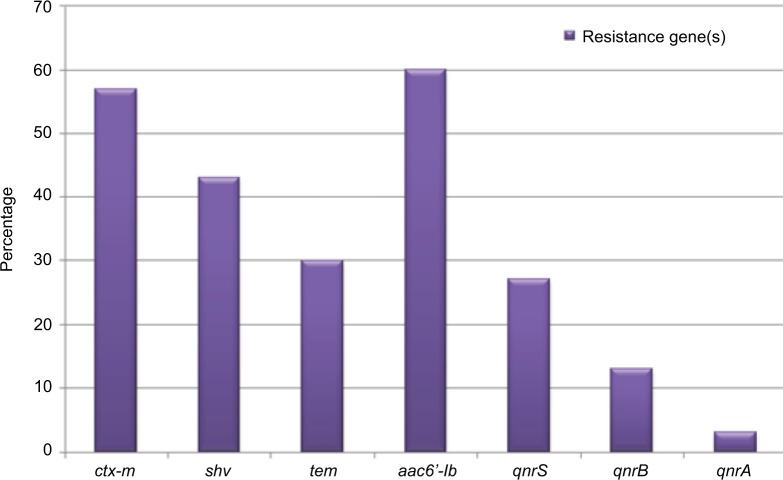
Results: On examination for positive bacterial growth, it was found that 334 specimens showed no growth, while 195 were positive. Out of the 195 positive culture specimens, 102 (102/195, 52.3%) were Gram-negative and 93 (93/195, 47.7%) were Gram-positive. Out of the 102 GNB, 70 (70/102, 68.6%) were MDR, including Escherichia coli (27/70, 38.6%), Klebsiella pneumoniae (24/70, 34.3%), Acinetobacter baumannii (9/70, 12.8%), Enterobacter cloacae (4/70, 5.7%), Pseudomonas aeruginosa (2/70, 2.8%), Klebsiella oxytoca (2/70, 2.8%), and Klebsiella ornithinolytica (2/70, 2.8%). All MDR GNB showed high resistance to ampicillin, cefepime, ceftriaxone, and cephradine (minimum inhibitory concentration at which 50% of the isolates were inhibited [MIC50] >512 μg/mL for each). However, they showed good susceptibility to colistin (MIC50 <1 μg/mL). The most common extended-spectrum β-lactamases (ESBLs) genes detected were ctx-m (39/70, 55.7%), shv (31/70, 44.3%), and tem (22/70, 31.4%). The most common aminoglycoside-resistant gene detected was aac(6')-Ib (42/70, 60%) followed by the plasmid-mediated quinolone resistance determinants; qnrA (2/70, 2.8%), qnrB (9/70, 12.8%), and qnrS (19/70, 27.1%). ESBL determinants were significantly associated with resistance to ciprofloxacin, levofloxacin, amikacin, and carbapenems (P-value <0.005). The fractional inhibitory concentration index for ampicillin/sulbactam plus ceftriaxone, ampicillin/sulbactam plus amikacin, and amikacin plus levofloxacin showed synergism against 29 (29/70, 41.4%), 19 (19/70, 27.1%), and 11 (11/70, 15.7%) isolates of the tested MDR GNB isolates, respectively.
Conclusion: Accordingly, new empirical antibiotics should be administered including the use of colistin or meropenem alone or both against the MDR GNB in neutropenic cancer patients.
Keywords: ESBLs; FICI; PMQR; fractional inhibitory concentration; plasmid-mediated quinolone resistance.
Conflict of interest statement
Disclosure The authors report no conflicts of interest in this work.
Figures
References
-
- Kuo FC, Wang SM, Shen CF, et al. Bloodstream infections in pediatric patients with acute leukemia: emphasis on gram-negative bacteria infections. J Microbiol Immunol Infect. 2017;50(4):507–513. - PubMed
-
- Baos E, Candel FJ, Merino P, Pena I, Picazo JJ. Characterization and monitoring of linezolid-resistant clinical isolates of Staphylococcus epidermidis in an intensive care unit 4 years after an outbreak of infection by cfr-mediated linezolid-resistant Staphylococcus aureus. Diagn Microbiol Infect Dis. 2013;76(3):325–329. - PubMed
-
- Biehl LM, Schmidt-Hieber M, Liss B, Cornely OA, Vehreschild MJ. Colonization and infection with extended spectrum beta-lactamase producing Enterobacteriaceae in high-risk patients – review of the literature from a clinical perspective. Crit Rev Microbiol. 2016;42(1):1–16. - PubMed
-
- Saghir S, Faiz M, Saleem M, Younus A, Aziz H. Characterization and anti-microbial susceptibility of gram-negative bacteria isolated from bloodstream infections of cancer patients on chemotherapy in Pakistan. Indian J Med Microbiol. 2009;27(4):341–347. - PubMed
-
- Pitout JD, Laupland KB. Extended-spectrum beta-lactamase-producing Enterobacteriaceae: an emerging public-health concern. Lancet Infect Dis. 2008;8(3):159–166. - PubMed
LinkOut - more resources
Full Text Sources
Other Literature Sources
