. 2018 May 16;7(5):349-355.
doi: 10.1002/open.201800040. eCollection 2018 May.

Synthesis and Application of Dendritic Fibrous Nanosilica/Gold Hybrid Nanomaterials

Affiliations

Synthesis and Application of Dendritic Fibrous Nanosilica/Gold Hybrid Nanomaterials

Wongyun Byoun et al. ChemistryOpen. .

Abstract

Morphologically unique silica nanoparticles can be used as effective templates to prepare silica-metal hybrid nanomaterials, which are highly applicable in a variety of areas. Mesoporous silica nanoparticles, which have high surface areas and an abundance of pores, can be used to synthesize mesoporous silica core-metal shell nanostructures with catalytically active sites. In this work, dendritic fibrous nanosilica (DFNS) with a high surface area is successfully employed as a template to synthesize DFNS/Au hybrid nanomaterials. Au nanodots are initially synthesized through the selective reduction of Au ions on the surface of the DFNS after surface modification to form DFNS/Au dots. A seed-mediated growth method is used to controllably grow Au nanoparticles on the DFNS/Au dots to generate DFNS core-Au nanoparticles shell nanohybrids (DFNS/Au NPs) and DFNS core-Au layer shell nanohybrids (DFNS/Au layers). The catalytic activities of DFNS/Au NPs and DFNS/Au layers in the 4-nitrophenol reduction reaction are compared.

Keywords: 4-nitrophenol reduction; Au layer; core–shell nanostructures; dendritic fibrous nanosilica; silica–metal hybrid nanoparticle.


Figures
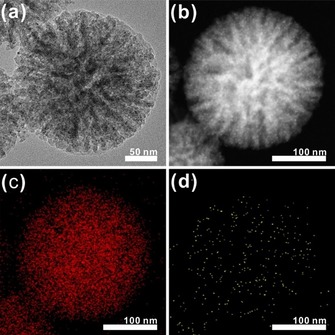
Figure 1
Figure 1
TEM images of DFNS/Au dots: a) bright‐field TEM image; b) dark‐field TEM image; c, d)  EDS mapping elemental analysis showing the oxygen (c) and gold (d) content of the DFNS/Au dots.
Figure 2
Figure 2
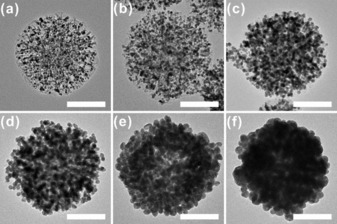
TEM images of DFNS/Au nanohybrids synthesized by using various HAuCl4(aq) concentrations (scale bar: 100 nm): a) 1.25 mm, b) 2.5 mm, c) 5 mm, d) 10 mm, e) 20 mm, and f) 30 mm HAuCl4(aq) (the same volume of the second growth solution, 0.8 mL, is used in all cases). Based on the synthesis ratio (molar ratio=amount of HAuCl4 in the growth solution/ amount of HAuCl4 in the DFNS/Au dots), the reaction ratios can be assigned as: a) 7, b) 15, c) 30, d) 61, e) 123, and f) 246.
Figure 3
Figure 3
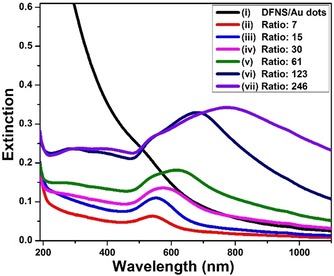
UV/Vis spectra of aqueous solutions of DFNS/Au dots and DFNS/Au nanohybrids synthesized using various HAuCl4(aq) concentrations: ii) 1.25 mm, iii) 2.5 mm, iv) 5 mm, v) 10 mm, vi) 20 mm, and vii) 30 mm HAuCl4(aq) (the same volume of the second growth solution, 0.8 mL, is used in all cases). According to the synthesis ratio (molar ratio=amount of HAuCl4 in the growth solution/ amount of HAuCl4 in the DFNS/Au dots), the reaction ratio can be assigned as: ii) 7, iii) 15, iv) 30, v) 61, vi) 123, and vii) 246.
Figure 4
Figure 4
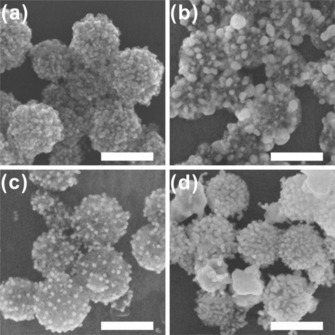
SEM images of DFNS/Au nanohybrids synthesized by using various reaction conditions (scale bar: 250 nm): DFNS/Au hybrids synthesized a) using the original synthesis method (ratio: 246), b) without AgNO3 (aq), c) without Brij 35, and d) without CTAB. The HAuCl4 concentration is 30 mm in each case, and other experimental conditions are kept the same.
Figure 5
Figure 5
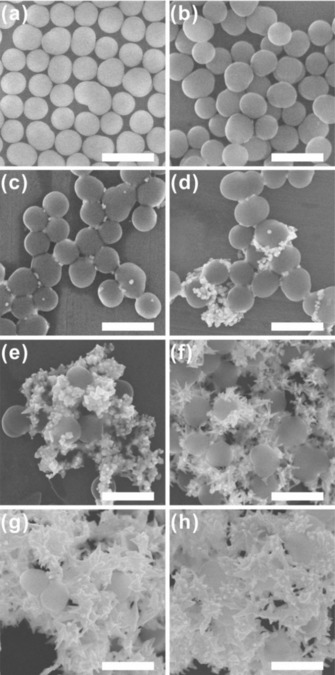
SEM images of SNS/Au nanohybrids synthesized using various HAuCl4(aq) concentrations (scale bar: 500 nm): a) SNS, b) SNS/Au dots, and c–h) SNS/Au NPs synthesized using c) 1.25 mm, d) 2.5 mm, e) 5 mm, f) 10 mm, g) 20 mm, and h) 30 mm HAuCl4(aq). The same volume of the second growth solution, 0.8 mL, was used in all cases.
Figure 6
Figure 6
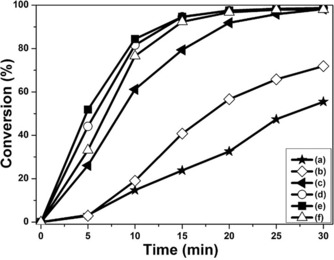
4‐NP conversion by a) DFNS/Au dots, (b to f) DFNS/Au nanohybrids synthesized: b) ratio: 7, c) ratio: 15, d) ratio: 30, d) ratio: 61, e) ratio: 123, and f) ratio: 246. 4‐NP conversion is calculated as follows: Conversion (%)= (1−C t C 0 −1)×100, where C t is the absorption of 4‐NP at a given reaction time, t, and C 0 is the initial absorption by 4‐NP at t=0.

References

    1. None
    1. Moore C. J., Montón H., O'Kennedy R., Williams D. E., Nogués C., Lynam C. C., Gubala V., J. Mater. Chem. B 2015, 3, 2043–2055; - PubMed
    1. Hoshikawa Y., Yabe H., Nomura A., Yamaki T., Shimojima A., Okubo T., Chem. Mater. 2010, 22, 12–14;
    1. Kim S. M., Jeon M., Kim K. W., Park J., Lee I. S., J. Am. Chem. Soc. 2013, 135, 15714–15717; - PubMed
    1. Lu J., Fan Y., Howard M. D., Vaughan J. C., Zhang B., J. Am. Chem. Soc. 2017, 139, 2964–2971; - PMC - PubMed