Review
. 2018 Feb 20;2(1):5.
doi: 10.1038/s41698-018-0049-y. eCollection 2018.

Interaction between Wnt/β-catenin and RAS-ERK pathways and an anti-cancer strategy via degradations of β-catenin and RAS by targeting the Wnt/β-catenin pathway

Affiliations
Review

Interaction between Wnt/β-catenin and RAS-ERK pathways and an anti-cancer strategy via degradations of β-catenin and RAS by targeting the Wnt/β-catenin pathway

Woo-Jeong Jeong et al. NPJ Precis Oncol. .

Abstract

Aberrant activation of the Wnt/β-catenin and RAS-extracellular signal-regulated kinase (ERK) pathways play important roles in the tumorigenesis of many different types of cancer, most notably colorectal cancer (CRC). Genes for these two pathways, such as adenomatous polyposis coli (APC) and KRAS are frequently mutated in human CRC, and involved in the initiation and progression of the tumorigenesis, respectively. Moreover, recent studies revealed interaction of APC and KRAS mutations in the various stages of colorectal tumorigenesis and even in metastasis accompanying activation of the cancer stem cells (CSCs). A key event in the synergistic cooperation between Wnt/β-catenin and RAS-ERK pathways is a stabilization of both β-catenin and RAS especially mutant KRAS by APC loss, and pathological significance of this was indicated by correlation of increased β-catenin and RAS levels in human CRC where APC mutations occur as high as 90% of CRC patients. Together with the notion of the protein activity reduction by lowering its level, inhibition of both β-catenin and RAS especially by degradation could be a new ideal strategy for development of anti-cancer drugs for CRC. In this review, we will discuss interaction between the Wnt/β-catenin and RAS-ERK pathways in the colorectal tumorigenesis by providing the mechanism of RAS stabilization by aberrant activation of Wnt/β-catenin. We will also discuss our small molecular anti-cancer approach controlling CRC by induction of specific degradations of both β-catenin and RAS via targeting Wnt/β-catenin pathway especially for the KYA1797K, a small molecule specifically binding at the regulator of G-protein signaling (RGS)-domain of Axin.


Conflict of interest statement

The authors declare no competing financial interests.

Figures
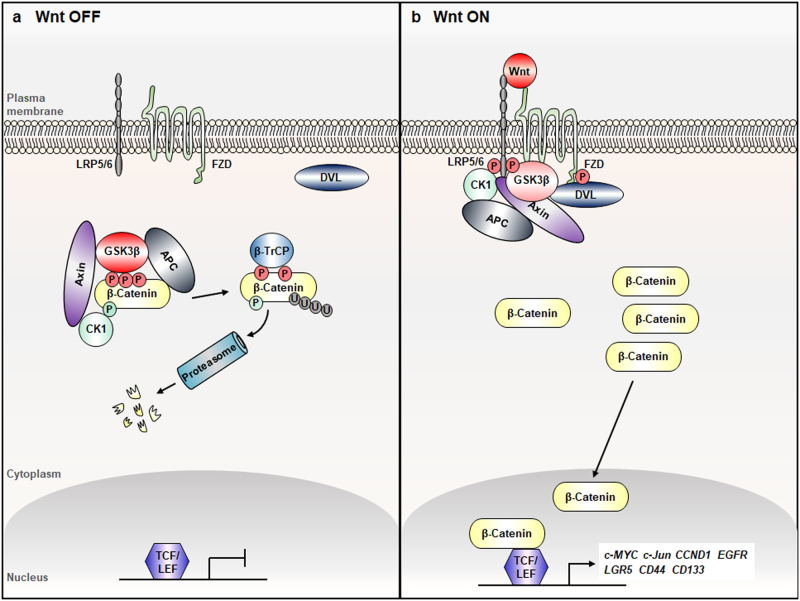
Fig. 1
Fig. 1
The canonical Wnt/β-catenin pathway. a In the absence of Wnt ligands, APC (adenomatous polyposis coli) and Axin are recruited into the “β-catenin destruction complex”. The phosphorylations by CK1α (casein kinase 1α) and GSK3β (glycogen synthase kinase 3β) recruit β‑TrCP E3 linker (β-transducin repeat-containing protein, an E3 ubiquitin ligase), and subsequently degrade β‑catenin via the proteasome. Low-cytoplasmic levels of β-catenin ensure in activation of TCF/LEF (T-cell factor/lymphoid enhancer factor) transcription factors and transcriptional repression of Wnt target genes. b In the accumulation of the extracellular Wnt ligands, the association of Axin with phosphorylated LRP5/6 (lipoprotein receptor-related protein 5/6) and recruitment of phosphorylated DVL (dishevelled) to FZD (frizzled) lead to the dissociation of the destruction complex. β-Catenin is stabilized, translocated into the nucleus, forms the complex with TCF or LEF, and subsequently activates the target genes. CCND1, cyclin D1; EGFR, epidermal growth factor receptor; LGR5, Leucine-rich repeat-containing G-protein coupled receptor 5; P, phosphorylation; U, ubiquitination
Fig. 2
Fig. 2
The RAS-ERK signaling pathway. Binding of EGF (epidermal growth factor) activates EGFR, providing the docking sites for several SH2 (src homology 2) domain-containing adaptor proteins such as Grb2 (growth factor receptor-bound protein 2), Shc (src homology 2 domain-containing), PLCγ (phospholipase C γ), and p110 subunit of the PI3 kinase (phosphatidylinositol-4,5-bisphosphate 3-kinase). As the major route involving the EGFR activation by EGF binding, Grb2-SOS (son of sevenless) complex is recruited to the receptor through SH2 domain, allowing SOS to activate RAS by exchanging GDP (guanosine diphosphate) to GTP (guanosine triphosphate). GTP-bound RAS activates the RAF (rapidly accelerated fibrosarcom)-MEK (MAPK/ERK kinase)-ERK (extracellular signal-regulated kinase) kinase cascade by series of phosphorylations. Phosphorlyated ERK translocates to nucleus and activates trasncription factors, such as ATF (activating transcription factor), leading to expression of the target genes
Fig. 3
Fig. 3
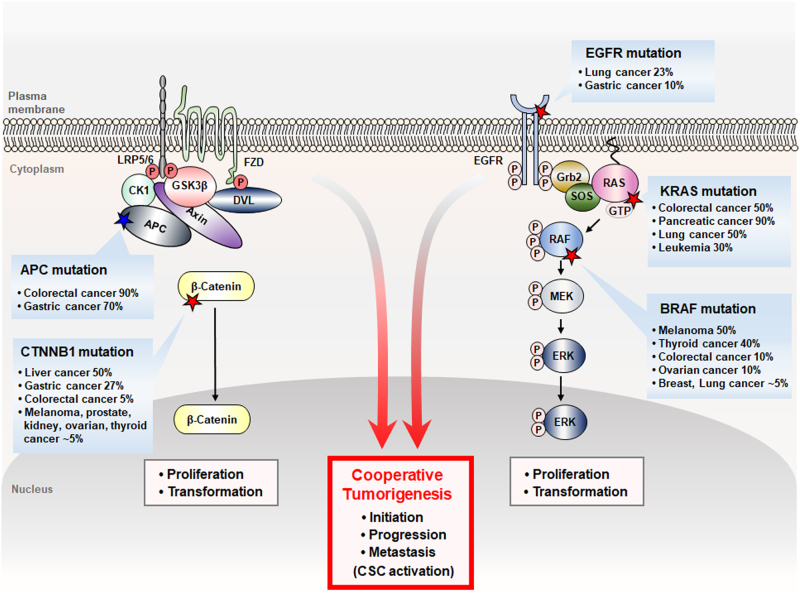
Aberrancies of the Wnt/β-catenin and RAS-ERK pathways and their cooperation in the tumorigenesis. Aberrant activations of the Wnt/β-catenin and RAS-ERK pathways caused by various mutations occur in various human cancers as described. When aberrancies of the two pathways occur together by mutations, such as APC and KRAS, they cooperate in the tumorigenesis and that results in the enhancements of the tumorigenesis at different stages of CRC (colorectal cancer), including initiation, progression, and metastasis, involving CSC (cancer stem cell) activation. Red star, gain-of-function mutation; Blue star, loss-of-function mutation
Fig. 4
Fig. 4
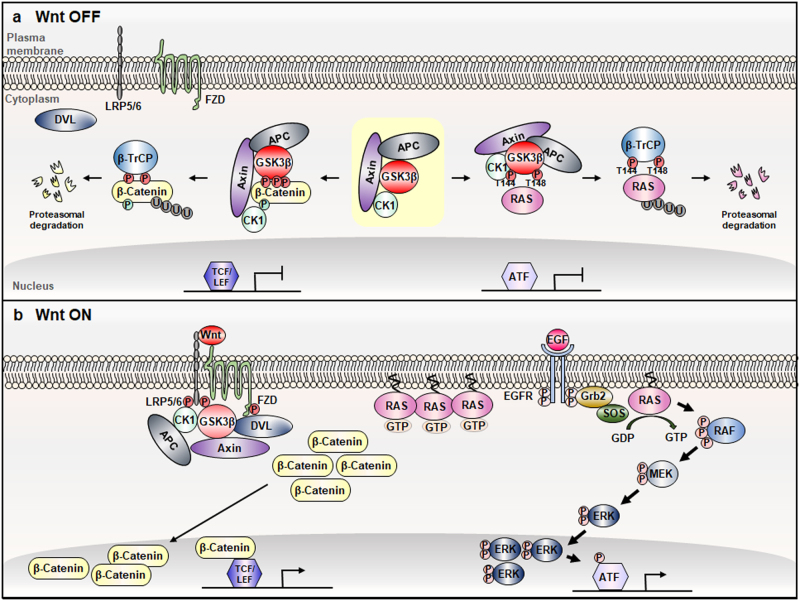
Cross-talk between the Wnt/β-catenin and RAS-ERK pathway. a In the absence of Wnt ligands, β-catenin is subjected to proteasomal degradation by association of the β-catenin destruction complex (yellow shaded) as described in Fig. 1a. The active GSK3β in the destruction complex can also phosphorylate RAS. The β-TrCP E3 ligase is recruited to both of the phosphorylated β-catenin and RAS proteins and subsequently degrades them via the polyubiquitination-dependent proteasomal degradation. Low β-catenin and RAS protein levels in cytoplasm ensure the repression of the signaling activities and target gene expressions. b In the presence of Wnt ligands, the dissociation of the destruction complex stabilizes both β-catenin and RAS in the cytoplasm, leading to the activation of the signaling pathways and target gene expressions
Fig. 5
Fig. 5
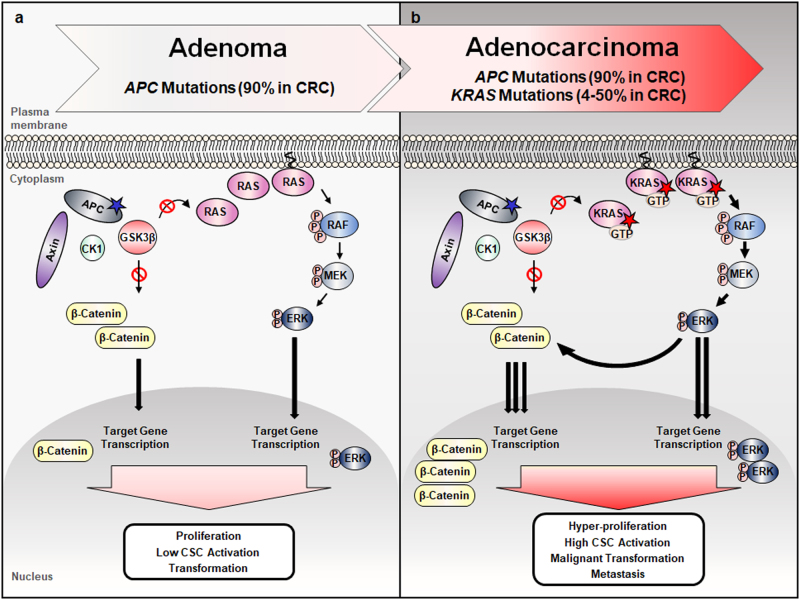
Pathological significance of the synergistic cooperation in the colorectal tumorigenesis by both APC and KRAS mutations and supporting mechanism. a Loss-of-function mutations of APC, observed in 90% of CRC patients, disrupt the destruction complex, lead to accumulation of β-catenin and RAS and thereby initiate adenoma formation. b When both APC and KRAS mutations occur, mutant KRAS proteins are accumulated by stabilization due to absence of its phosphorylation by inactivated GSK3β by APC loss. The Wnt/β-catenin signaling is strongly enhanced by its initial stabilization and further activation via the stabilized oncogenic mutant KRAS by APC loss. The additional activation of β-catenin signaling by the oncogenic KRAS occurs via a positive feedback loop through the MEK-ERK pathway, although in the detailed mechanism is not illustrated. The strong activation of the Wnt/β-catenin signaling involves malignant transformation accompanying the activation of CSCs
Fig. 6
Fig. 6
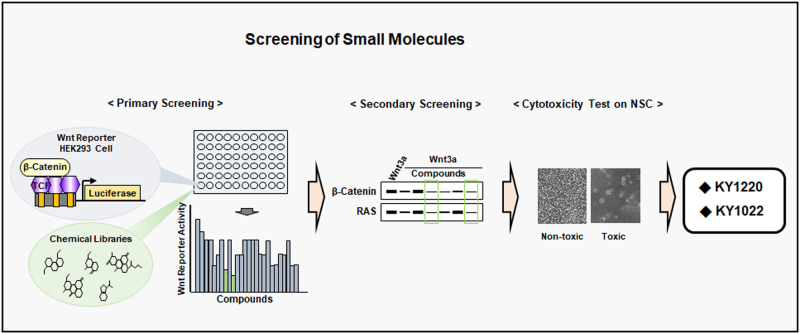
Screening procedures to obtain small molecules degrading both β-catenin and RAS. A schematic representation of screening procedures for identification of small molecules destabilizing both β-catenin and RAS. Through primary screening of chemical libraries for inhibitory effects on the Wnt reporter activities, the secondary screening for the effective reduction of both β-catenin and RAS protein levels by immunoblot analyses and following cytotoxicity tests by using NSCs (neural stem cells) to avoid potential toxic compounds, KY1220 and KY1022 were selected as representative compounds
Fig. 7
Fig. 7
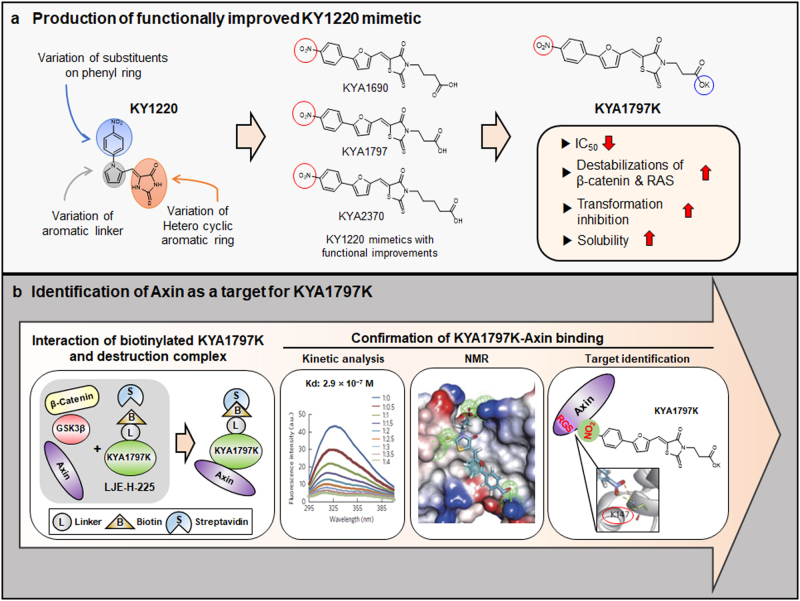
Production of KYA1797K, a functionally improved analog of KY1220, and identification of Axin as the target for KYA1797K. a Based on the structure of KY1220, a focused library was designed and selected three derivatives with NO2 moiety essential for the Wnt inhibitory effects (red circle) by improved inhibitory effect on the Wnt/β-catenin signaling. Among them, KYA1797K was produced as the most efficient analog with improved solubility (blue circle). b Among the candidate β-catenin complex proteins including Axin, GSK3β, β-catenin, Axin was specifically pulled-down with the KYA1797K attached biotinylated active compound LJE-H-225. Binding of Axin-RGS (regulator of G-protein signaling domain of Axin) with KYA1797K was analyzed with a dissociation constant (Kd) of 2.9 × 10−7 M. Further confirmation of KYA1797K interaction with Axin-RGS by NMR (nuclear magnetic resonance) spectra specified direct interaction of K147 with the NO2 moiety of the KYA1797K. Reproduced with permission and adapted from: Cha, P.H. et al.
Fig. 8
Fig. 8
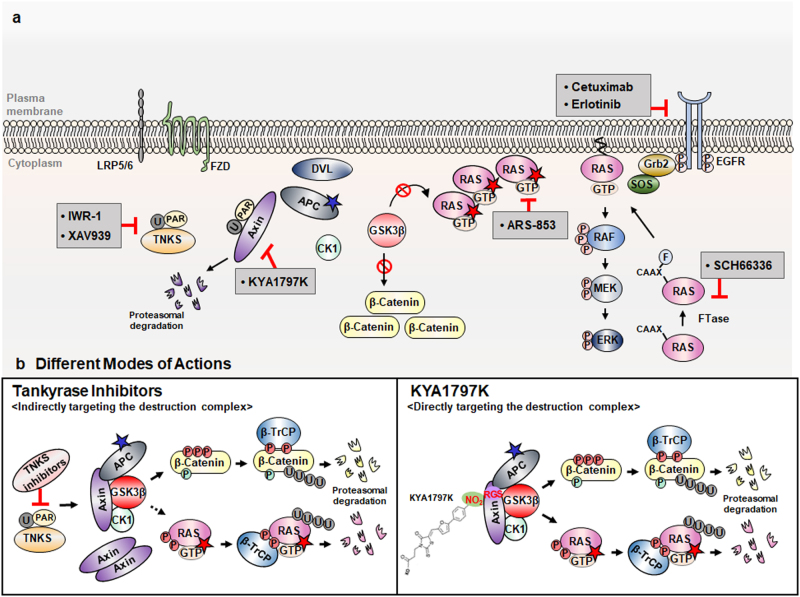
KYA1797K as a potential strategy to overcome resistance to EGFR targeting drugs in CRC. a A schematic representation of several therapeutic agents targeting the EGFR-RAS-ERK pathway including EGFR antibody drug cetuximab, FTase (farnesyl transferase) inhibitor SCH66336, KRAS-G12C specific inhibitor ARS-853 and those targeting Wnt/β-catenin pathways, including the IWR-1 and XAV939 TNKS (tankyrase) inhibitors and KYA1797K targeting RGS-Axin. b Differences in the mode of actions of TNKS inhibitors and KYA1797K. Left: TNKS inhibitors indirectly target the destruction complex by inhibiting the TNKS-mediated Axin destabilization which may change the balance of the β-catenin destruction complex components. Right: KYA1797K directly targets the destruction complex by binding to Axin-RGS which enhances the formation of the β-catenin destruction complex leading to increased GSK3β activity without changing the stoichiometry of the β-catenin destruction complex. F, farnesylation; PAR, poly-ADP-ribosylation; Dotted line, not experimentally confirmed

References

    1. Vogelstein B, Kinzler KW. Cancer genes and the pathways they control. Nat. Med. 2004;10:789–799. doi: 10.1038/nm1087. - DOI - PubMed
    1. Fearon ER, Vogelstein B. A genetic model for colorectal tumorigenesis. Cell. 1990;61:759–767. doi: 10.1016/0092-8674(90)90186-I. - DOI - PubMed
    1. D’Abaco GM, Whitehead RH, Burgess AW. Synergy between Apc min and an activated ras mutation is sufficient to induce colon carcinomas. Mol. Cell Biol. 1996;16:884–891. doi: 10.1128/MCB.16.3.884. - DOI - PMC - PubMed
    1. Harada N, et al. Hepatocarcinogenesis in mice with beta-catenin and Ha-ras gene mutations. Cancer Res. 2004;64:48–54. doi: 10.1158/0008-5472.CAN-03-2123. - DOI - PubMed
    1. Janssen KP, et al. APC and oncogenic KRAS are synergistic in enhancing Wnt signaling in intestinal tumor formation and progression. Gastroenterology. 2006;131:1096–1109. doi: 10.1053/j.gastro.2006.08.011. - DOI - PubMed