. 2018 Nov 1;4(11):1589-1593.
doi: 10.1001/jamaoncol.2018.2297.

Prevalence of Clonal Hematopoiesis Mutations in Tumor-Only Clinical Genomic Profiling of Solid Tumors

Affiliations

Prevalence of Clonal Hematopoiesis Mutations in Tumor-Only Clinical Genomic Profiling of Solid Tumors

Ryan N Ptashkin et al. JAMA Oncol. .

Erratum in

  • Missing Conflict of Interest Disclosure.
    [No authors listed] [No authors listed] JAMA Oncol. 2019 Jan 1;5(1):122. doi: 10.1001/jamaoncol.2018.5678. JAMA Oncol. 2019. PMID: 30422161 Free PMC article. No abstract available.

Abstract

Importance: Although clonal hematopoiesis (CH) is well described in aging healthy populations, few studies have addressed the practical clinical implications of these alterations in solid-tumor sequencing.

Objective: To identify and quantify CH-related mutations in patients with solid tumors using matched tumor-blood sequencing, and to establish the proportion that would be misattributed to the tumor based on tumor-only sequencing (unmatched analysis).

Design, setting, and participants: Retrospective analysis of samples from 17 469 patients with solid cancers who underwent prospective clinical sequencing of DNA isolated from tumor tissue and matched peripheral blood using the MSK-IMPACT assay between January 2014 and August 2017.

Main outcomes and measures: We identified the presence of CH-related mutations in each patient's blood leukocytes and quantified the fraction of DNA molecules harboring the mutation in the corresponding matched tumor sample.

Results: The mean age of the 17 469 patients with cancer at sample collection was 59.2 years (range, 0.3-98.9 years); 53.6% were female. We identified 7608 CH-associated mutations in the blood of 4628 (26.5%) patients. A total of 1075 (14.1%) CH-associated mutations were also detectable in the matched tumor above established thresholds for calling somatic mutations. Overall, 912 (5.2%) patients would have had at least 1 CH-associated mutation erroneously called as tumor derived in the absence of matched blood sequencing. A total of 1061 (98.7%) of these mutations were absent from population scale databases of germline polymorphisms and therefore would have been challenging to filter informatically. Annotating variants with OncoKB classified 534 (49.7%) as oncogenic or likely oncogenic.

Conclusions and relevance: This study demonstrates how CH-derived mutations could lead to erroneous reporting and treatment recommendations when tumor-only sequencing is used.


Conflict of interest statement

Conflict of Interest Disclosures: . Dr Baselga reports nonfinancial support and reasonable reimbursement for travel from Roche/Genentech; receiving fees from and stock ownership in the following companies: Aura Biosciences (including serving on the board of directors from 2013-2017), Infinity Pharmaceuticals (including serving on the board of directors from 2013-2017), PMV Pharma Biotechnologies (including serving on the scientific advisory board from 2014-present), Juno Therapeutics (acquired by Celgene) (including serving on the scientific advisory board from 2014-2017), Grail (including serving as member or chair of the scientific advisory board from 2016-2018), Varian Medical Systems (including serving on the board of directors from 2017-2018), Bristol-Myers Squibb (including serving on the board of directors from March to September 2018), Seragon (acquired by Roche) (including serving on the scientific advisory board of directors from 2013-2014); stock ownership in ApoGen Biotechnologies (including serving on the scientific advisory board from 2014-present), and Foghorn Therapeutics (including serving on the board from 2017-present); serving as cofounder, receiving fees from, and stock ownership in Tango (formerly Synthetic Lethal) from 2016-present and Northern Biologics (formerly Mosaic Biomedicals) (including serving on the scientific advisory board from 2013-present); receiving consulting and travel fees from Novartis and Eli Lilly; serving as cofounder of Venthera; and serving as investigator on a patent licensed to Memorial Sloan Kettering for use of phosphoinositide 3-kinase inhibitors for treatment of vascular malformations and serving as investigator for patents pending assignment to Memorial Sloan Kettering for combination therapy using PDK1 and PI3K inhibitors and inhibition of KMT2D for the treatment of breast cancer. No other disclosures were reported.

Figures

Figure 1.
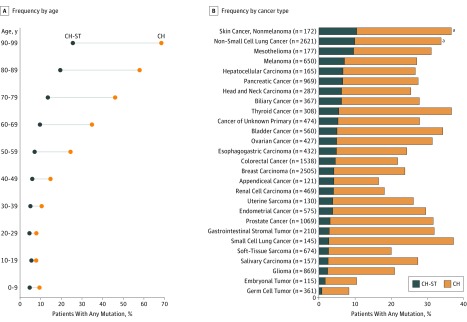
Figure 1.. Clonal Hematopoiesis (CH)-Derived Mutations Observed in Solid Tumors (CH-ST)
A, Frequency of CH-ST mutations, identified by analyzing matched normal blood and solid-tumor data, increases with patient age. B, Nonmelanoma skin cancer, lung cancer, and mesothelioma have the highest rates of CH-ST mutations observed. aTumor types in which significant enrichment is observed for CH-ST mutations (Fisher exact test, Benjamini-Hochberg corrected P = .03 for nonmelanoma skin cancer and P < .001 for non–small cell lung cancer).
Figure 2.
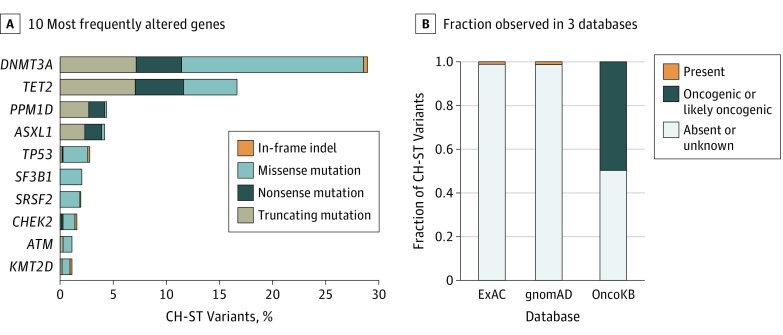
Figure 2.. Characteristics of Clonal Hematopoiesis in Solid Tumor (CH-ST) Mutations
A, Top 10 frequently altered genes with CH-ST mutations. B, Fraction of CH-ST mutations observed in ExAC, gnomAD, and OncoKB databases.

Comment in

References

    1. Zehir A, Benayed R, Shah RH, et al. Mutational landscape of metastatic cancer revealed from prospective clinical sequencing of 10,000 patients. Nat Med. 2017;23(6):703-713. doi: 10.1038/nm.4333 - DOI - PMC - PubMed
    1. Hartmaier RJ, Albacker LA, Chmielecki J, et al. High-throughput genomic profiling of adult solid tumors reveals novel insights into cancer pathogenesis. Cancer Res. 2017;77(9):2464-2475. doi: 10.1158/0008-5472.CAN-16-2479 - DOI - PubMed
    1. Sholl LM, Do K, Shivdasani P, et al. Institutional implementation of clinical tumor profiling on an unselected cancer population. JCI Insight. 2016;1(19):e87062. doi: 10.1172/jci.insight.87062 - DOI - PMC - PubMed
    1. Boland GM, Piha-Paul SA, Subbiah V, et al. Clinical next generation sequencing to identify actionable aberrations in a phase I program. Oncotarget. 2015;6(24):20099-20110. doi: 10.18632/oncotarget.4040 - DOI - PMC - PubMed
    1. Hiltemann S, Jenster G, Trapman J, van der Spek P, Stubbs A. Discriminating somatic and germline mutations in tumor DNA samples without matching normals. Genome Res. 2015;25(9):1382-1390. doi: 10.1101/gr.183053.114 - DOI - PMC - PubMed