. 2018 Jun 6;13(6):e0198691.
doi: 10.1371/journal.pone.0198691. eCollection 2018.

Phase matters: A role for the subthalamic network during gait

Affiliations

Phase matters: A role for the subthalamic network during gait

Gabriele Arnulfo et al. PLoS One. .

Abstract

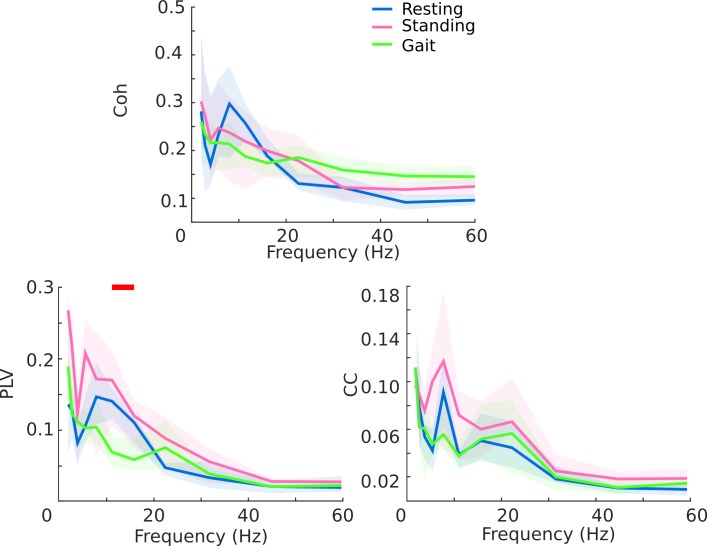
The role of the subthalamic nucleus in human locomotion is unclear although relevant, given the troublesome management of gait disturbances with subthalamic deep brain stimulation in patients with Parkinson's disease. We investigated the subthalamic activity and inter-hemispheric connectivity during walking in eight freely-moving subjects with Parkinson's disease and bilateral deep brain stimulation. In particular, we compared the subthalamic power spectral densities and coherence, amplitude cross-correlation and phase locking value between resting state, upright standing, and steady forward walking. We observed a phase locking value drop in the β-frequency band (≈13-35Hz) during walking with respect to resting and standing. This modulation was not accompanied by specific changes in subthalamic power spectral densities, which was not related to gait phases or to striatal dopamine loss measured with [123I]N-ω-fluoropropyl-2β-carbomethoxy-3β-(4-iodophenyl)nortropane and single-photon computed tomography. We speculate that the subthalamic inter-hemispheric desynchronization in the β-frequency band reflects the information processing of each body side separately, which may support linear walking. This study also suggests that in some cases (i.e. gait) the brain signal, which could allow feedback-controlled stimulation, might derive from network activity.


Conflict of interest statement

The authors declare that the research was conducted in the absence of any commercial or financial relationships that could be construed as a potential conflict of interest.

Figures
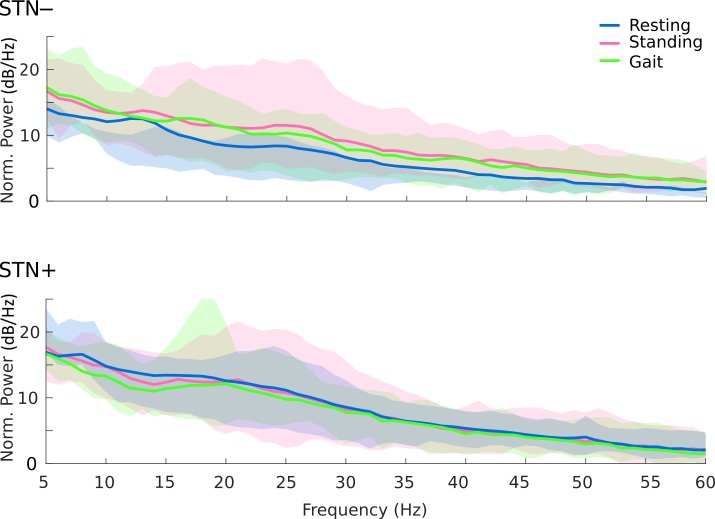
Fig 1
Fig 1. Spectral profiles (average) during resting, upright standing, and gait.
Average spectral power of the STN local field potential during resting (blue line), standing (pink line) and gait (green line) for the two hemispheres, with less (–) and more (+) striatal dopamine innervation. Results are corrected for the nominal noise floor level of the device (150nV/rtHz, [32,33]), all values above 0dB/Hz are reliable. Shaded areas represent the confidence intervals (5–95%) of the group mean. The peak at 32 Hz is a known artefact of the Activa PC+S® system tied to clock settings or due to a triggered check of the battery status.
Fig 2
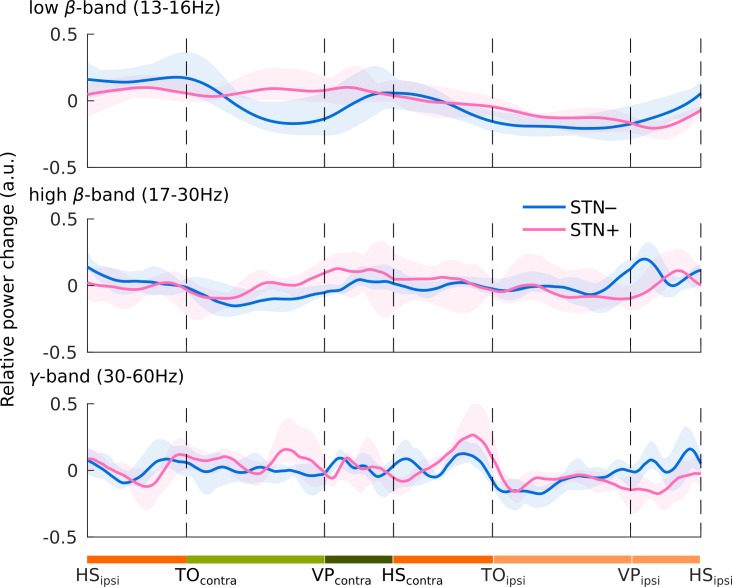
Fig 2. Modulation of the spectral power during the gait cycle.
Event related synchronization (ERS) and desynchronization (ERD) in low β- (top) high β- (middle) and γ-frequency band (bottom). Subthalamic power changes of the phases of gait are shown as the average relative change of the whole stride of all subjects. Shaded areas represent the confidence intervals (5–95%) of the group mean. We analyzed the power changes of STN–and STN+ during the gait cycle of the contralateral foot (but they could be also referred to the matched gait phases of the ipsilateral one). Stance is the period during which the foot is on the ground (dark and light orange bars). The stance phase includes a period of bilateral foot contact with the floor (double-support phases [dark orange bars]), and a period of unilateral foot contact (single-support phase [light orange bar]). The swing phase (light green and dark green bars) is the interval in which the foot is lifted from the floor. Thanks to the velocity peak (VP) of the marker placed on the lateral malleolus, we identified an acceleration (light green) a deceleration (dark green) sub-phase of the swing phase. HS = heel strike; TO = toe off; VP = velocity peak; lower case subscript indicates the foot contralateral (contra) or ipsilateral (ipsi) to STN–or STN+.
Fig 3
Fig 3. Spectral profiles (single subject) during resting, upright standing and gait.
Single subject spectral power of the STN local field potential during resting (blue line), standing (pink line) and gait for the two hemispheres, with less (–) and more (+) striatal dopamine innervation. Axial slices are left-right flipped to match the corresponding STN. The peak at 32 Hz is a known artefact of the Activa PC+S® system tied to clock settings or due to a triggered check of the battery status. SPECT scans (central column) show striatal dopaminergic loss as percentage decline with respect to healthy subjects (calculated from BPND of DAT, Table 3).
Fig 4
Fig 4. Inter-hemispheric coherence.
Inter-hemispheric coherence (Coh, top panel), phase locking value (PLV, bottom left plot) and amplitude cross-correlation (CC, bottom right plot) during resting state (blue line), upright standing (pink line) and walking (green line). Statistical significance (red bar, paired Wilcoxon test, p<0.05 uncorrected) was reached for the PLV selectively in the β-frequency band between resting state and walking. Shaded areas represent the confidence intervals (5–95%) of the group mean.

References

    1. Takakusaki K. Functional Neuroanatomy for Posture and Gait Control. J Mov Disord. Korean Movement Disorders Society; 2017;10: 1–17. doi: 10.14802/jmd.16062 - DOI - PMC - PubMed
    1. Kiehn O. Decoding the organization of spinal circuits that control locomotion. Nat Rev Neurosci. Nature Publishing Group; 2016;17: 224–238. doi: 10.1038/nrn.2016.9 - DOI - PMC - PubMed
    1. la Fougère C, Zwergal A, Rominger A, Förster S, Fesl G, Dieterich M, et al. Real versus imagined locomotion: A [18F]-FDG PET-fMRI comparison. Neuroimage. 2010; doi: 10.1016/j.neuroimage.2009.12.060 - DOI - PubMed
    1. Tard C, Delval A, Devos D, Lopes R, Lenfant P, Dujardin K, et al. Brain Metabolic Abnormalities During Gait With Freezing in Parkinson’S Disease. Neuroscience. 2015;307: 281–301. doi: 10.1016/j.neuroscience.2015.08.063 - DOI - PubMed
    1. Clark DJ. Automaticity of walking: functional significance, mechanisms, measurement and rehabilitation strategies. Front Hum Neurosci. Frontiers Media SA; 2015;9: 246 doi: 10.3389/fnhum.2015.00246 - DOI - PMC - PubMed

Publication types

MeSH terms