


Trend of Age-Adjusted Rates of Pediatric Traumatic Brain Injury in U.S. Emergency Departments from 2006 to 2013
- PMID: 29874782
- PMCID: PMC6024977
- DOI: 10.3390/ijerph15061171
Trend of Age-Adjusted Rates of Pediatric Traumatic Brain Injury in U.S. Emergency Departments from 2006 to 2013
Abstract
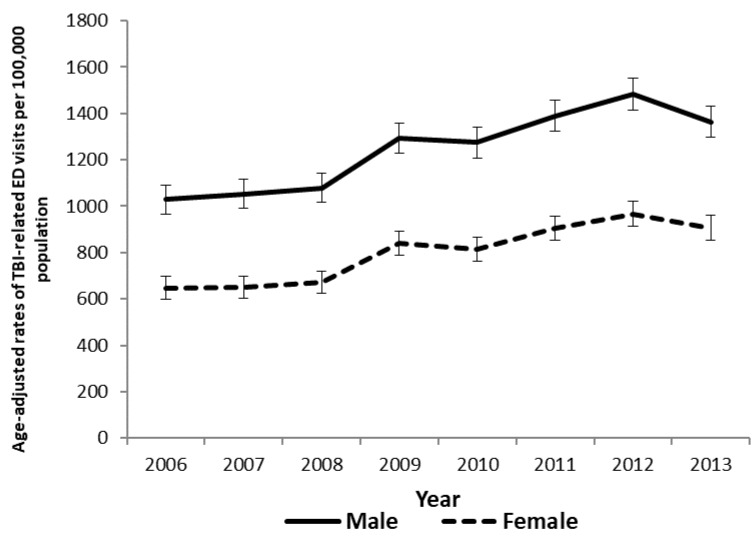
Objective: To use the 2006⁻2013 Nationwide Emergency Department Sample (NEDS) database to describe trends of age-adjusted rates of pediatric traumatic brain injuries (TBI) treated in U.S. emergency departments. Methods: Time trend analysis was conducted on age-adjusted rates among children ≤17 years in the U.S. The annual percent change (APC) was calculated by fitting a least squares regression to the logarithm of the rates, using the calendar year as an independent variable. Results: In males, motor-vehicle-related trauma (APC -2.5%) and severe TBI (APC -3.6%) decreased over the study time period. Conversely, concussion (APC 5.1%), unspecified head injury (APC 6.6%), fall-related TBI (APC 7.1%), and mild TBI (APC 5.9%) increased. In females, severe TBI (APC -3.3%) decreased over the study time period and concussion (APC 6.5%), unspecified head injury (APC 7.2%), fall-related TBI (APC 7.6%), and mild TBI (APC 6.8%) increased. Conclusion: The overall age-adjusted rates of pediatric TBI-related emergency department (ED) visits increased from 2006 to 2013, which is largely caused by pediatric mild TBIs, especially unspecified injury to the head (ICD-9-CM code 959.01) and concussion. In comparison, age-adjusted rates of pediatric severe TBIs decreased. A major contributing factor might be a reduced number of traffic-related head trauma.
Keywords: annual percent change; emergency department; pediatric; traumatic brain injury.
Conflict of interest statement
The authors declare no conflict of interest.
Figures
References
-
- Centers for Disease Control and Prevention Rates of Hospitalization Related to Traumatic Brain Injury—Nine States, 2003. Morb. Mortal. Wkly. Rep. 2007;56:167–170. - PubMed
Publication types
MeSH terms
Grants and funding
LinkOut - more resources
Full Text Sources
Other Literature Sources
Medical
