Review
. 2018 Jun 5;19(6):1663.
doi: 10.3390/ijms19061663.

Connexins and Pannexins in Vascular Function and Disease

Affiliations
Review

Connexins and Pannexins in Vascular Function and Disease

Filippo Molica et al. Int J Mol Sci. .

Abstract

Connexins (Cxs) and pannexins (Panxs) are ubiquitous membrane channel forming proteins that are critically involved in many aspects of vascular physiology and pathology. The permeation of ions and small metabolites through Panx channels, Cx hemichannels and gap junction channels confers a crucial role to these proteins in intercellular communication and in maintaining tissue homeostasis. This review provides an overview of current knowledge with respect to the pathophysiological role of these channels in large arteries, the microcirculation, veins, the lymphatic system and platelet function. The essential nature of these membrane proteins in vascular homeostasis is further emphasized by the pathologies that are linked to mutations and polymorphisms in Cx and Panx genes.

Keywords: connexin; pannexin; vascular disease; vascular physiology.


Conflict of interest statement

The authors declare no conflict of interest.

Figures
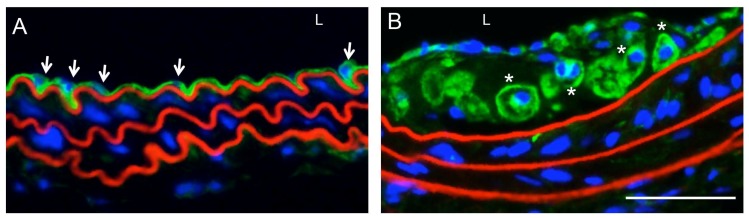
Figure 1
Figure 1
Panx1 expression in healthy and atherosclerotic arteries. (A) Panx1 (in green) is expressed in ECs (arrowheads) separating the arterial wall from the lumen (L) of a healthy mouse carotid artery; (B) Panx1 is found in lipid-laden macrophages (asterisks) present in atherosclerotic lesions. Of note, Panx1 is absent from the SMC-rich media of non-diseased and diseased conduit arteries. Nuclei are stained with DAPI (in blue) and elastic laminae are counterstained with Evans Blue (in red). Scale bar represents 25 μm.
Figure 2
Figure 2
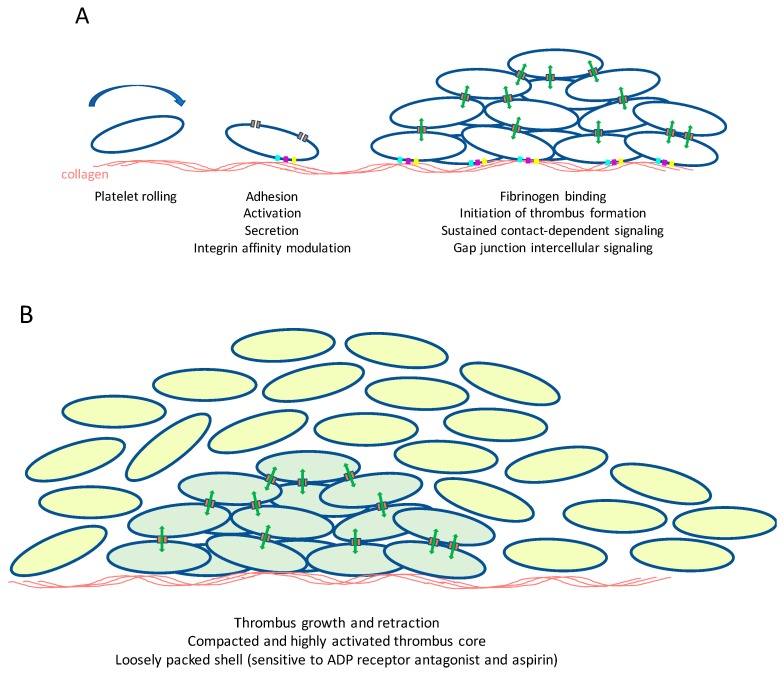
Gap junction intercellular communication between platelets: a working model. (A) Blood vessel injury leads to the exposure of subendothelial collagens. Through interaction with von Willebrand factor, which also binds to collagens, platelets roll along the surface, slowing their movement and allowing direct binding of collagen to the cell surface receptors integrin, α2β1, and GPVI, initiating platelet intracellular signaling. This results in the secretion or release of prothrombotic factors such as ADP and TXA2 that further propagate platelet activation. This culminates in an increase in affinity of integrin αIIbβ3 which then binds fibrinogen that supports platelet-platelet adhesion and thrombus formation. Close contact between platelets allows the formation of gap junctions that permit intercellular signaling during thrombus formation and stabilization; (B) Intercellular signaling controls thrombus contraction by enabling the formation of a core of platelets that are highlight activated and tightly packed. A more loosely packed shell of platelets develops, although this is inhibited in the presence of ADP receptor antagonists or aspirin (to prevent TXA2 formation). Whether gap junctional intercellular communication controls platelet thrombus core and shell assembly has yet to be formally established.

References

    1. Molica F., Meens M.J., Morel S., Kwak B.R. Mutations in cardiovascular connexin genes. Biol. Cell. 2014;106:269–293. doi: 10.1111/boc.201400038. - DOI - PubMed
    1. Abascal F., Zardoya R. Evolutionary analyses of gap junction protein families. Biochim. Biophys. Acta. 2013;1828:4–14. doi: 10.1016/j.bbamem.2012.02.007. - DOI - PubMed
    1. Laird D.W. Life cycle of connexins in health and disease. Pt 3Biochem. J. 2006;394:527–543. doi: 10.1042/BJ20051922. - DOI - PMC - PubMed
    1. Thevenin A.F., Kowal T.J., Fong J.T., Kells R.M., Fisher C.G., Falk M.M. Proteins and mechanisms regulating gap-junction assembly, internalization, and degradation. Physiology. 2013;28:93–116. doi: 10.1152/physiol.00038.2012. - DOI - PMC - PubMed
    1. Patel D., Zhang X., Veenstra R.D. Connexin hemichannel and pannexin channel electrophysiology: How do they differ? FEBS Lett. 2014;588:1372–1378. doi: 10.1016/j.febslet.2013.12.023. - DOI - PMC - PubMed

LinkOut - more resources