


Using Co-Design to Develop a Collective Leadership Intervention for Healthcare Teams to Improve Safety Culture
- PMID: 29874883
- PMCID: PMC6025638
- DOI: 10.3390/ijerph15061182
Using Co-Design to Develop a Collective Leadership Intervention for Healthcare Teams to Improve Safety Culture
Abstract
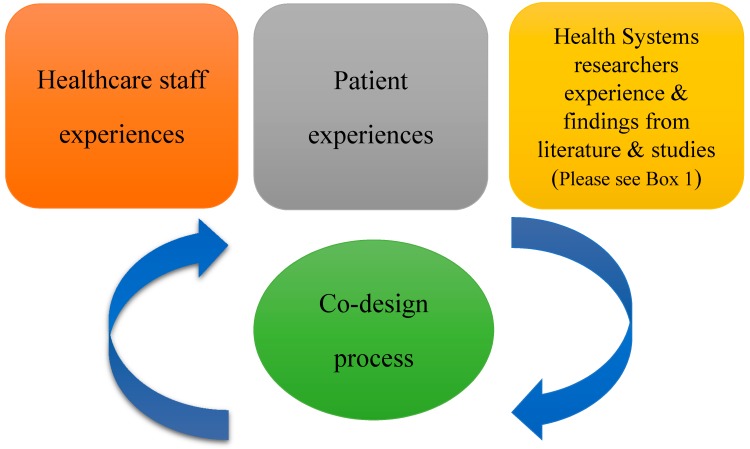
While co-design methods are becoming more popular in healthcare; there is a gap within the peer-reviewed literature on how to do co-design in practice. This paper addresses this gap by delineating the approach taken in the co-design of a collective leadership intervention to improve healthcare team performance and patient safety culture. Over the course of six workshops healthcare staff, patient representatives and advocates, and health systems researchers collaboratively co-designed the intervention. The inputs to the process, exercises and activities that took place during the workshops and the outputs of the workshops are described. The co-design method, while challenging at times, had many benefits including grounding the intervention in the real-world experiences of healthcare teams. Implications of the method for health systems research are discussed.
Keywords: co-design; co-production; collective leadership; safety culture; team performance.
Conflict of interest statement
The authors declare no conflicts of interest.
Figures
References
-
- Blackwell W.N.R., Lowton K., Robert G., Grudzen C., Grocott P. Using Experience-based Co-design with older patients, their families and staff to improve palliative care experiences in the Emergency Department: A reflective critique on the process and outcomes. Int. J. Nurs. Stud. 2017;68:83–94. doi: 10.1016/j.ijnurstu.2017.01.002. - DOI - PubMed
-
- Manikam L., Shah R., Reed K., Santini G., Lakhanpaul M. Using a co-production prioritization exercise involving South Asian children, young people and their families to identify health priorities requiring further research and public awareness. Health Expect. 2017;20:852–861. doi: 10.1111/hex.12524. - DOI - PMC - PubMed
-
- Bovaird T., Loeffler E. From engagement to co-production: How users and communities contribute to public services. In: Brandsen T., Pestoff V., editors. New Public Governance, the Third Sector and Co-Production. Routledge; London, UK: 2012.
Publication types
MeSH terms
LinkOut - more resources
Full Text Sources
Other Literature Sources
Medical
Miscellaneous
