. 2018 Sep;171(2):399-411.
doi: 10.1007/s10549-018-4841-8. Epub 2018 Jun 6.

Machine-learning-derived classifier predicts absence of persistent pain after breast cancer surgery with high accuracy

Affiliations

Machine-learning-derived classifier predicts absence of persistent pain after breast cancer surgery with high accuracy

Jörn Lötsch et al. Breast Cancer Res Treat. 2018 Sep.

Abstract

Background: Prevention of persistent pain following breast cancer surgery, via early identification of patients at high risk, is a clinical need. Supervised machine-learning was used to identify parameters that predict persistence of significant pain.

Methods: Over 500 demographic, clinical and psychological parameters were acquired up to 6 months after surgery from 1,000 women (aged 28-75 years) who were treated for breast cancer. Pain was assessed using an 11-point numerical rating scale before surgery and at months 1, 6, 12, 24, and 36. The ratings at months 12, 24, and 36 were used to allocate patents to either "persisting pain" or "non-persisting pain" groups. Unsupervised machine learning was applied to map the parameters to these diagnoses.

Results: A symbolic rule-based classifier tool was created that comprised 21 single or aggregated parameters, including demographic features, psychological and pain-related parameters, forming a questionnaire with "yes/no" items (decision rules). If at least 10 of the 21 rules applied, persisting pain was predicted at a cross-validated accuracy of 86% and a negative predictive value of approximately 95%.

Conclusions: The present machine-learned analysis showed that, even with a large set of parameters acquired from a large cohort, early identification of these patients is only partly successful. This indicates that more parameters are needed for accurate prediction of persisting pain. However, with the current parameters it is possible, with a certainty of almost 95%, to exclude the possibility of persistent pain developing in a woman being treated for breast cancer.

Keywords: Bioinformatics; Chronification; Data science; Pain.


Conflict of interest statement

The authors have declared no competing interests.

Figures
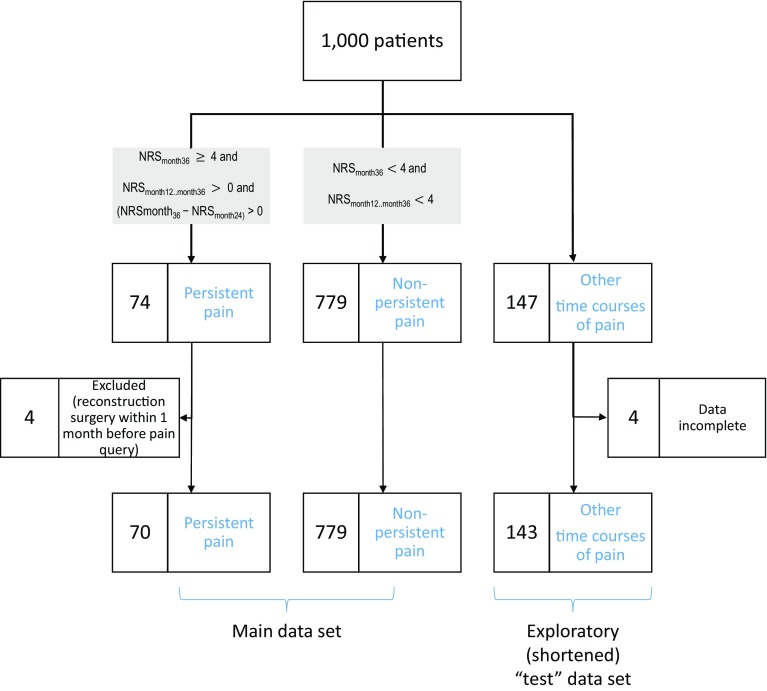
Fig. 1
Fig. 1
Flow chart showing the classification of the patients on the basis of the 3-year development of pain following breast cancer surgery. A total of 853 women fell into the two main groups of persisting or non-persisting pain, according to the criteria displayed in the gray-shaded frames. This was the main cohort that was analyzed. The remaining 143 women in whom the criteria for class assignment applied only partly were therefore excluded from machine-learned classifier establishment but they were used as an exploratory shortened “test” data set. Incomplete returns of pain questionnaires were dealt with by imputation as detailed in the methods section
Fig. 2
Fig. 2
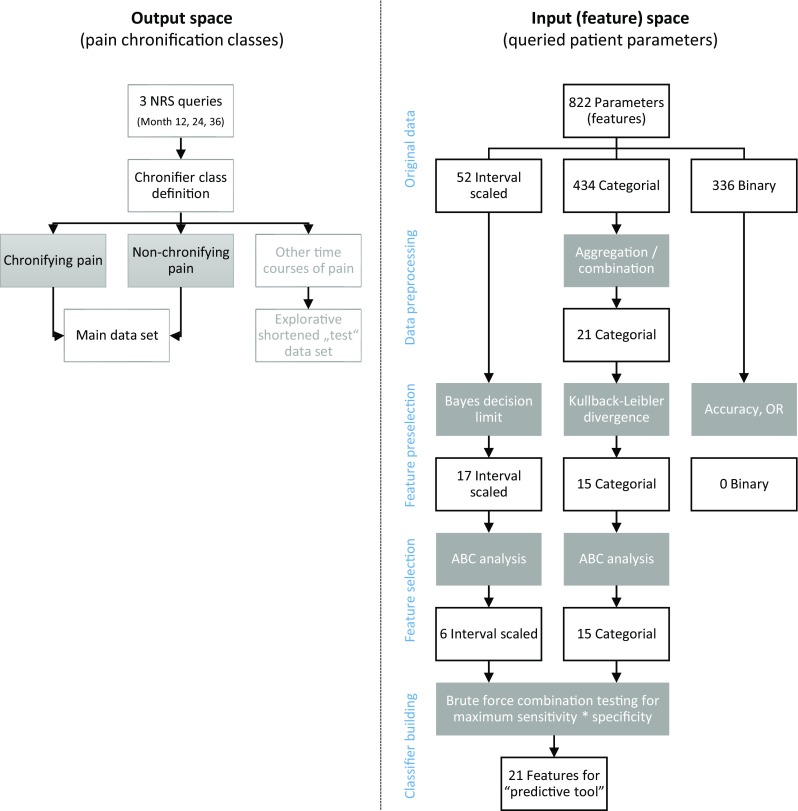
Flow chart of the data analysis. The figure provides an overview on the applied machine-learning approach in four steps (indicated in blue: output space preparation, input space feature pre-selection, feature selection and classifier building, including validation). The white frames show the variable flow; the gray frames depict the bioinformatics operation applied on the variables. During feature pre-selection and feature selection, the number of candidate variables qualifying as component s of a diagnostic tool respectively classifier was stepwise reduced (initially 542, finally 21), forwarding to the next analytical step only those features that had passed the criteria of the actual selection procedure. The Bayesian decision limit and Kullback–Leibler divergence refer to the respective standard procedure presented elsewhere [28, 35]
Fig. 3
Fig. 3
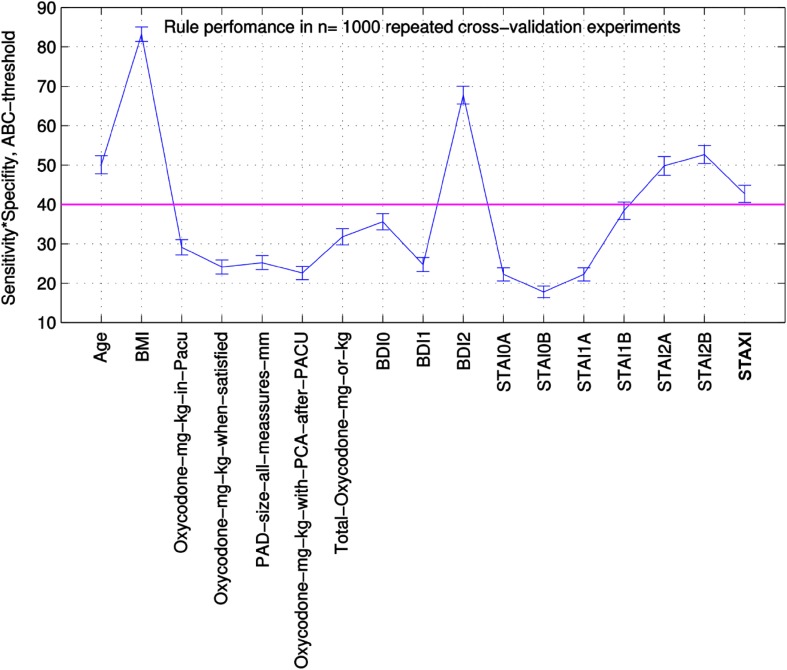
Performance of the continuous variables with a Bayesian decision boundary in 1,000 repeated cross-validations. The n = 17 continuous variables were subjected to an ABC analysis (for ABC analysis, see [56]). The set A (best performers) was characterized by a sensitivity · specificity > 40% (threshold; magenta line). The resulting 6 variables in set A were included in the classifier construction. Names of variables above the threshold: Age, BMI, BDI0 = preoperative BDI, BDI1 = BDI at 1 month after surgery, BDI2 = BDI at 6 months after surgery, STAI0A, STAI1A, STAI2A = State anxiety (STAI) aquired preoperatively and at 1 month and 6 months after surgery, respectively, STAI0B, STAI1B, STAI2B = Trait anxiety (STAI) aquired preoperatively and at 1 and 6 months postoperatively, respectively, STAXI = Anger inhibition (STAXI)
Fig. 4
Fig. 4
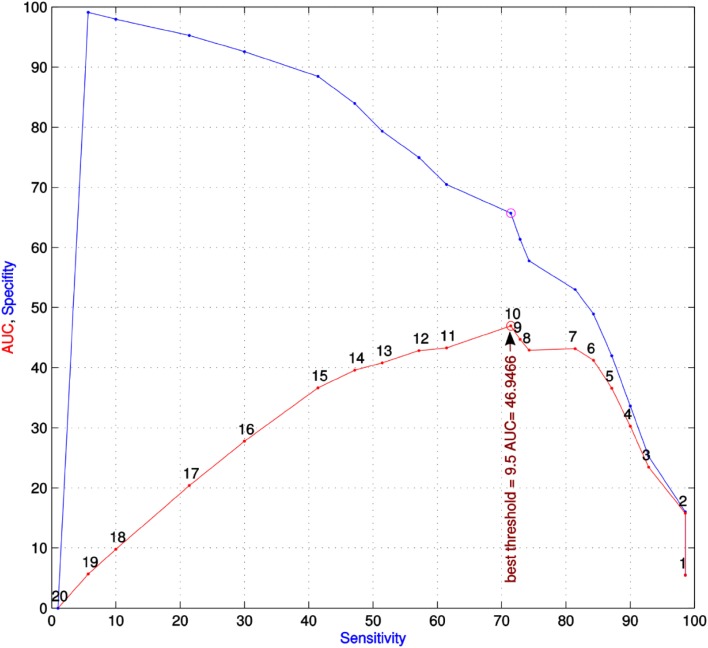
Plot of the specificity versus the sensitivity of using all possible combinations and thresholds for the 21 candidate predictors of persistent pain after breast cancer surgery (classifier construction). The number of conditions for a positive classification into the “persisting pain” groups ranges from n = 1–20 conditions. For all of these positive conditions, the sensitivity, specificity, and the area under the curve (AUC = sensitivity · specificity) was calculated. The red dots in the figure show AUC versus sensitivity. The black numbers close to the red dots indicate the number of conditions to be true according to the questions in Table 2. The maximum AUC, i.e., the best number of conditions for a classifier, was obtained with at least 10 positive items from Table 2, which was the result of the analysis shown in this figure and the reason why the final predictive tool required 10 or more positive items. The blue dots in the blue line indicate the corresponding specificity (ordinate) versus sensitivity (abscissa) values. The lines have been drawn to enhance visibility and are spline interpolations

References

    1. Andersen KG, Kehlet H. Persistent pain after breast cancer treatment: a critical review of risk factors and strategies for prevention. J Pain. 2011;12:725–746. doi: 10.1016/j.jpain.2010.12.005. - DOI - PubMed
    1. Beck AT, Ward CM, Mendelson M, Mock JE, Erbaugh JK. An inventory for measuring depression. Arch Gen Psychiat. 1961;4:561–571. doi: 10.1001/archpsyc.1961.01710120031004. - DOI - PubMed
    1. Bray F, Ren JS, Masuyer E, Ferlay J. Global estimates of cancer prevalence for 27 sites in the adult population in 2008. Int J Cancer. 2013;132:1133–1145. doi: 10.1002/ijc.27711. - DOI - PubMed
    1. Bruce J, Thornton AJ, Scott NW, Marfizo S, Powell R, Johnston M, Wells M, Heys SD, Thompson AM. Chronic preoperative pain and psychological robustness predict acute postoperative pain outcomes after surgery for breast cancer. Br J Cancer. 2012;107:937–946. doi: 10.1038/bjc.2012.341. - DOI - PMC - PubMed
    1. Burke AL, Mathias JL, Denson LA. Psychological functioning of people living with chronic pain: a meta-analytic review. Br J Clin Psychol. 2015;54:345–360. doi: 10.1111/bjc.12078. - DOI - PubMed