


Taste Perception of Antidesma bunius Fruit and Its Relationships to Bitter Taste Receptor Gene Haplotypes
- PMID: 29878085
- PMCID: PMC6108389
- DOI: 10.1093/chemse/bjy037
Taste Perception of Antidesma bunius Fruit and Its Relationships to Bitter Taste Receptor Gene Haplotypes
Abstract
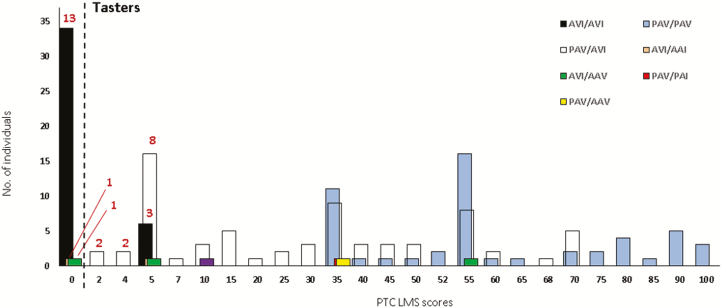
It was shown more than 40 years ago that the ability to perceive the bitterness of the fruit of the Antidesma bunius tree is inversely correlated with the ability to perceive the well-studied bitter tastant phenylthiocarbamide (PTC). To determine if variants of the TAS2R38 gene, which encodes the PTC taste receptor, or variants in any of the other TAS2R bitter or TAS1R sweet receptor genes account for Antidesma taste perception, we recruited an independent subject sample and examined associations between these taste receptor gene haplotypes and Antidesma perception. Consistent with previous findings, almost none of our subjects who reported Antidesma juice as bitter was a PTC "responder" by previous definitions (i.e. a PTC taster). In our study, of the 132 individuals who perceived PTC as bitter, 15 perceived Antidesma as bitter, although these 15 subjects had very weak bitterness perception scores. Examination of TAS2R38 gene haplotypes showed that, of the subjects who perceive Antidesma as bitter, all carried at least one copy of the TAS2R38 AVI (PTC non-taster) haplotype. However, 86 subjects carried at least one AVI haplotype and failed to perceive Antidesma as bitter. No other TAS2R or TAS1R gene variants showed an association with Antidesma bitter, sweet, or sour perception. Our results show that TAS2R38 haplotypes are associated with differential perception of Antidesma berry juice bitterness, and that all those who perceive this bitterness carry at least one AVI haplotype. This indicates that the AVI haplotype is necessary for this perception, but that additional variable factors are involved.
Figures
Comment in
-
Bitter Fruit: Inverse Associations Between PTC and Antidesma bunius Perception.Chem Senses. 2018 Aug 24;43(7):447-450. doi: 10.1093/chemse/bjy044. Chem Senses. 2018. PMID: 29982450
References
-
- Adler E, Hoon MA, Mueller KL, Chandrashekar J, Ryba NJ, Zuker CS. 2000. A novel family of mammalian taste receptors. Cell. 100:693–702. - PubMed
Publication types
MeSH terms
Substances
LinkOut - more resources
Full Text Sources
Other Literature Sources
Medical
