. 2018 Jun;192(3):284-291.
doi: 10.1111/cei.13125.

The United Kingdom Primary Immune Deficiency (UKPID) registry 2012 to 2017

Affiliations

The United Kingdom Primary Immune Deficiency (UKPID) registry 2012 to 2017

B Shillitoe et al. Clin Exp Immunol. 2018 Jun.

Abstract

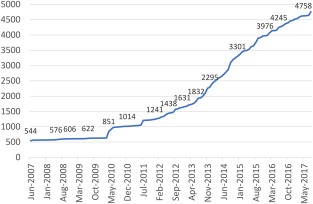
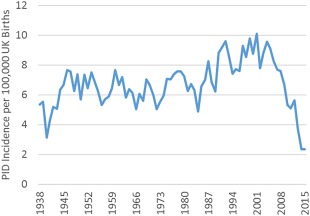
This is the second report of the United Kingdom Primary Immunodeficiency (UKPID) registry. The registry will be a decade old in 2018 and, as of August 2017, had recruited 4758 patients encompassing 97% of immunology centres within the United Kingdom. This represents a doubling of recruitment into the registry since we reported on 2229 patients included in our first report of 2013. Minimum PID prevalence in the United Kingdom is currently 5·90/100 000 and an average incidence of PID between 1980 and 2000 of 7·6 cases per 100 000 UK live births. Data are presented on the frequency of diseases recorded, disease prevalence, diagnostic delay and treatment modality, including haematopoietic stem cell transplantation (HSCT) and gene therapy. The registry provides valuable information to clinicians, researchers, service commissioners and industry alike on PID within the United Kingdom, which may not otherwise be available without the existence of a well-established registry.

Keywords: autoimmunity; autoinflammatory disease; human; immunodeficiency diseases; transplantation.


Figures

Figure 1
Figure 1
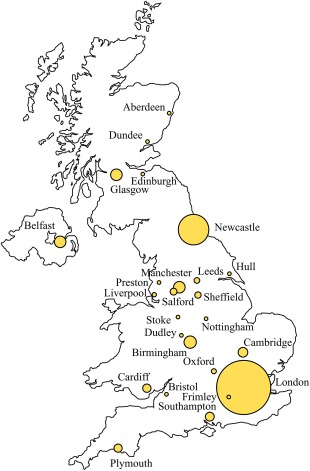
Geographical distribution of patients enrolled in the United Kingdom Primary Immune Deficiency (UKPID) Registry by city or town of documenting centre. The diameter of the circle is directly proportional to the number of patients enrolled in each centre.
Figure 2
Figure 2
Recruitment of total patient numbers into the United Kingdom Primary Immunodeficiency Registry.
Figure 3
Figure 3
UK incidence of registered primary immunodeficiency (PID) per 100 000 live births.
Figure 4
Figure 4
Number of primary immunodeficiency (PID) patients undergoing haematopoietic stem cell transplantation (HSCT) or gene therapy.

References

    1. Grimbacher B. The European Society for Immunodeficiencies (ESID) registry 2014. Clin Exp Immunol 2014; 178:18–20. - PMC - PubMed
    1. Edgar JDM, Buckland M, Guzman D et al The United Kingdom Primary Immune Deficiency (UKPID) Registry: report of the first 4 years' activity 2008–2012. Clin Exp Immunol 2014; 175:68–78. - PMC - PubMed
    1. Picard C, Al‐Herz W, Bousfiha A et al Primary immunodeficiency diseases: an update on the classification from the International Union of Immunological Societies Expert Committee for primary immunodeficiency 2015. J Clin Immunol 2015; 35:696–726. - PMC - PubMed
    1. Eades‐Perner A‐MM, Gathmann B, Knerr V et al The European internet‐based patient and research database for primary immunodeficiencies: results 2004‐06. Clin Exp Immunol 2007; 147:306–12. - PMC - PubMed
    1. Gathmann B, Grimbacher B, Beauté J et al The European internet‐based patient and research database for primary immunodeficiencies: results 2006–2008. Clin Exp Immunol 2009; 157:3–11. - PMC - PubMed

MeSH terms