. 2019 Jan;17(1):252-263.
doi: 10.1111/pbi.12961. Epub 2018 Jul 6.

QQS orphan gene and its interactor NF-YC4 reduce susceptibility to pathogens and pests

Affiliations

QQS orphan gene and its interactor NF-YC4 reduce susceptibility to pathogens and pests

Mingsheng Qi et al. Plant Biotechnol J. 2019 Jan.

Abstract

Enhancing the nutritional quality and disease resistance of crops without sacrificing productivity is a key issue for developing varieties that are valuable to farmers and for simultaneously improving food security and sustainability. Expression of the Arabidopsis thaliana species-specific AtQQS (Qua-Quine Starch) orphan gene or its interactor, NF-YC4 (Nuclear Factor Y, subunit C4), has been shown to increase levels of leaf/seed protein without affecting the growth and yield of agronomic species. Here, we demonstrate that overexpression of AtQQS and NF-YC4 in Arabidopsis and soybean enhances resistance/reduces susceptibility to viruses, bacteria, fungi, aphids and soybean cyst nematodes. A series of Arabidopsis mutants in starch metabolism were used to explore the relationships between QQS expression, carbon and nitrogen partitioning, and defense. The enhanced basal defenses mediated by QQS were independent of changes in protein/carbohydrate composition of the plants. We demonstrate that either AtQQS or NF-YC4 overexpression in Arabidopsis and in soybean reduces susceptibility of these plants to pathogens/pests. Transgenic soybean lines overexpressing NF-YC4 produce seeds with increased protein while maintaining healthy growth. Pull-down studies reveal that QQS interacts with human NF-YC, as well as with Arabidopsis NF-YC4, and indicate two QQS binding sites near the NF-YC-histone-binding domain. A new model for QQS interaction with NF-YC is speculated. Our findings illustrate the potential of QQS and NF-YC4 to increase protein and improve defensive traits in crops, overcoming the normal growth-defense trade-offs.

Keywords: QQS; NF-YC4; carbon and nitrogen partitioning; orphan; pathogen; pest.


Figures

Figure 1
Figure 1
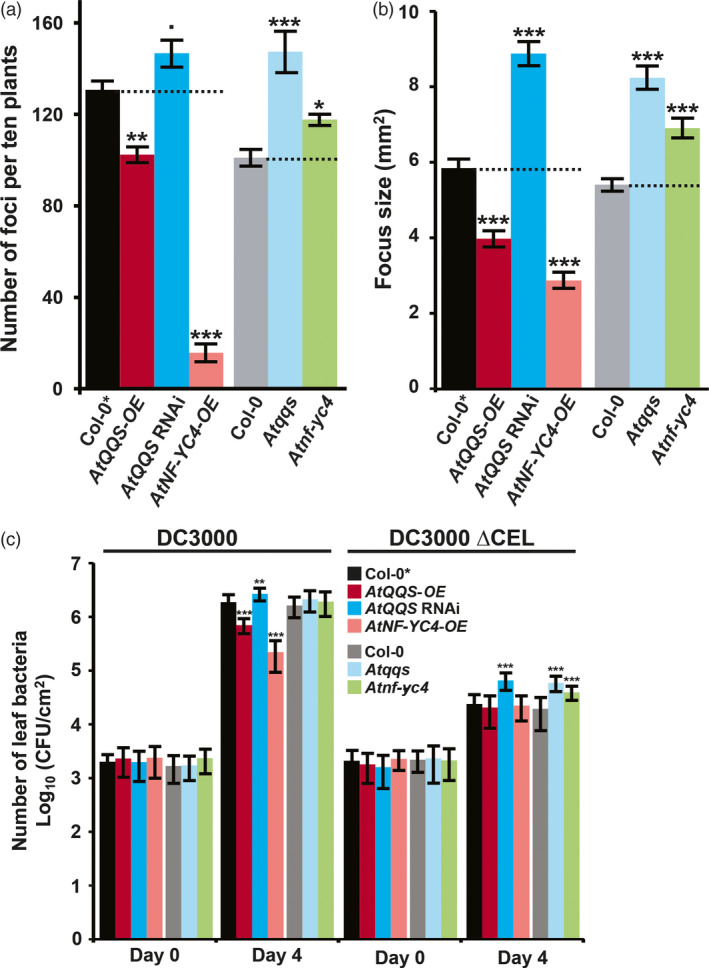
Arabidopsis mutants of QQS and its interactor NFYC4 have altered susceptibility to viral and bacterial infection. Mutants: transgenic AtQQS RNAi, AtQQSOE and AtNFYC4‐OE in Arabidopsis Col‐0* (few trichomes), and T‐DNA knockout mutants Atqqs, and Atnf‐yc4 in Col‐0 (trichomes). (a) The numbers of TuMVGFP infection foci at 120 HAI, (b) the sizes of TuMVGFP infection foci at 120 HAI and (c) the growth of the Pst DC3000 (DC3000) and CUCPB5115 (Pst DC3000 ΔCEL) bacterial strains were altered in the mutants. CFU, colony forming units. All data in bar charts show mean ± SE (standard error), n = 3. Statistical significance was determined as described in Appendix S1 ‘Experiment design and statistical methods’: ***< 0.001; **< 0.01; *< 0.05; •< 0.1.
Figure 2
Figure 2
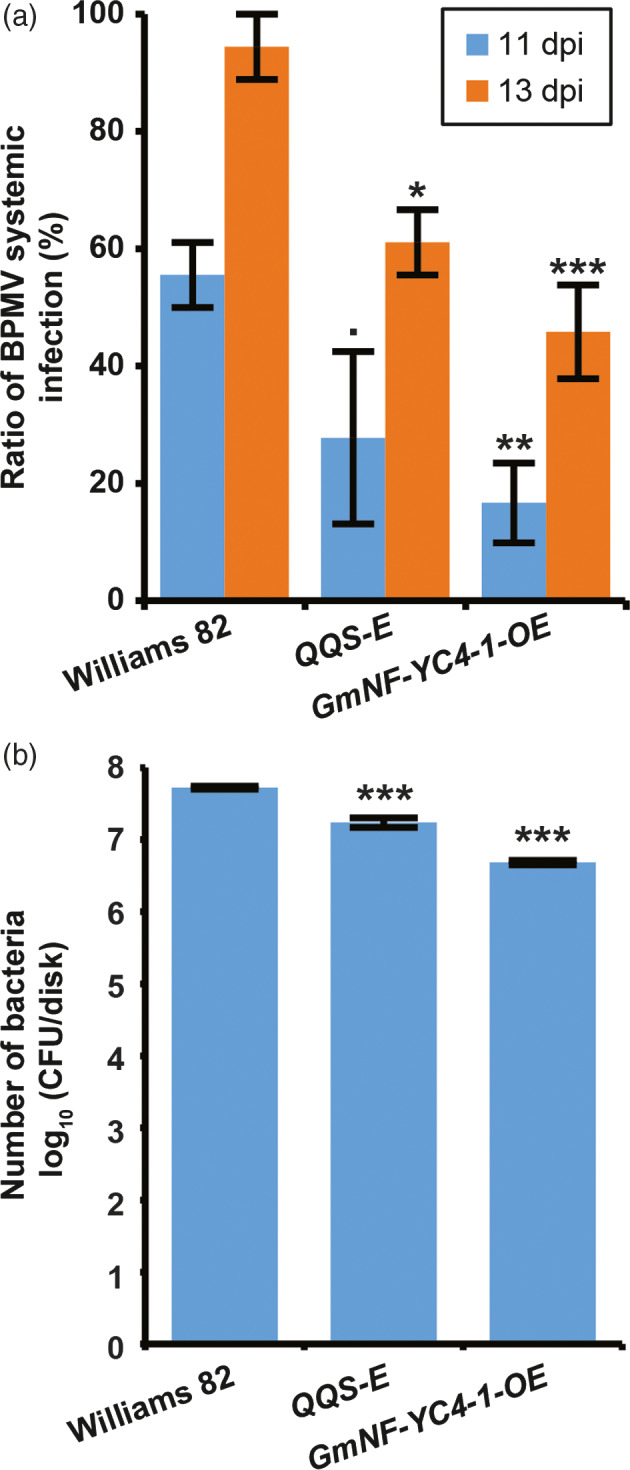
Transgenic soybean lines constitutively expressing AtQQS or overexpressing GmNFYC4‐1 had decreased viral and bacterial infection. (a) Systemic infection of BPMV was decreased at both 11 and 13 DPI. (b) Growth of PsgR4 was decreased at 7 DPI. CFU, colony forming units. All data in bar charts show mean ± SE,= 3. ***< 0.001; **< 0.01; *< 0.05; •< 0.1.
Figure 3
Figure 3
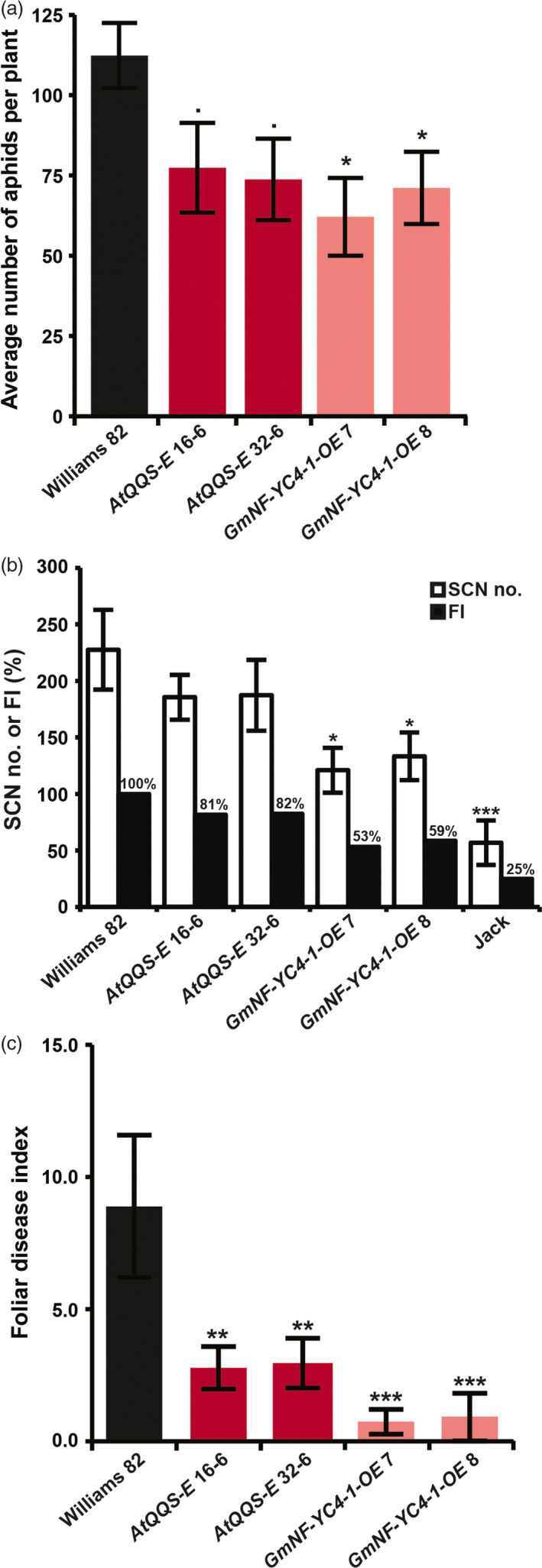
Aphid, SCN and SDS performance were altered in soybean AtQQS‐E and GmNFYC4‐1‐OE mutants. (a) Aphid number, (b) number of soybean cyst nematode females and (c) foliar disease index were decreased in mutants. FI, female index; Williams 82 and Jack lines of soybean, controls for highly susceptible and resistant, respectively. Bar graphs show mean ± SE,= 10 (a) or 6 (b and c). ***< 0.001; **< 0.01; *< 0.05; •< 0.1.
Figure 4
Figure 4
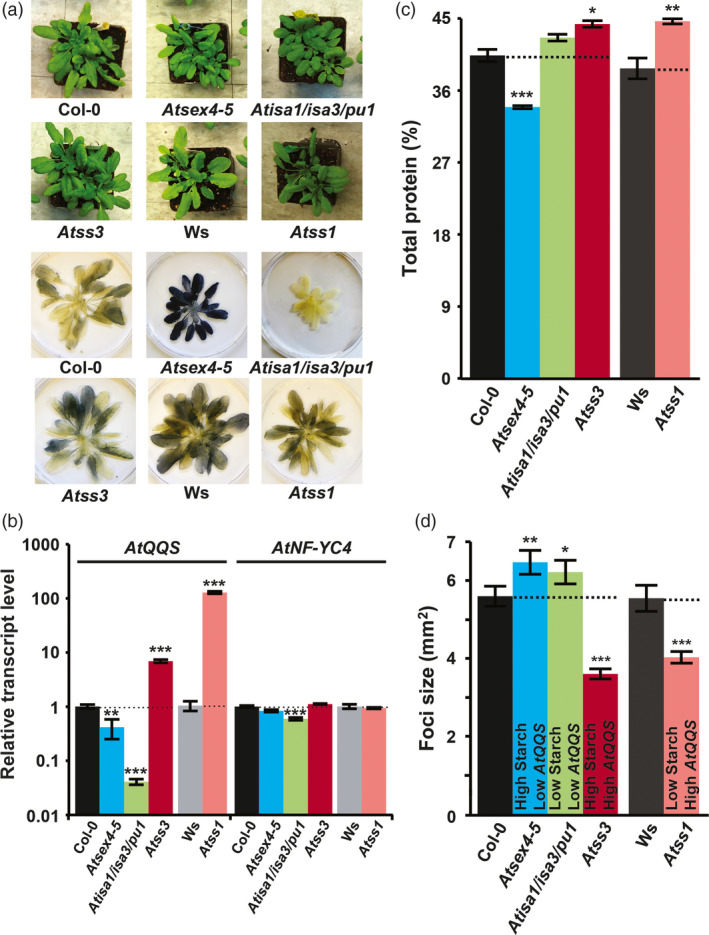
Virus infection of Arabidopsis starch mutants is correlated with QQS transcript level. (a) Leaf starch accumulation, (b) the transcript levels of QQS and NFYC4 in mutants, quantified by real‐time PCR, and (c) leaf protein content, at the end of light period. (d) The average sizes of TuMVGFP infection foci at 120 HAI were increased in plants with down‐regulated AtQQS and decreased in plants overexpressing AtQQS . Bar charts show mean ± SE,= 3. ***< 0.001; **< 0.01; *< 0.05.
Figure 5
Figure 5
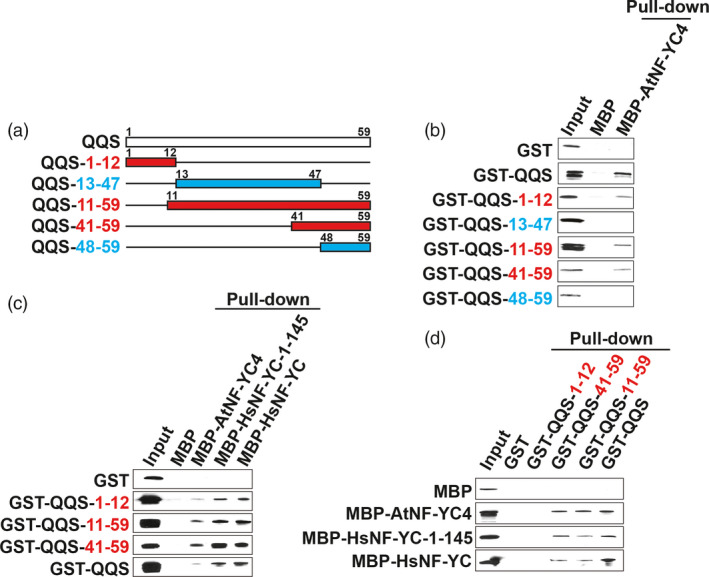
QQS binding with NFYC4. (a) QQS fragments used for pull‐down assays. NFYC fragments used are shown in Figure S5. (b) MBP pull‐down assays: QQS binds to AtNFYC4 in the regions of aa 1‐12 and aa 41‐59. (c) MBP pull‐down assays: QQS binds to HsNFYC in the regions of aa 1‐12 and aa 41‐59. (d) GST pull‐down assays: QQS fragments bind to AtNFYC4, full‐length HsNFYC and the first‐145‐aa N‐terminal of HsNFYC. Blue font, no interaction, red font, interaction between QQS fragments and NFYC.
Figure 6
Figure 6
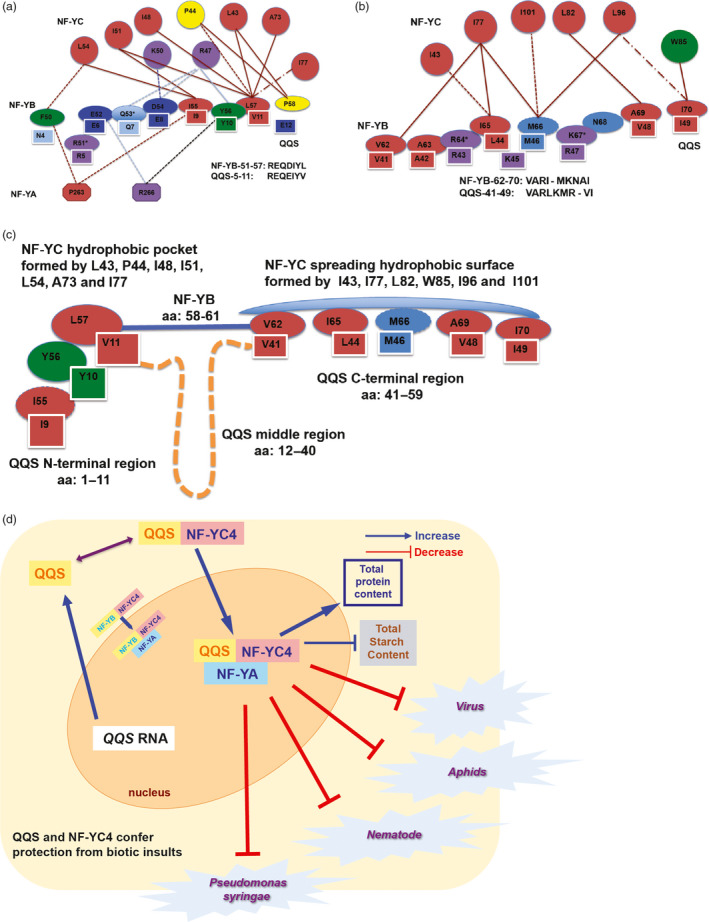
QQS binding sites with NFYC and speculated model for QQS and NFYC4‐induced changes in composition and plant defense. (a) Model of the interactions of NFYB‐51‐57, NFYC, and NFYA, and the QQS‐5‐11 interactions with NFYC. (b) Model of the interactions of NFYB‐62‐70 and NFYC, and the QQS‐41‐49 interactions with NFYC. NFYB‐62‐70 are not in contact with NFYA, so NFYA is not represented here. See Figure S6a,b for detailed explanation of the models, which are based on analysis of previously published crystal structure data [Protein Database Bank (PDB) IDs: 1N1J (Romier et al., 2003) and 4 AWL (Nardini et al., 2013)]. (c) QQS binds to two NFYC hydrophobic interfaces. Based on the sequence similarity between QQS‐5‐11 and QQS‐41‐49 and the NFYB N‐terminal region, we propose QQS binds to two NFYC hydrophobic interfaces that the NFYB N‐terminal region binds to (Figure 6a,b). However, NFYB only has three residues (aa from 58 to 61, solid light blue line) in α1 to link the two binding sites and QQS has a 29‐residue long fragment (aa 12–40, dashed yellow line) to link the QQS N‐ and C‐terminal binding sites. Shape of the residues: octagon, NFYA; ellipse, NFYB; circle, NFNC; and shaded rectangle, QQS. Colour of residues represents the polarity and hydrophobicity: red, aliphatic; purple, negatively charged; blue, positively charged; light blue, polar; green, aromatic; and yellow, unique Pro (P). The distance cut‐offs for interaction: 5 Å for hydrophobic interaction, 6 Å for ionic interaction and cation‐pi interaction, and 3.5 Å and 4.0 Å for hydrogen bond when the donor is oxygen/nitrogen and sulphur, respectively. Solid line represents the interaction in both 1N1J and 4 AWL, the broken line in 1N1J only, and the dashed line in 4 AWL only. The colour of the lines represents the type of interaction: dark red, hydrophobic interaction; light blue, hydrogen bond; dark blue, ionic interaction; and black, cation‐pi interaction. The residue marked with * is in contact with DNA within 5 Å. (d) Proposed model of defense priming by QQS: QQS/NFYC4 protein complex moves to the nucleus, binding NFYA to regulate transcription of downstream genes. QQS may compete with NFYB to bind NFYC, thus altering the NF‐Y protein complex.

References

    1. Arendsee, Z.W. , Li, L. and Wurtele, E.S. (2014) Coming of age: orphan genes in plants. Trends Plant Sci. 19, 698–708. - PubMed
    1. Badel, J.L. , Shimizu, R. , Oh, H.S. and Collmer, A. (2006) A Pseudomonas syringae pv. tomato avrE1/hopM1 mutant is severely reduced in growth and lesion formation in tomato. Mol. Plant Microbe Interact. 19, 99–111. - PubMed
    1. Benedetti, M. , Pontiggia, D. , Raggi, S. , Cheng, Z. , Scaloni, F. , Ferrari, S. , Ausubel, F.M. et al. (2015) Plant immunity triggered by engineered in vivo release of oligogalacturonides, damage‐associated molecular patterns. Proc. Natl Acad. Sci. USA, 112, 5533–5538. - PMC - PubMed
    1. Blackman, R.L. and Eastop, V.F. (2000) Aphids on the World's Crops: An Identification and Information Guide. Chichester and New York, NY: Wiley.
    1. Bolton, M.D. (2009) Primary metabolism and plant defense–fuel for the fire. Mol. Plant Microbe Interact. 22, 487–497. - PubMed

Publication types

MeSH terms