


Vital Signs: Trends in State Suicide Rates - United States, 1999-2016 and Circumstances Contributing to Suicide - 27 States, 2015
- PMID: 29879094
- PMCID: PMC5991813
- DOI: 10.15585/mmwr.mm6722a1
Vital Signs: Trends in State Suicide Rates - United States, 1999-2016 and Circumstances Contributing to Suicide - 27 States, 2015
Abstract
Introduction: Suicide rates in the United States have risen nearly 30% since 1999, and mental health conditions are one of several factors contributing to suicide. Examining state-level trends in suicide and the multiple circumstances contributing to it can inform comprehensive state suicide prevention planning.
Methods: Trends in age-adjusted suicide rates among persons aged ≥10 years, by state and sex, across six consecutive 3-year periods (1999-2016), were assessed using data from the National Vital Statistics System for 50 states and the District of Columbia. Data from the National Violent Death Reporting System, covering 27 states in 2015, were used to examine contributing circumstances among decedents with and without known mental health conditions.
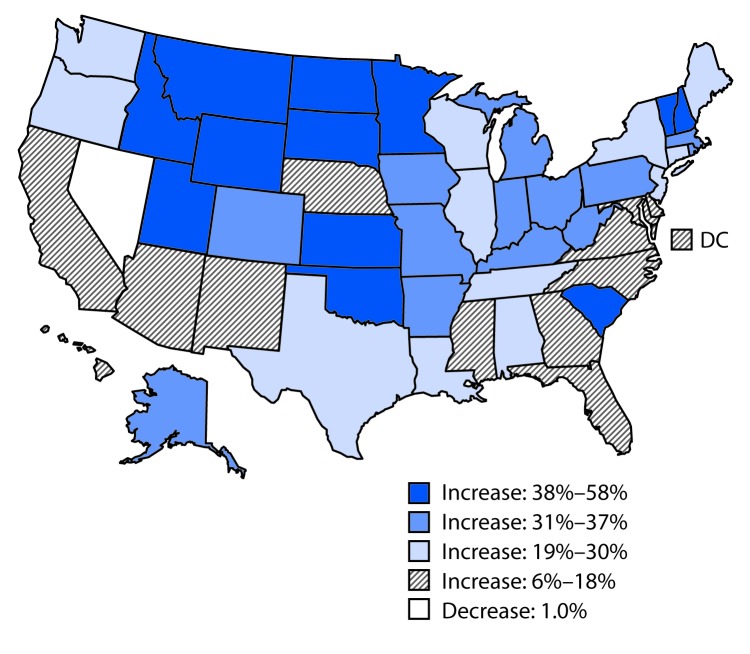
Results: During 1999-2016, suicide rates increased significantly in 44 states, with 25 states experiencing increases >30%. Rates increased significantly among males and females in 34 and 43 states, respectively. Fifty-four percent of decedents in 27 states in 2015 did not have a known mental health condition. Among decedents with available information, several circumstances were significantly more likely among those without known mental health conditions than among those with mental health conditions, including relationship problems/loss (45.1% versus 39.6%), life stressors (50.5% versus 47.2%), and recent/impending crises (32.9% versus 26.0%), but these circumstances were common across groups.
Conclusions: Suicide rates increased significantly across most states during 1999-2016. Various circumstances contributed to suicides among persons with and without known mental health conditions.
Implications for public health practice: States can use a comprehensive evidence-based public health approach to prevent suicide risk before it occurs, identify and support persons at risk, prevent reattempts, and help friends and family members in the aftermath of a suicide.
Conflict of interest statement
No conflicts of interest were reported.
Figures
Comment in
-
The increase of suicide rates: the need for a paradigm shift.Lancet. 2018 Aug 11;392(10146):474-475. doi: 10.1016/S0140-6736(18)31498-3. Epub 2018 Aug 9. Lancet. 2018. PMID: 30129456 No abstract available.
References
-
- CDC. Web-based Injury Statistics Query and Reporting System (WISQARS). Atlanta, GA: US Department of Health and Human Services, CDC, National Center for Injury Prevention and Control; 2018. https://www.cdc.gov/injury/wisqars/index.html
-
- Curtin SC, Warner M, Hedegaard H. Increase in suicide in the United States, 1999–2014. NCHS data brief no. 241. Hyattsville, MD: US Department of Health and Human Services, CDC, National Center for Health Statistics; 2016. https://www.cdc.gov/nchs/data/databriefs/db241.pdf
-
- Kochanek K, Murphy S, Xu J, Arias E. Mortality in the United States, 2016. NCHS data brief no. 293. Hyattsville, MD: US Department of Health and Human Services, CDC, National Center for Health Statistics; 2017. https://www.cdc.gov/nchs/data/databriefs/db293.pdf
-
- Office of the Surgeon General; National Action Alliance for Suicide Prevention. 2012 National strategy for suicide prevention: goals and objectives for action. Washington, DC: US Department of Health and Human Services, Office of the Surgeon General; 2012. https://www.surgeongeneral.gov/library/reports/national-strategy-suicide... - PubMed
MeSH terms
LinkOut - more resources
Full Text Sources
Other Literature Sources
Medical
