


How do clinicians use implementation tools to apply breast cancer screening guidelines to practice?
- PMID: 29879984
- PMCID: PMC5992659
- DOI: 10.1186/s13012-018-0765-2
How do clinicians use implementation tools to apply breast cancer screening guidelines to practice?
Abstract
Background: Implementation tools (iTools) may enhance uptake of guidelines. However, little evidence exists on their use by primary care clinicians. This study explored which iTools clinicians used and how often; how satisfied clinicians were with the tools; whether tool use was associated with practice changes; and identified mediators for practice change(s) related to breast cancer screening (BCS).
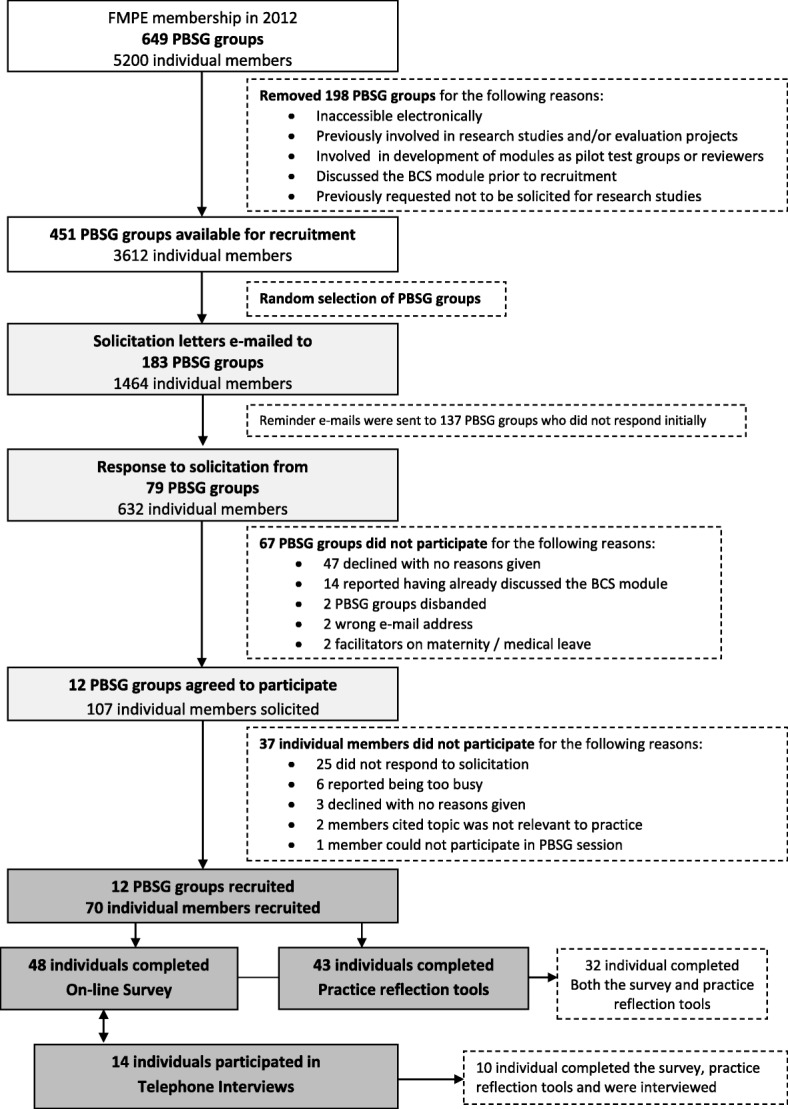
Methods: Canadian primary care providers who are members of the Practice-Based Small Group Learning Program (n = 1464) were invited to participate in this mixed methods study. An educational module was discussed in a small group learning context, and data collection included an on-line survey, practice reflection tools (PRTs), and interviews. The module included both the Canadian Task Force on Preventive Health Care revised guideline on BCS and iTools for clinician and/or patient use. After discussing the module and at 3 months, participants completed PRTs identifying their planned practice change(s) and documenting implementation outcome(s). Use of the iTools was explored via online survey and individual interviews.
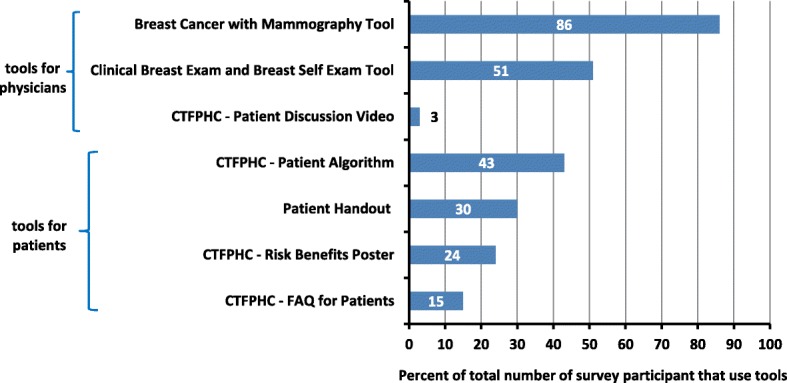
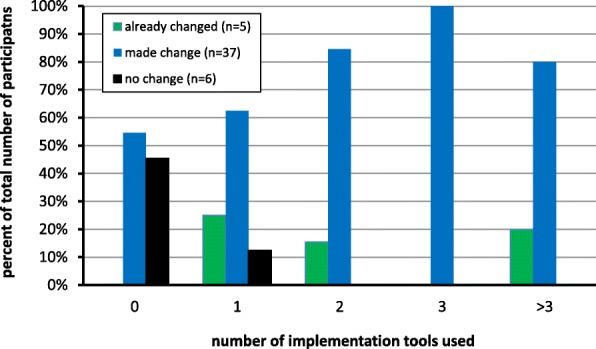
Results: Seventy participants agreed to participate. Of these, 48 participated in the online survey, 43 completed PRTs and 14 were interviewed. Most survey participants (77%) reported using at least one of seven tools available for implementing BCS guideline. Of these (78%) reported using more than one tool. Almost all participants used tools for clinicians (92%) and 62% also used tools for patients. As more tools were used, more practice changes were reported on the survey and PRTs. Interviews provided additional findings. Once information from an iTool was internalized, there was no further need for the tool. Participants did not use tools (23%) due to disagreements with the BCS guideline, patients' expectations, and/or experiences with diagnosis of breast cancer.
Conclusion: This study found that clinicians use tools to implement practice changes related to BCS guideline. Tools developed for clinicians were used to understand and consolidate the recommendations before tools to be used with patients were employed to promote decision-making. Mediating factors that impacted tool use confirmed previous research. Finally, use of some iTools decreased over time because information was internalized.
Keywords: Breast cancer screening; Clinical practice guidelines; Guideline implementation; Implementation strategy; Implementation tools.
Conflict of interest statement
Ethics approval and consent to participate
Ethics approval for the study was obtained through St. Michael’s Hospital Research and Ethics Board, Toronto, Canada, REB 12–220 and through the University of Calgary Conjoint Health Research Ethics Board, Calgary, Alberta, REB14–1676.
Competing interests
The following authors are affiliated with the non-profit Foundation for Medical Practice Education (FMPE) that produces educational modules with implementation tools: HA is the FMPE research director, TE is the FMPE executive director and SR is the coordinator of the research program at FMPE.
SES is an associate editor of implementation science and the chair of the Knowledge Translation working group for the Canadian Task Force on Preventive Health Care.
Publisher’s Note
Springer Nature remains neutral with regard to jurisdictional claims in published maps and institutional affiliations.
Figures

References
Publication types
MeSH terms
Grants and funding
LinkOut - more resources
Full Text Sources
Other Literature Sources
Medical
Research Materials
