


Determinants of antenatal care attendance among women residing in highly disadvantaged communities in northern Jordan: a cross-sectional study
- PMID: 29879992
- PMCID: PMC5992715
- DOI: 10.1186/s12978-018-0542-3
Determinants of antenatal care attendance among women residing in highly disadvantaged communities in northern Jordan: a cross-sectional study
Abstract
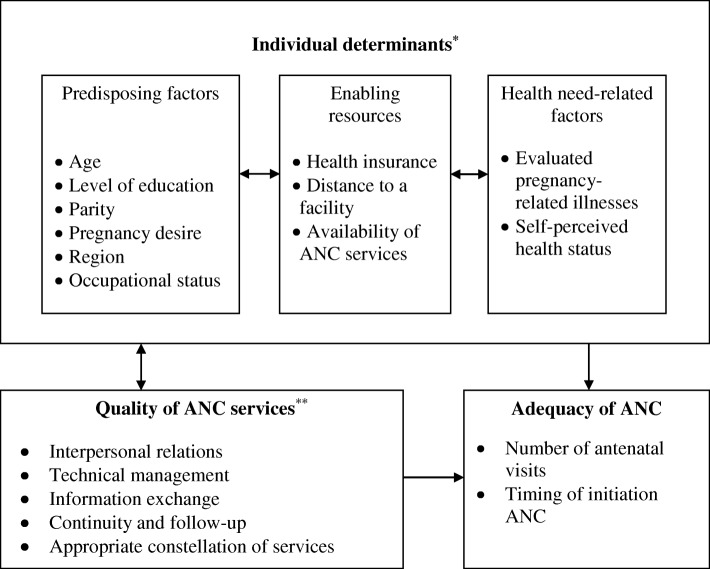
Background: One of the major reproductive health challenges among disadvantaged populations is to provide pregnant women with the necessary antenatal care (ANC). In this study, we suggest applying an integrated conceptual framework aimed at ascertaining the extent to which attendance at ANC clinics may be attributed to individual determinants or to the quality of the care received.
Methods: Using a cross-sectional design, data were collected from a sample of 831 women residing in nine sub-districts in three northern governorates of Jordan and designated according to national categorization as persistent poverty pockets. All of the sampled women were recruited from public maternal and child health centers and interviewed using a structured pre-tested survey. This tool covered certain predictors, ranging from the user's attributes, including predisposing, enabling, and need factors, to the essential components of the experience of care. These components assessed the quality of ANC in terms of five elements: woman-provider relations, technical management, information exchange, continuity of care, and appropriate constellation of services. Adequate ANC content was assessed in relation to the frequency of antenatal visits and the time of each visit.
Results: The results of multivariate logistic regression analyses show that the use of ANC facilities is affected by various factors related to the quality of service delivery. These include receiving information and education on ANC during clinic visits (OR = 9.1; 95% CI = 4.9-16.9), providing pregnant women with opportunities for dialogue and health talks (OR = 7.2; 95% CI = 4.1-12.8), having scheduled follow-up appointments (OR = 6.5; 95% CI = 3.5-12.0), and offering dignified and respectful care (OR = 5.7; 95% CI = 2.5-13.1). At the individual level, our findings have identified a woman's education level (OR = 1.2; 95% CI = 1.1-1.3), desire for the pregnancy (OR = 1.7; 95% CI = 1.1-2.7), and living in a district served by an ANC clinic (OR = 4.3; 95% CI = 2.3-8.1) as determinants affecting ANC utilization.
Conclusion: Taking women's experiences of ANC as a key metric for reporting the quality of the care is more likely to lead to increased utilization of ANC services by women in highly disadvantaged communities. Our findings suggest that the degree to which women feel that they are respected, informed, and engaged in their care has potential favorable implications for ANC.
Keywords: Antenatal care; Disadvantaged communities; Experience of care; Jordan; Poverty; Quality; Utilization.
Conflict of interest statement
Ethics approval and consent to participate
Ethical approval to conduct this study was obtained from the Jordanian Ministry of Health, and the Institutional Review Board (IRB) at Jordan University of Science and Technology (79/2015). Researchers obtained informed consents from all participating women. All precautions were taken to protect the anonymity and confidentiality of data.
Competing interests
The authors declare they have no potential conflicts of interest with respect to the research, authorship, and/or publication of this article.
Publisher’s Note
Springer Nature remains neutral with regard to jurisdictional claims in published maps and institutional affiliations.
Figures
References
MeSH terms
LinkOut - more resources
Full Text Sources
Other Literature Sources
Medical
