


Comparative Analysis of the Classification of Food Products in the Mexican Market According to Seven Different Nutrient Profiling Systems
- PMID: 29880737
- PMCID: PMC6024607
- DOI: 10.3390/nu10060737
Comparative Analysis of the Classification of Food Products in the Mexican Market According to Seven Different Nutrient Profiling Systems
Abstract
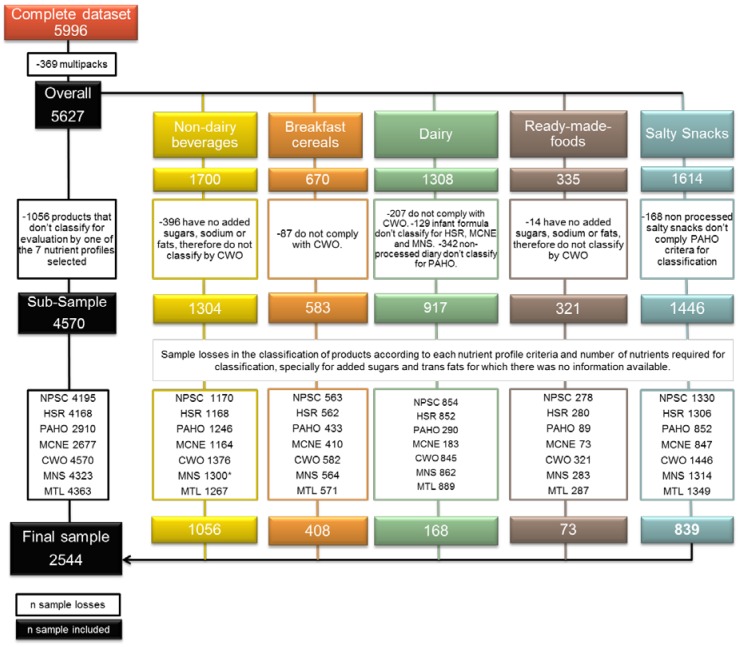
Nutrient profiling systems (NPS) are used around the world. In some countries, the food industry participates in the design of these systems. We aimed to compare the ability of various NPS to identify processed and ultra-processed Mexican products containing excessive amounts of critical nutrients. A sample of 2544 foods and beverages available in the Mexican market were classified as compliant and non-compliant according to seven NPS: the Pan American Health Organization (PAHO) model, which served as our reference, the Nutrient Profiling Scoring Criterion (NPSC), the Mexican Committee of Nutrition Experts (MCNE), the Health Star Rating (HSR), the Mexican Nutritional Seal (MNS), the Chilean Warning Octagons (CWO) 2016, 2018 and 2019 criteria, and Ecuador's Multiple Traffic Light (MTL). Overall, the proportion of foods classified as compliant by the HSR, MTL and MCNE models was similar to the PAHO model. In contrast, the NPSC, the MNS and the CWO-2016 classified a higher amount of foods as compliant. Larger differences between NPS classification were observed across food categories. Results support the notion that models developed with the involvement of food manufacturers are more permissive than those based on scientific evidence. Results highlight the importance of thoroughly evaluating the underlying criteria of a model.
Keywords: Chilean Warning Octagons; Health Star Rating; Mexican Nutrition Seal; NPSC; PAHO model; critical nutrients; multiple traffic light; nutrient profiling system; ultra-processed products.
Conflict of interest statement
The authors declare no conflict of interest.
Figures
References
-
- Ng M., Fleming T., Robinson M., Thomson B., Graetz N., Margono C., Mullany E.C., Biryukov S., Abbafati C., Abera S.F., et al. Global, regional, and national prevalence of overweight and obesity in children and adults during 1980–2013: A systematic analysis for the Global Burden of Disease Study 2013. Lancet. 2014;384:766–781. doi: 10.1016/S0140-6736(14)60460-8. - DOI - PMC - PubMed
-
- Encuesta Nacional de Salud y Nutrición de Medio Camino 2016 (ENSANUT MC 2016). Informe Final de Resultados. [(accessed on 5 January 2018)]; (In Spanish) Available online: https://www.gob.mx/cms/uploads/attachment/file/209093/ENSANUT.pdf.
-
- OECD Diabetes Cardiovascular Disease and Diabetes: Policies for Better Health and Quality of Care. [(accessed on 5 June 2018)];2015 Country Note–Mexico. Available online: https://www.oecd.org/mexico/Cardiovascular-Disease-and-Diabetes-Policies....
-
- WHO . Nutrient Profiling: Report of a WHO/IASO Technical Meeting. World Health Organization; London, UK: 2011.
Publication types
MeSH terms
LinkOut - more resources
Full Text Sources
Other Literature Sources
Medical
