


Wearable Sensors Integrated with Internet of Things for Advancing eHealth Care
- PMID: 29882790
- PMCID: PMC6022128
- DOI: 10.3390/s18061851
Wearable Sensors Integrated with Internet of Things for Advancing eHealth Care
Abstract
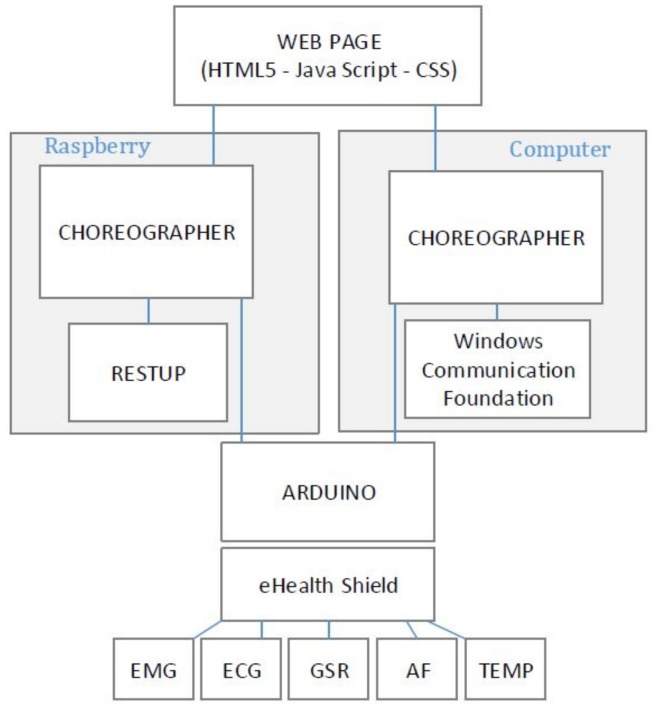
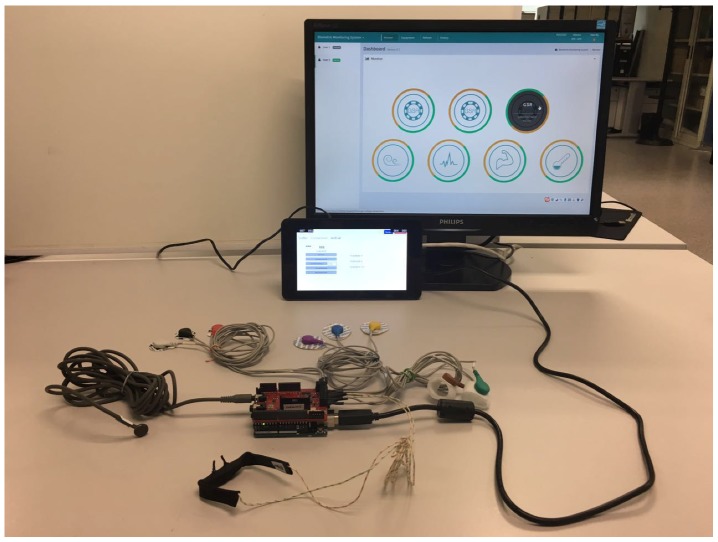
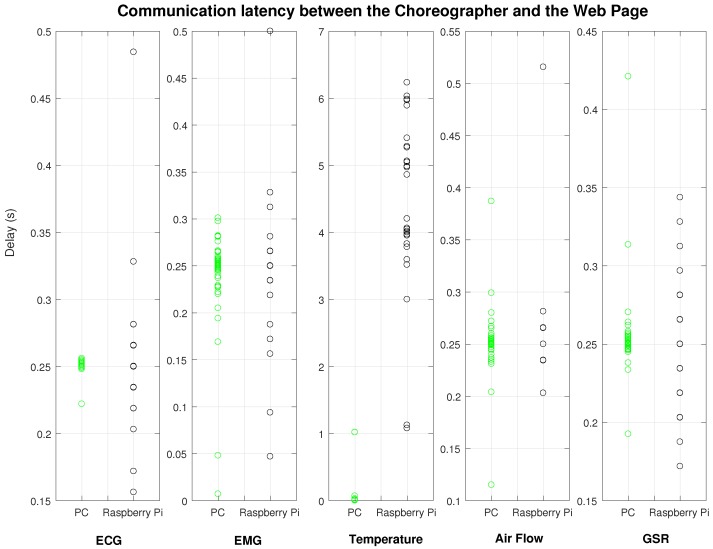
Health and sociological indicators alert that life expectancy is increasing, hence so are the years that patients have to live with chronic diseases and co-morbidities. With the advancement in ICT, new tools and paradigms are been explored to provide effective and efficient health care. Telemedicine and health sensors stand as indispensable tools for promoting patient engagement, self-management of diseases and assist doctors to remotely follow up patients. In this paper, we evaluate a rapid prototyping solution for information merging based on five health sensors and two low-cost ubiquitous computing components: Arduino and Raspberry Pi. Our study, which is entirely described with the purpose of reproducibility, aimed to evaluate the extent to which portable technologies are capable of integrating wearable sensors by comparing two deployment scenarios: Raspberry Pi 3 and Personal Computer. The integration is implemented using a choreography engine to transmit data from sensors to a display unit using web services and a simple communication protocol with two modes of data retrieval. Performance of the two set-ups is compared by means of the latency in the wearable data transmission and data loss. PC has a delay of 0.051 ± 0.0035 s (max = 0.2504 s), whereas the Raspberry Pi yields a delay of 0.0175 ± 0.149 s (max = 0.294 s) for N = 300. Our analysis confirms that portable devices ( p < < 0 . 01 ) are suitable to support the transmission and analysis of biometric signals into scalable telemedicine systems.
Keywords: IoT; Telemedicine; eHealth; integration; monitoring; services; wearable.
Conflict of interest statement
The authors declare no conflict of interest. The founding sponsors had no role in the design of the study; in the collection, analyses, or interpretation of data; in the writing of the manuscript, and in the decision to publish the results.
Figures



References
-
- Wortmann F., Fluchter K. Internet of things. Bus. Inf. Syst. Eng. 2015;57:221–224. doi: 10.1007/s12599-015-0383-3. - DOI
-
- Whitmore A., Agarwal A., Da Xu L. The Internet of Things—A survey of topics and trends. Inf. Syst. Front. 2015;17:261–274. doi: 10.1007/s10796-014-9489-2. - DOI
-
- Warren S. Beyond telemedicine: Infrastructures for intelligent home care technology; Proceedings of the Pre-ICADI Workshop on Technology for Aging, Disability, and Independence; London, UK. 26–27 June 2003.
MeSH terms
LinkOut - more resources
Full Text Sources
Other Literature Sources
Medical
Research Materials
Miscellaneous
