


Epidemiology and risk factors for typhoid fever in Central Division, Fiji, 2014-2017: A case-control study
- PMID: 29883448
- PMCID: PMC6010302
- DOI: 10.1371/journal.pntd.0006571
Epidemiology and risk factors for typhoid fever in Central Division, Fiji, 2014-2017: A case-control study
Abstract
Background: Typhoid fever is endemic in Fiji, with high reported annual incidence. We sought to identify the sources and modes of transmission of typhoid fever in Fiji with the aim to inform disease control.
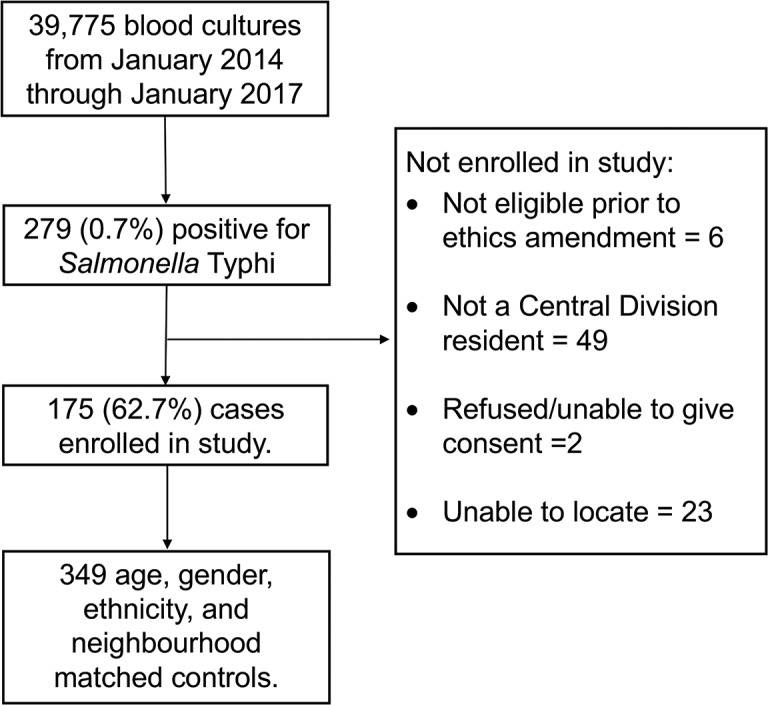
Methodology/principal findings: We identified and surveyed patients with blood culture-confirmed typhoid fever from January 2014 through January 2017. For each typhoid fever case we matched two controls by age interval, gender, ethnicity, and residential area. Univariable and multivariable analysis were used to evaluate associations between exposures and risk for typhoid fever. We enrolled 175 patients with typhoid fever and 349 controls. Of the cases, the median (range) age was 29 (2-67) years, 86 (49%) were male, and 84 (48%) lived in a rural area. On multivariable analysis, interrupted water availability (odds ratio [OR] = 2.17; 95% confidence interval [CI] 1.18-4.00), drinking surface water in the last 2 weeks (OR = 3.61; 95% CI 1.44-9.06), eating unwashed produce (OR = 2.69; 95% CI 1.48-4.91), and having an unimproved or damaged sanitation facility (OR = 4.30; 95% CI 1.14-16.21) were significantly associated with typhoid fever. Frequent handwashing after defecating (OR = 0.57; 95% CI 0.35-0.93) and using soap for handwashing (OR = 0.61; 95% CI 0.37-0.95) were independently associated with a lower odds of typhoid fever.
Conclusions: Poor sanitation facilities appear to be a major source of Salmonella Typhi in Fiji, with transmission by drinking contaminated surface water and consuming unwashed produce. Improved sanitation facilities and protection of surface water sources and produce from contamination by human feces are likely to contribute to typhoid control in Fiji.
Conflict of interest statement
I have read the journal's policy and the authors of this manuscript have the following competing interests: DS at present is a full time employee of GlaxoSmithKline vaccine.
Figures
References
-
- Antillon M, Warren JL, Crawford FW, Weinberger DM, Kurum E, Pak GD, et al. The burden of typhoid fever in low- and middle-income countries: A meta-regression approach. PLoS Negl Trop Dis. 2017;11(2):e0005376 Epub 2017/02/28. doi: 10.1371/journal.pntd.0005376 ; PubMed Central PMCID: PMCPMC5344533. - DOI - PMC - PubMed
-
- World Health Organization, UNICEF. Progress on sanitation and drinking water–2015 update and MDG assessment: UNICEF; 2015 [10 March 2017]. Available from: https://www.unicef.org/publications/index_82419.html.
-
- World Health Organization. Regional Office for the Western Pacific Sanitation, drinking-water and health in Pacific island countries: 2015 update and future outlook: Manila: WHO Regional Office for the Western Pacific; 2016. [10 March 2017]. Available from: http://iris.wpro.who.int/handle/10665.1/13130.
-
- Thompson CN, Kama M, Acharya S, Bera U, Clemens J, Crump JA, et al. Typhoid fever in Fiji: a reversible plague? Trop Med Int Health. 2014;19(10):1284–92. Epub 2014/07/30. doi: 10.1111/tmi.12367 ; PubMed Central PMCID: PMCPMC4285329. - DOI - PMC - PubMed
Publication types
MeSH terms
Substances
LinkOut - more resources
Full Text Sources
Other Literature Sources
