


Dry Eye Assessment and Management (DREAM©) Study: Study design and baseline characteristics
- PMID: 29883769
- PMCID: PMC7250048
- DOI: 10.1016/j.cct.2018.06.002
Dry Eye Assessment and Management (DREAM©) Study: Study design and baseline characteristics
Abstract
Purpose: Describe trial design and baseline characteristics of participants in the DRy Eye Assessment and Management (DREAM©) Study.
Design: Prospective, multi-center, randomized, double-masked "real-world" clinical trial assessing efficacy and safety of oral omega-3 (ω3) supplementation for the treatment of dry eye disease (DED).
Methods: RESULTS: Mean age of participants was 58.0 ± 13.2 years. Mean OSDI score at baseline was 44.4 ± 14.2. Mean conjunctival staining score (scale 0-6) was 3.0 ± 1.4, corneal staining score (scale 0-15) was 3.9 ± 2.7, tear break-up time was 3.1 ± 1.5 s, and Schirmer test was 9.6 ± 6.5 mm/5 min.
Conclusions: DREAM© participants mirror real world patients who seek intervention for their DED-related symptoms despite their current treatments. Results regarding the efficacy of omega-3 supplementation will be helpful to clinicians and patients with moderate to severe DED who are considering omega-3 as a treatment. This trial design may be a model for future RCT's on nutritional supplements and DED treatments seeking to provide useful information for clinical practice.
Trial registration: ClinicalTrials.gov number NCT02128763.
Keywords: Baseline characteristics; Clinical trial design; Dry eye disease; Inflammation; Nutritional trial design; Omega-3 fatty acid.
Copyright © 2018 Elsevier Inc. All rights reserved.
Figures
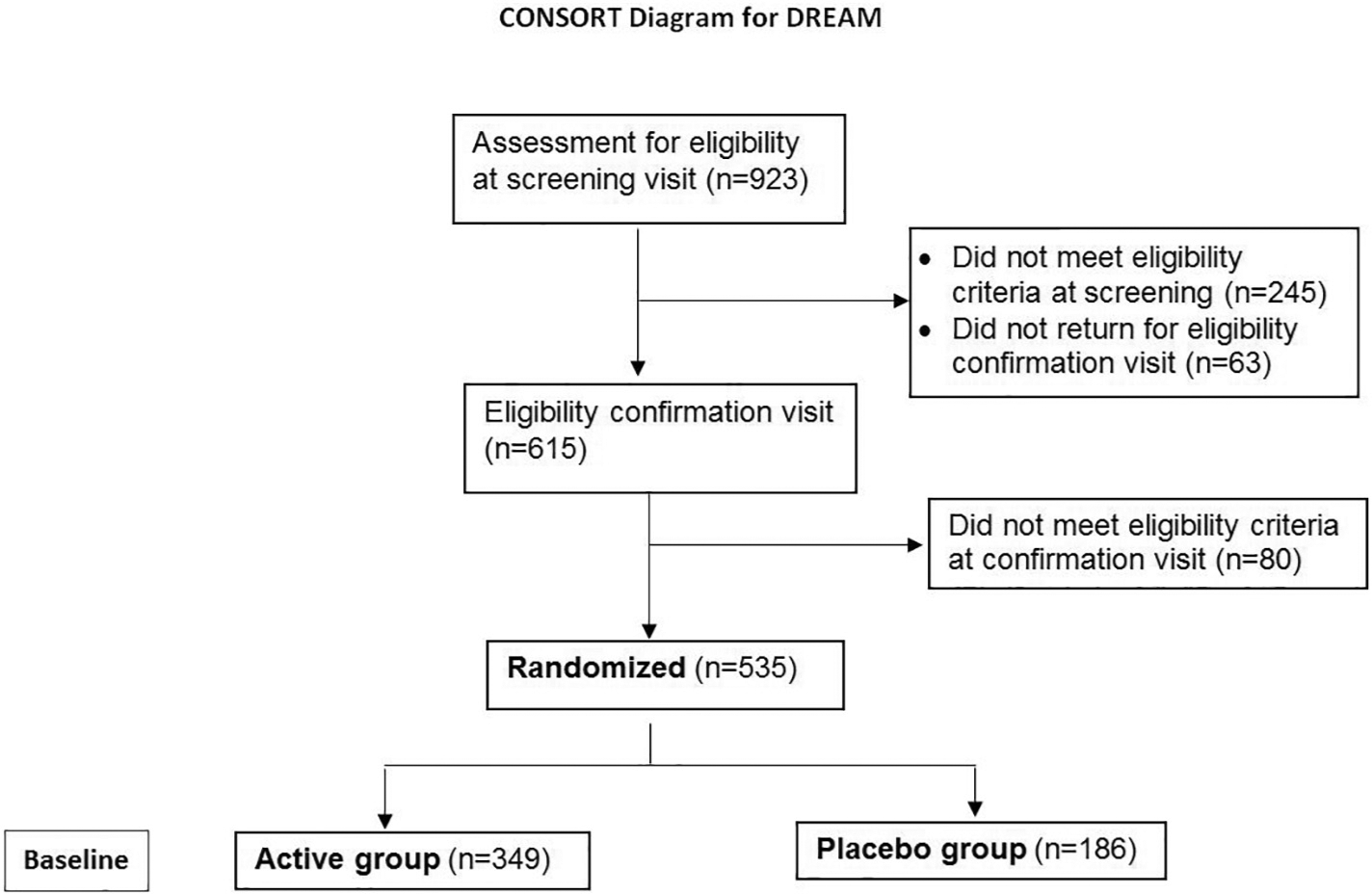
References
-
- Craig JP, Nichols KK, Akpek EK, Caffery B, Dua HS, Joo CK, Liu Z, Nelson JD, Nichols JJ, Tsubota K, Stapleton F, TFOS DEWS II definition and classification report, Ocul. Surf 15 (2017) 276–283. - PubMed
-
- Farrand KF, Fridman M, Stillman IO, Schaumberg DA, Prevalence of diagnosed dry eye disease in the United States among adults aged 18 years and older, Am J. Ophthalmol 182 (2017) 90–98. - PubMed
-
- Stapleton F, Garrett Q, Chan C, Craig J, The epidemiology of dry eye disease, Essentials Ophthalmol. (2015) 21–29.
-
- Moss SE, Klein R, Klein BE, Prevalence of and risk factors for dry eye syndrome, Arch. Ophthalmol 118 (2000) 1264–1268. - PubMed
Publication types
MeSH terms
Substances
Associated data
Grants and funding
LinkOut - more resources
Full Text Sources
Other Literature Sources
Medical
