


Adapting Word Embeddings from Multiple Domains to Symptom Recognition from Psychiatric Notes
- PMID: 29888086
- PMCID: PMC5961810
Adapting Word Embeddings from Multiple Domains to Symptom Recognition from Psychiatric Notes
Abstract
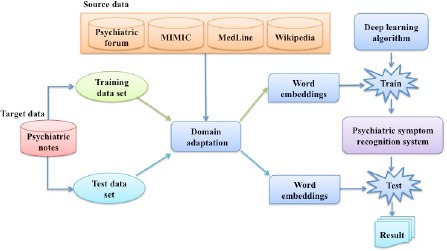
Mental health is increasingly recognized an important topic in healthcare. Information concerning psychiatric symptoms is critical for the timely diagnosis of mental disorders, as well as for the personalization of interventions. However, the diversity and sparsity of psychiatric symptoms make it challenging for conventional natural language processing techniques to automatically extract such information from clinical text. To address this problem, this study takes the initiative to use and adapt word embeddings from four source domains - intensive care, biomedical literature, Wikipedia and Psychiatric Forum - to recognize symptoms in the target domain of psychiatry. We investigated four different approaches including 1) only using word embeddings of the source domain, 2) directly combining data of the source and target to generate word embeddings, 3) assigning different weights to word embeddings, and 4) retraining the word embedding model of the source domain using a corpus of the target domain. To the best of our knowledge, this is the first work of adapting multiple word embeddings of external domains to improve psychiatric symptom recognition in clinical text. Experimental results showed that the last two approaches outperformed the baseline methods, indicating the effectiveness of our new strategies to leverage embeddings from other domains.
Figures

References
-
- Proctor EK, Landsverk J, Aarons G, Chambers D, Glisson C, Mittman B. Implementation research in mental health services: an emerging science with conceptual, methodological, and training challenges. Administration and Policy in Mental Health and Mental Health Services Research. 2009;36(1):24–34. - PMC - PubMed
-
- Gorrell G, Jackson R, Roberts A, Stewart R. Finding negative symptoms of schizophrenia in patient records. Proc NLP Med Biol Work (NLPMedBio), Recent Adv Nat Lang Process (RANLP) 2013:9–17.
-
- Lafferty J, McCallum A, Pereira FC. ICML '01. San Francisco, CA, USA: 2001. Conditional random fields: Probabilistic models for segmenting and labeling sequence data.
-
- Friedman C, Kra P, Rzhetsky A. Two biomedical sublanguages: a description based on the theories of Zellig Harris. Journal of biomedical informatics. 2002;35(4):222–235. - PubMed
Grants and funding
LinkOut - more resources
Full Text Sources