


The relationship between stress and Alzheimer's disease
- PMID: 29888308
- PMCID: PMC5991350
- DOI: 10.1016/j.ynstr.2018.04.002
The relationship between stress and Alzheimer's disease
Abstract
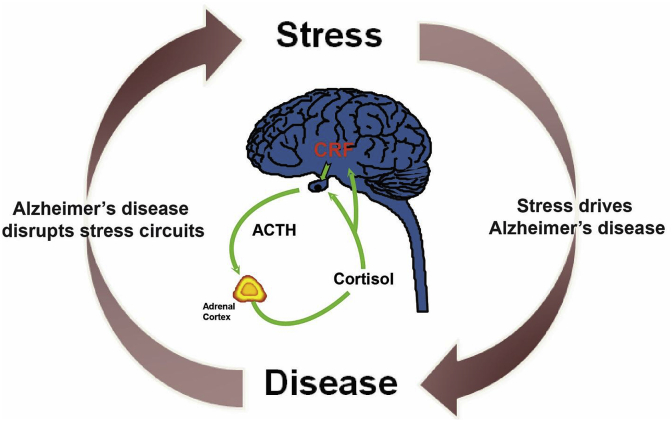
Stress is critically involved in the development and progression of disease. From the stress of undergoing treatments to facing your own mortality, the physiological processes that stress drives have a serious detrimental effect on the ability to heal, cope and maintain a positive quality of life. This is becoming increasingly clear in the case of neurodegenerative diseases. Neurodegenerative diseases involve the devastating loss of cognitive and motor function which is stressful in itself, but can also disrupt neural circuits that mediate stress responses. Disrupting these circuits produces aberrant emotional and aggressive behavior that causes long-term care to be especially difficult. In addition, added stress drives progression of the disease and can exacerbate symptoms. In this review, I describe how neural and endocrine pathways activated by stress interact with ongoing neurodegenerative disease from both a clinical and experimental perspective.
Keywords: Alzheimer's disease; CRF; CRH; Corticosteroids; Cortisol; Stress.
Figures
References
-
- Aisen P.S., Davis K.L., Berg J.D., Schafer K., Campbell K., Thomas R.G., Weiner M.F., Farlow M.R., Sano M., Grundman M., Thal L.J. A randomized controlled trial of prednisone in Alzheimer's disease. Alzheimer's Disease Cooperative Study. Neurology. 2000;54:588–593. - PubMed
-
- Alexander G., Hanna A., Serna V., Younkin L., Younkin S., Janus C. Increased aggression in males in transgenic Tg2576 mouse model of Alzheimer's disease. Behav. Brain Res. 2011;216:77–83. - PubMed
-
- Amore M., Tagariello P., Laterza C., Savoia E.M. Subtypes of depression in dementia. Arch. Gerontol. Geriatr. 2007;44(Suppl. 1):23–33. - PubMed
-
- Armario A., Escorihuela R.M., Nadal R. Long-term neuroendocrine and behavioural effects of a single exposure to stress in adult animals. Neurosci. Biobehav. Rev. 2008;32:1121–1135. - PubMed
Publication types
Grants and funding
LinkOut - more resources
Full Text Sources
Other Literature Sources
