


Striatal alcohol cue-reactivity is stronger in male than female problem drinkers
- PMID: 29888821
- PMCID: PMC6767856
- DOI: 10.1111/ejn.13991
Striatal alcohol cue-reactivity is stronger in male than female problem drinkers
Abstract
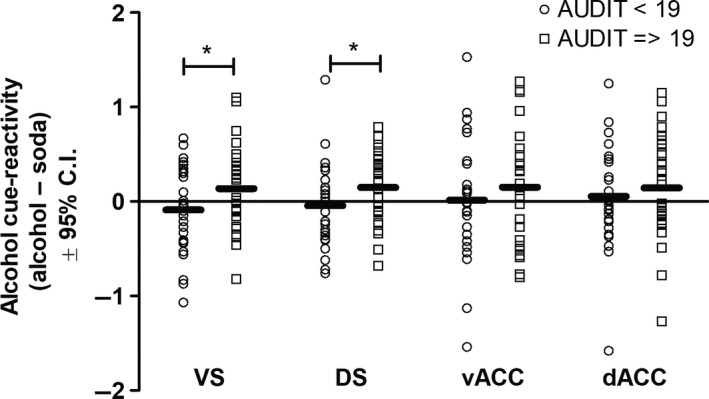
Despite apparent sex differences in the development and treatment of alcohol use disorder, relatively little is known about the underlying neural mechanisms. In this study, we therefore investigated neural cue-reactivity in a sample of male (n = 28) and female (n = 27) problem drinkers (matched on age and alcohol use severity) with an average alcohol use disorder identification test score of 12 which is indicative of a likely alcohol use disorder. Neural cue-reactivity data were extracted from four regions of interest: the ventral and dorsal striatum and the ventral and dorsal anterior cingulate cortex, with a significance level set at p < 0.05. While the cue-reactivity paradigm induced similar levels of self-reported craving in men and women, visual alcohol cues induced significantly stronger striatal activation in men compared to drinkers. While sex differences in ventral striatal cue-reactivity were partly explained by sex differences in alcohol intake, cannabis use, negative affect and anxiety, this was not the case for sex differences in dorsal striatal cue-reactivity. These results suggest that alcohol cues are differentially processed by men and women and that the neurobiological mechanisms behind cue-reactivity differ between the sexes. Consequently, paradigms using alcohol-related pictures may not be optimal to induce cue-reactivity in female drinkers and may not be optimal to measure neurobiological markers of alcohol use severity and relapse. Future alcohol cue-reactivity studies should, in addition to including both men and women, include different types of cues (e.g., stressors and imagery in addition to pictures) to assess sex differences in alcohol cue-reactivity.
Keywords: alcohol cue-reactivity; alcohol use disorder; craving; nucleus accumbens; sex differences; striatum.
© 2018 The Authors. European Journal of Neuroscience published by Federation of European Neuroscience Societies and John Wiley & Sons Ltd.
Conflict of interest statement
The authors report no conflict of interest.
Figures

References
-
- Adamson, S. J. , & Sellman, J. D. (2003). A prototype screening instrument for cannabis use disorder: The Cannabis Use Disorders Identification Test (CUDIT) in an alcohol‐dependent clinical sample. Drug and Alcohol Review, 22, 309–315. - PubMed
-
- American Psychiatric Association and DSM‐5 Task Force . (2013). Diagnostic and statistical manual of mental disorders : DSM‐5. Philadelphia, PA: American Psychiatric Association.
-
- Banis, S. , & Lorist, M. M. (2017). The combined effects of menstrual cycle phase and acute stress on reward‐related processing. Biological Psychology, 125, 130–145. - PubMed
-
- Baxter‐Potter, L. N. , Henricks, A. M. , Berger, A. L. , Bieniasz, K. V. , Lugo, J. M. , & McLaughlin, R. J. (2017). Alcohol vapor exposure differentially impacts mesocorticolimbic cytokine expression in a sex‐, region‐, and duration‐specific manner. Neuroscience, 346, 238–246. - PubMed
Publication types
MeSH terms
Grants and funding
LinkOut - more resources
Full Text Sources
Other Literature Sources
Medical
Molecular Biology Databases
