


Investigating the loss of work productivity due to symptomatic leiomyoma
- PMID: 29889874
- PMCID: PMC5995435
- DOI: 10.1371/journal.pone.0197958
Investigating the loss of work productivity due to symptomatic leiomyoma
Abstract
Introduction: Leiomyoma affects up to 50% of fertile women, leading to morbidity such as bleeding or pain. The effect of symptomatic leiomyoma on the productivity of employed women is understudied. The present study investigates productivity loss in a Swedish setting in women with symptomatic leiomyoma compared to healthy women.
Material and methods: Women seeking care for leiomyoma and heavy menstrual bleeding (HMB) were recruited at nine Swedish sites. Healthy controls with self-perceived mild to normal menstruation were recruited at routine visits. Cases and controls were employed without option to work from home. After recruitment, all women reported the work productivity and activity impairment (WPAI) questionnaire, the pictorial blood assessment chart (PBAC) and pain on the visual analog scale (VAS).
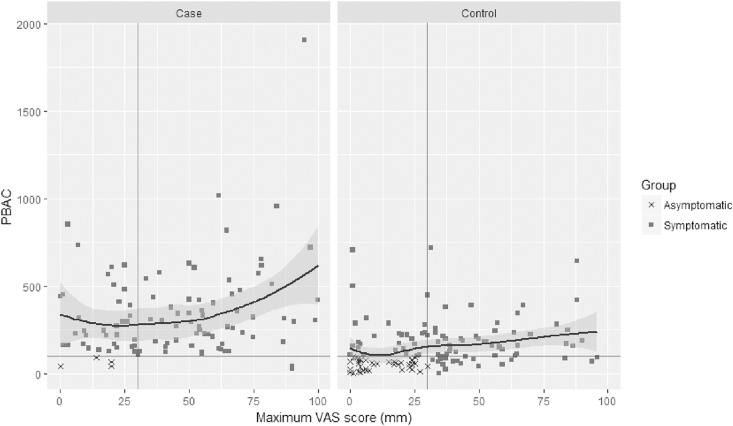
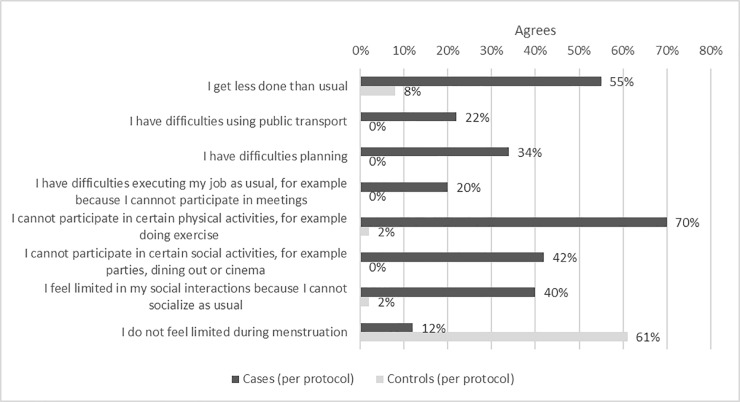
Results: Women with symptomatic leiomyoma (n = 88) missed more working time during menses compared to asymptomatic controls (n = 34): 7.6 vs 0.2% p = 0.003. The proportion of impairment while working was also significantly higher in women with symptomatic leiomyoma (43.8 vs 12.1% p<0.001). Moreover, cases reported greater activity impairment outside office hours (43.9 vs 12.1%, p<0.001). Among healthy controls, 69.5% reported symptoms of HMB (PBAC>100).
Conclusions: Symptomatic leiomyoma leads to loss of working hours as well as loss of productivity during working hours, and affects women in other daily activities. Increased awareness of the impact of leiomyomas on women's lives is needed, and timely and appropriate management of the symptomatic leiomyomas could improve work productivity and quality of life.
Conflict of interest statement
Mia Lindeberg is an employee of Gedeon Richter Nordics AB. Helena Kopp Kallner has received honorariums for lectures and participation in expert groups from Gedeon Richter. She has also participated as principal investigator in studies financed by Gedeon Richter. HKK received no compensation for manuscript writing. KH has received no compensation for manuscript writing, nor does she receive any other honorariums from Gedeon Richter. PK was employed by Parexel at the time of data analysis but not at the time of manuscript writing and received no compensation for manuscript writing. This does not alter our adherence to PLOS ONE policies on sharing data and materials.
Figures
References
-
- Pron G, Cohen M, Soucie J, Garvin G, Vanderburgh L, Bell S, et al. The Ontario Uterine Fibroid Embolization Trial. Part 1. Baseline patient characteristics, fibroid burden, and impact on life. Fertil Steril. 2003;79(1):112–9. Epub 2003/01/14. . - PubMed
-
- Divakar H. Asymptomatic uterine fibroids. Best Pract Res Clin Obstet Gynaecol. 2008;22(4):643–54. Epub 2008/04/01. doi: 10.1016/j.bpobgyn.2008.01.007 . - DOI - PubMed
-
- Walker CL, Stewart EA. Uterine fibroids: the elephant in the room. Science. 2005;308(5728):1589–92. Epub 2005/06/11. doi: 10.1126/science.1112063 . - DOI - PubMed
Publication types
MeSH terms
LinkOut - more resources
Full Text Sources
Other Literature Sources
