Assessment of the Utility of Ictal Magnetoencephalography in the Localization of the Epileptic Seizure Onset Zone
- PMID: 29889930
- PMCID: PMC6233852
- DOI: 10.1001/jamaneurol.2018.1430
Assessment of the Utility of Ictal Magnetoencephalography in the Localization of the Epileptic Seizure Onset Zone
Abstract
Importance: Literature on ictal magnetoencephalography (MEG) in clinical practice and the relationship to other modalities is limited because of the brevity of routine studies.
Objective: To investigate the utility and reliability of ictal MEG in the localization of the epileptogenic zone.
Design, setting, and participants: A retrospective medical record review and prospective analysis of a novel ictal rhythm analysis method was conducted at a tertiary epilepsy center with a wide base of referrals for epilepsy surgery evaluation and included consecutive cases of patients who experienced epileptic seizures during routine MEG studies from March 2008 to February 2012. A total of 377 studies screened. Data were analyzed from November 2011 to October 2015.
Main outcomes and measures: Presurgical workup and interictal and ictal MEG data were reviewed. The localizing value of using extended-source localization of a narrow band identified visually at onset was analyzed.
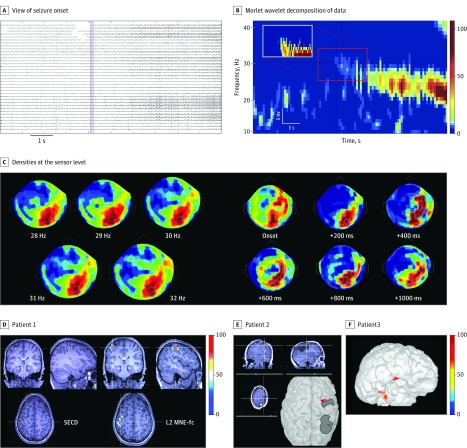
Results: Of the 44 included patients, the mean (SD) age at the time of recording was 19.3 (14.9) years, and 25 (57%) were male. The mean duration of recording was 51.2 minutes. Seizures were provoked by known triggers in 3 patients and were spontaneous otherwise. Twenty-five patients (57%) had 1 seizure, 6 (14%) had 2, and 13 (30%) had 3 or more. Magnetoencephalography single equivalent current dipole analysis was possible in 29 patients (66%), of whom 8 (28%) had no clear interictal discharges. Sublobar concordance between ictal and interictal dipoles was seen in 18 of 21 patients (86%). Three patients (7%) showed clear ictal MEG patterns without electroencephalography changes. Ictal MEG dipoles correlated with the lobe of onset in 7 of 8 patients (88%) who underwent intracranial electroencephalography evaluations. Reasons for failure to identify ictal dipoles included diffuse or poor dipolar ictal patterns, no MEG changes, and movement artifact. Resection of areas containing a minimum-norm estimate of a narrow band at onset, not single equivalent current dipole, was associated with sustained seizure freedom.
Conclusions and significance: Ictal MEG data can provide reliable localization, including in cases that are difficult to localize by other modalities. These findings support the use of extended-source localization for seizures recorded during MEG.
Conflict of interest statement
Figures

References
-
- Knowlton RC, Elgavish R, Howell J, et al. Magnetic source imaging versus intracranial electroencephalogram in epilepsy surgery: a prospective study. Ann Neurol. 2006;59(5):835-842. - PubMed
-
- Agirre-Arrizubieta Z, Thai NJ, Valentín A, et al. The value of magnetoencephalography to guide electrode implantation in epilepsy. Brain Topogr. 2014;27(1):197-207. - PubMed
-
- Knowlton RC, Laxer KD, Aminoff MJ, Roberts TP, Wong ST, Rowley HA. Magnetoencephalography in partial epilepsy: clinical yield and localization accuracy. Ann Neurol. 1997;42(4):622-631. - PubMed
-
- Zimmermann R, Scharein E. MEG and EEG show different sensitivity to myogenic artifacts. Neurol Clin Neurophysiol. 2004;2004:78. - PubMed
Publication types
MeSH terms
Grants and funding
LinkOut - more resources
Full Text Sources
Other Literature Sources
Medical